Cushing’s Awareness Challenge, Day 7

A Cushing’s diagnosis can be a long and frustrating event with testing, repeat testing, redoing testing.

Sometimes, I think that this was the path that some of my UFCs took on the way to my diagnosis:

 

cushie-diagnosis


It took three years from 1983 to 1986 before doctors would consider testing me for Cushing’s, even though I was sure that this was what my problem was.

My first 24-hour urine free cortisol was run by a Hematologist/Oncologist.  After that, things seemed to move a little better, if not faster.  That UFC got me to my first endo.

The Endocrinologist, of course, didn’t trust the other test so I was back to square one. He ran his own multitude of tests. He had to draw blood at certain times like 9 AM. and 5 PM. There was a dexamethasone suppression test where I took a pill at 10 p.m. and gave blood at 9 am the next day.

ufcI collected gallons of urine in BIG boxes (Fun in the fridge!). Those were from 6 a.m. to 6 a.m. to be delivered to his office by 9 a.m. same day. I was always worried that I’d be stopped in rush hour and the police would ask about what was in that big container. I did those daily for a week.

When the endo confirmed that I had Cushing’s in 1987 he sent me to a local hospital where they repeated all those same tests for another week and decided that it was not my adrenal gland (Cushing’s Syndrome) creating the problem. The doctors and nurses had no idea what to do with me, so they put me on the brain cancer ward.

When I left this hospital after a week, we didn’t know any more than we had before.

As luck would have it, NIH (National Institutes of Health, Bethesda, Maryland) was doing a clinical trial of Cushing’s. I live in the same area as NIH so it was not too inconvenient but very scary at first to think of being tested there. At that time I only had a choice of NIH, Mayo Clinic and a place in Quebec to do this then-rare pituitary surgery called a Transsphenoidal Resection. I chose NIH – closest and free. After I was interviewed by the Doctors there, I got a letter that I had been accepted into the clinical trial. The first time I was there was for 6 weeks as an inpatient. More of the same tests.

Six weeks of daily UFC testing.  To this day, I still remember nurses waking me just after 6 am to “close out your urine”.  Sounded like a bank account!

The testing pathway today looks a little more organized but it still takes far too long:
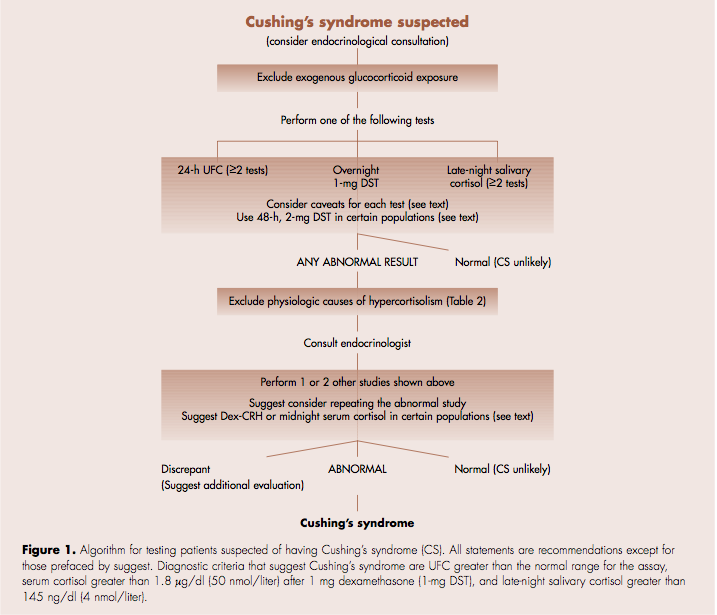
testing-cushings


No High-Quality Studies for Cushing’s Drugs

By Salynn Boyles, Contributing Writer, MedPage Today

Reviewed by Zalman S. Agus, MD; Emeritus Professor, Perelman School of Medicine at the University of Pennsylvania and Dorothy Caputo, MA, BSN, RN, Nurse Planner

There is a paucity of clinical trial data supporting the efficacy of most drugs used to treat Cushing’s disease, researchers reported.

Just one drug — pasireotide — has been evaluated in a randomized, double-blind trial, but even it was judged by the researchers to have only a ‘moderate’ level of evidence supporting its effectiveness and safety.

The review of the literature evaluating drug treatments for Cushing’s disease, a rare pituitary disorder, is the first to employ a rigorous systematic approach with strict, predefined inclusion criteria and formal analysis of the quality of evidence using an established standard, researcher Monica Gadelha, MD, PhD, of Brazil’s Federal University of Rio de Janeiro, and colleagues wrote in the journal Clinical Endocrinology.

“This systematic review indicates that the majority of medical therapies currently used in the treatment of Cushing’s disease are supported by a low level of evidence,” the researchers wrote. “Further well-designed prospective studies of medications in Cushing’s disease would help to inform clinical practice further.”

Cushing’s disease is the most common form of endogenous Cushing’s syndrome, a hormonal disorder resulting from persistent exposure to abnormally high levels of the hormone cortisol. In the case of Cushing’s disease, the cortisol is secreted by a pituitary adenoma.

Prolonged exposure to high levels of cortisol raises the risk for diabetes mellitus, cardiovascular disease, osteoporosis and nephrolithiasis. Patients with persistent Cushing’s disease have a 3- to 5-fold higher mortality than the general population.

Surgery to remove the pituitary adenoma is the first-line treatment for Cushing’s disease in the U.S., and when the procedure is performed by an experienced surgeon, remission rates in patients with smaller tumors range from 65% to 90%. The long-term remission rate is lower, however, because many patients develop recurrent disease.

Several medical therapies are widely used to treat patients who are not candidates for surgery or who experience relapse following surgery.

Novartis Oncology’s somatostatin analog drug pasireotide (Signifor) became the only drug approved for this indication in December of last year. And the progesterone-blocking drug mifepristone, best known as the abortion pill once called RU-486, was approved in February of 2012 for the treatment of Cushing’s disease-associated hyperglycemia.

Other drugs — including metyrapone, mitotane, cabergoline, and ketoconazole — are also used off-label in the treatment of Cushing’s, and several have shown better response rates than pasireotide in small studies.

In their systematic review, Gadelha and colleagues identified 15 studies that included at least 10 adults with Cushing’s disease and reported treatment responses as the proportion of patients reaching a specified definition of response. Studies examining combinations of medications were excluded from the analysis, as were studies with indefinite diagnoses of Cushing’s disease.

For medications other than mifepristone, studies had to report the proportion of patients with normalized urinary free cortisol (UFC), midnight salivary cortisol or midnight serum cortisol.

The studies were scored according to the Grading of Recommendations, Assessment, Development and Evaluation (GRADE) system for rating quality of evidence.

Ten of the 15 included studies reported outcomes specifically for patients with Cushing’s disease and the remaining five included patients with other forms of Cushing’s syndrome.

The researchers reported that:

  • Pasireotide was the only treatment assessed in a randomized trial, and it was judged to have a ‘moderate’ level of evidence supporting its use. Response rates from three prospective studies of the drug ranged from 17% to 29%.
  • The remaining medications were supported by a ‘low’ or ‘very low’ level of evidence.
  • The highest response rates were reported in a small retrospective studies of metyrapone (75%, one study) and mitotane (72%, one study).
  • Response rates were 25% to 50% for cabergoline (four studies) and 45% for ketoconazole (one study).
  • Among studies that included patients with other forms of Cushing’s syndrome, response rates were 53% to 88% for ketoconazole (three studies), 70% for mitotane (one study), 57% for metyrapone (one study), and 38% to 60% for mifepristone (one study).


But the researchers urged caution in comparing the drugs, citing the variability in the study designs and patient selection endpoints, among other limitations in the research literature.

“The wide variation in the time-frames over which response to treatment was measured makes comparison a challenge,” they wrote. “Comparison of response rates reported in the included studies is also complicated by the variation in methodology used to assess response.”

They noted that well-designed clinical trials are needed to determine which drugs or drug combinations are most effective in the treatment of Cushing’s disease patients.

“Combinations of medical therapies with different modes of action might aid in optimizing the balance of efficacy and safety,” they wrote. “Investigational medications, such as bexarotene, LC1699 and retinoic acid, may help to expand the range of future therapeutic options.”

Maria Fleseriu, MD, who was not involved in the review, agreed that more drug treatments are needed. But she added that Cushing’s patients today have many more drug options than they did just a few years ago.

Fleseriu directs the Pituitary Center at Oregon Health & Science University, where she is an associate professor of medicine and endocrinology.

In a recently published analysis, Fleseriu wrote that pituitary-targeted medical therapies should soon play a more prominent role in treating Cushing’s disease, and may become first-line treatments when surgery fails or is contraindicated.

“We now have one drug approved for Cushing’s and another approved for diabetes symptoms associated with the disease,” she told MedPage Today. “We are moving forward, but we are not where we would like to be. Combination therapy is probably where we are heading, but further studies are needed.”

Financial support for this research was provided by Novartis Pharmaceuticals.

Researcher Monica Gadelha reports receiving speaker fees and participating on advisory boards for Novartis. Gadelha and co-author Leonardo Vieira Neto were investigators in Novartis’ clinical trials of pasireotide.


From http://www.medpagetoday.com/Endocrinology/GeneralEndocrinology/42043

Pasireotide for the treatment of Cushing’s disease

Posted online on June 17, 2013. (doi:10.1517/21678707.2013.807731)

Annamaria Colao Chiara Simeoli Monica De Leo Alessia Cozzolino Rosario Pivonello

Department of Clinical Medicine and Surgery, Section of Endocrinology, Federico II University, Via Sergio Pansini 5,

80131 Naples

, Italy +39 0817462132; +39 0815465443; colao@unina.it

Author for correspondence

Introduction: Pasireotide, a novel multireceptor targeted somatostatin analog is the first drug approved for treatment of adult patients with Cushing’s disease (CD) for whom pituitary surgery is not an option or has not been curative.

Areas covered: The review describes published data on efficacy and safety of pasireotide in CD patients. In particular, the review focuses on a Phase III study (CSOM230B2305) evaluating the outcomes of treatment with pasireotide at the doses of 600 and 900 µg twice daily for 12 months in 162 CD patients. This clinical trial reported a decrease in urinary free cortisol levels in the majority of patients, with a substantial reduction in nearly half and a normalization in > 25% of patients included in the study, accompanied by an improvement in clinical picture as well as a significant reduction in pituitary tumor size. Hyperglycemia appears as the most important side effect, requiring a careful monitoring and a prompt administration of glucose-lowering medications.

Expert opinion: Pasireotide seems to have a promising role as medical option for CD patients who experienced a failure or not candidate for neurosurgery; its employment will probably induce in the near future significant changes in the therapeutic approach to CD.

Read More: http://informahealthcare.com/doi/abs/10.1517/21678707.2013.807731

Day Eleven, Cushing’s Awareness Challenge

In March of 1987, after the endo finally  confirmed that I had Cushing’s, I saw sent to a local hospital where they repeated all those same tests for another week and decided that it was not my adrenal gland (Cushing’s Syndrome) creating the problem. The doctors and nurses had no idea what to do with me, so they put me on the brain cancer ward.

When I left this hospital after a week, we didn’t know any more than we had before.

As luck would have it, NIH (National Institutes of Health, Bethesda, Maryland) was doing a clinical trial of Cushing’s. I live in the same area as NIH so it was not too inconvenient but very scary at first to think of being tested there. At that time I only had a choice of NIH, Mayo Clinic and a place in Quebec to do this then-rare pituitary surgery called a Transsphenoidal Resection.

My husband asked my endo if it were his wife, if he would recommend this surgery.  The endo responded that he was divorcing his wife – he didn’t care what happened to her.  Oh, my!

I chose NIH – closest and free. After I was interviewed by the Doctors there, I got a letter that I had been accepted into the clinical trial.

The night before I was admitted, I signed my will.  I was sure I was going to die there.  If not during testing, as a result of surgery.

The first time I was there was for 6 weeks as an inpatient. More of the same tests.

There were about 12 of us there and it was nice not to be alone with this mystery disease. Many of these Cushies (mostly women) were getting bald, couldn’t walk, having strokes, had diabetes. One was blind, one had a heart attack while I was there. Several were from Greece.

Towards the end of my testing period, I was looking forward to the surgery just to get this whole mess over with – either a cure or dying. While I was at NIH, I was gaining about a pound a day!

During the time I was home the weekend  before surgery, a college classmate of mine (I didn’t know her) DID die at NIH of a Cushing’s-related problem. I’m so glad I didn’t find out until reading the alumnae magazine a couple months later!  She was the same class, same major, same home-town, same disease…

We have a Scottish doctor named James Lind to thank for the clinical trial.  He  conducted the first ever clinical trial in 1747 and developed the theory that citrus fruits cured scurvy.  Lind  compared the effects of various different acidic substances, ranging from vinegar to cider, on groups of afflicted sailors, and found that the group who were given oranges and lemons had largely recovered from scurvy after 6 days.

I’d like to think that I advanced the knowledge of Cushing’s at least a little bit by being a guinea  pig in 1987-1989.

From the NIH: http://endocrine.niddk.nih.gov/pubs/cushings/cushings.aspx

Hope through Research

Several components of the National Institutes of Health (NIH) conduct and support research on Cushing’s syndrome and other disorders of the endocrine system, including the National Institute of Diabetes and Digestive and Kidney Diseases, the National Institute of Child Health and Human Development (NICHD), the National Institute of Neurological Disorders and Stroke, the National Cancer Institute, and the National Center for Research Resources.

NIH-supported scientists are conducting intensive research into the normal and abnormal function of the major endocrine glands and the many hormones of the endocrine system. Researchers continue to study the effects of excess cortisol, including its effect on brain structure and function. To refine the diagnostic process, studies are under way to assess the accuracy of existing screening tests and the effectiveness of new imaging techniques to evaluate patients with ectopic ACTH syndrome. Researchers are also investigating jugular vein sampling as a less invasive alternative to petrosal sinus sampling. Research into treatment options includes study of a new drug to treat the symptoms of Cushing’s syndrome caused by ectopic ACTH secretion.

Studies are under way to understand the causes of benign endocrine tumor formation, such as those that cause most cases of Cushing’s syndrome. In a few pituitary adenomas, specific gene defects have been identified and may provide important clues to understanding tumor formation. Endocrine factors may also play a role. Increasing evidence suggests that tumor formation is a multistep process. Understanding the basis of Cushing’s syndrome will yield new approaches to therapy.

The NIH supports research related to Cushing’s syndrome at medical centers throughout the United States. Scientists are also treating patients with Cushing’s syndrome at the NIH Clinical Center in Bethesda, MD. Physicians who are interested in referring an adult patient may contact Lynnette Nieman, M.D., at NICHD, 10 Center Drive, Room 1-3140, Bethesda, MD 20892-1109, or by phone at 301-496-8935. Physicians interested in referring a child or adolescent may contact Constantine Stratakis, M.D., D.Sc., at NICHD, 10 Center Drive, Room 1-3330, Bethesda, MD 20892-1103, or by phone at 301-402-1998.


Swine Flu And Asthma: NIH Prepares To launch 2009 H1N1 Influenza Vaccine Trial In People With Asthma

The National Institutes of Health is preparing to launch the first government-sponsored clinical trial to determine what dose of the 2009 H1N1 influenza vaccine is needed to induce a protective immune response in people with asthma, especially those with severe disease. The study is cosponsored by the National Institute of Allergy and Infectious Diseases (NIAID) and the National Heart, Lung, and Blood Institute (NHLBI), both part of NIH.

“People with severe asthma often take high doses of glucocorticoids that can suppress their immune system, placing them at greater risk for infection and possibly serious disease caused by 2009 H1N1 influenza virus,” says NIAID Director Anthony S. Fauci, M.D. “We need to determine the optimal dose of 2009 H1N1 influenza vaccine that can be safely administered to this at-risk population and whether one or two doses are needed to produce an immune response that is predictive of protection.”

The study plan has been submitted to the Food and Drug Administration for review. With FDA allowing it to proceed, the clinical trial will be conducted at seven sites across the United States that participate in NHLBI’s Severe Asthma Research Program.

This program already has a well-characterized group of participants with mild, moderate or severe asthma who may be eligible for this new study. These groups are largely distinguished by the amount and frequency of glucocorticoids needed to control asthma symptoms. People with mild disease may not need glucocorticoids, or may require low doses of inhaled glucocorticoids; those with moderate asthma need low to moderate doses of inhaled glucocorticoids; and those with severe asthma need high doses of inhaled glucocorticoids and frequently use oral glucocorticoids as well.

Individuals who already have been infected with 2009 H1N1 influenza or have received a 2009 H1N1 influenza vaccination will not be eligible for the study.

“The results of this study will have immediate implications for individuals with severe asthma as well as those who have milder asthma,” says NHLBI Director Elizabeth G. Nabel, M.D.

Early results from other clinical trials of 2009 H1N1 influenza vaccines in healthy adults have shown that a single 15-microgram dose of 2009 H1N1 influenza vaccine without adjuvant is well tolerated and induces a strong immune response in most participants. The same vaccine also generates an immune response that is expected to be protective in healthy children ages 10 to 17 years. Ongoing trials are comparing the immune response to one and two doses of 15- or 30-micrograms of vaccine given three weeks apart in various populations.

The Centers for Disease Control and Prevention has recommended that certain at-risk populations receive the new H1N1 vaccine as a priority before the general population. These target populations include pregnant women, health care providers and individuals with underlying chronic medical conditions, including asthma.

People who have severe asthma may be particularly at risk for infection with the 2009 H1N1 influenza virus. A report published in 2004 suggested that some people who took high doses of glucocorticoids to treat their asthma may receive less protection from influenza vaccines against some strains of influenza. Early in the 2009 H1N1 flu outbreak a CDC review of hospital records found that people with asthma have a four-fold increased risk of being hospitalized with infection compared to the general population.

The study will enroll approximately 350 people with mild, moderate and severe asthma. Participants will be organized into two groups: those with mild or moderate asthma and those with severe asthma. Half of the participants in each group will receive a 15-microgram dose of vaccine, and the other half a 30-microgram dose. Three weeks later, each participant will receive a second dose of the same amount. The strength of the immune response induced by the vaccine will be determined in blood samples by measuring the level of antibodies against 2009 H1N1 flu virus.

Safety data will be collected and examined throughout the course of the study by trial investigators and by an independent safety monitoring committee. Participants will be monitored for any side effects they may experience because of the vaccine, as well as asthma attacks that occur during the study period.

The vaccine to be used in the trial, manufactured by Novartis, contains inactivated 2009 H1N1 influenza virus and therefore cannot cause anyone to become infected with the virus.

The trial will be conducted at the following locations:
Cleveland Clinic, Ohio

Emory University, Atlanta

University of Pittsburgh Asthma Institute

University of Virginia, Charlottesville
University of Wisconsin, Madison
Wake Forest University, Winston-Salem, N.C.

Washington University School of Medicine, St. Louis
Detailed information about this study can be found on the ClinicalTrials.gov Web site at http://clinicaltrials.gov/ct2/results?term=H1N1+AND+asthma.

Source:
NIAID Office of Communications
NIH/National Institute of Allergy and Infectious Diseases