Cushing’s Syndrome is Hazardous to Your Health

morbidity

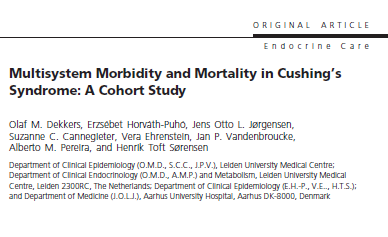
People with Cushing’s syndrome, even when treated, have higher morbidity and mortality rates that comparable controls. That is the conclusion of a new study published in the June issue of the Journal of Clinical Endocrinology Metabolism. The study by Olaf Dekkers et al, examined data records from the Danish National Registry of Patients and the Danish Civil Registration System of 343 patients with benign Cushing’s syndrome of adrenal or pituitary origin (i.e., Cushing’s disease) and a matched population comparison cohort (n=34,300).  Due to the lengthy delay of many patients being diagnosed with Cushing’s syndrome, morbidity was investigated in the 3 years before diagnosis while  morbidity and mortality were assessed during complete follow-up after diagnosis and treatment.

The study found that mortality was twice as high in Cushing’s syndrome patients (HR 2.3, 95% CI 1.8-2.9) compared with controls over a mean follow-up period of 12.1 years. Furthermore, patients with Cushing’s syndrome were at increased risk for:

  • venous thromboembolism (HR 2.6, 95% CI 1.5-4.7)
  • myocardial infarction (HR 3.7, 95% CI 2.4-5.5)
  • stroke (HR 2.0, 95% CI 1.3-3.2)
  • peptic ulcers (HR 2.0, 95% CI 1.1-3.6)
  • fractures (HR 1.4, 95% CI 1.0-1.9)
  • infections (HR 4.9, 95% CI 3.7-6.4).

The study also found that this increased multimorbidity risk was present before diagnosis indicating that it was due to cortisol overproduction rather than treatment.

Many of the Cushing’s syndrome patients underwent surgery to remove the benign tumor. For this group, the investigators performed a sensitivity analysis of the  long-term mortality and cardiovascular risk in this  subgroup (n=186)  considered to be cured after operation (adrenal surgery and patients with pituitary surgery in combination with a diagnosis of hypopituitarism in the first 6 months after operation).  The risk estimates for mortality (HR 2.31, 95% CI 1.62-3.28), venous thromboembolism (HR 2.03, 95% CI 0.75-5.48), stroke (HR 1.91, 95% CI 0.90-4.05), and acute myocardial infarction (HR 4.38, 95% CI 2.31-8.28) were also increased in this subgroup one year after the operation.

The standard treatment for endogenous Cushing’s syndrome is surgery. This past year, Signifor (pasireotide) was approved for treatment of adults patients with Cushing’s disease for whom pituitary surgery is not an option or has not been curative.  Cushing’s disease, which accounts for the majority of Cushing’s syndrome patients, is defined as the presence of an ACTH producing tumor on the pituitary grand. In the study by Dekker’s et al, the percentage of patients with Cushing’s disease is not known. We look forward to reexamination of this dataset in a few years following the introduction of more treatment options for Cushing’s disease as well as an analysis that explores the differences in mortality/morbidity rates in the different subsets of patients that make of Cushing’s syndrome (Cushing’s disease, ectopic Cushing’s syndrome, Exogenous Cyshing’s syndrome).

References

Dekkers OM, Horvath-Pujo, Jorgensen JOL, et al, Multisystem morbidity and mortality in Cushing’s syndrome: a cohort study. J Clin Endocrinol Metab 2013 98(6): 2277–2284. doi: 10.1210/jc.2012-3582

– See more at: http://www.raredr.com/medicine/articles/cushing%E2%80%99s-syndrome-hazardous-your-health-0

Adrenal Glands

adrenal-glandsAnatomy of the adrenal glands:

Adrenal glands, which are also called suprarenal glands, are small, triangular glands located on top of both kidneys. An adrenal gland is made of two parts: the outer region is called the adrenal cortex and the inner region is called the adrenal medulla.

Function of the adrenal glands:

The adrenal glands work interactively with the hypothalamus and pituitary gland in the following process:

  • the hypothalamus produces corticotropin-releasing hormones, which stimulate the pituitary gland.
  • the pituitary gland, in turn, produces corticotropin hormones, which stimulate the adrenal glands to produce corticosteroid hormones.

Both parts of the adrenal glands — the adrenal cortex and the adrenal medulla — perform very separate functions.

What is the adrenal cortex?

The adrenal cortex, the outer portion of the adrenal gland, secretes hormones that have an effect on the body’s metabolism, on chemicals in the blood, and on certain body characteristics. The adrenal cortex secretes corticosteroids and other hormones directly into the bloodstream. The hormones produced by the adrenal cortex include:

  • corticosteroid hormones
    • hydrocortisone hormone – this hormone, also known as cortisol, controls the body’s use of fats, proteins, and carbohydrates.
    • corticosterone – this hormone, together with hydrocortisone hormones, suppresses inflammatory reactions in the body and also affects the immune system.
  • aldosterone hormone – this hormone inhibits the level of sodium excreted into the urine, maintaining blood volume and blood pressure.
  • androgenic steroids (androgen hormones) – these hormones have minimal effect on the development of male characteristics.

What is the adrenal medulla?

The adrenal medulla, the inner part of the adrenal gland, is not essential to life, but helps a person in coping with physical and emotional stress. The adrenal medulla secretes the following hormones:

  • epinephrine (also called adrenaline) – this hormone increases the heart rate and force of heart contractions, facilitates blood flow to the muscles and brain, causes relaxation of smooth muscles, helps with conversion of glycogen to glucose in the liver, and other activities.
  • norepinephrine (also called noradrenaline) – this hormone has little effect on smooth muscle, metabolic processes, and cardiac output, but has strong vasoconstrictive effects, thus increasing blood pressure.

From: University of Maryland Center for Diabetes and Endocrinology

Pasireotide for the treatment of Cushing’s disease

Posted online on June 17, 2013. (doi:10.1517/21678707.2013.807731)

Annamaria Colao Chiara Simeoli Monica De Leo Alessia Cozzolino Rosario Pivonello

Department of Clinical Medicine and Surgery, Section of Endocrinology, Federico II University, Via Sergio Pansini 5,

80131 Naples

, Italy +39 0817462132; +39 0815465443; colao@unina.it

Author for correspondence

Introduction: Pasireotide, a novel multireceptor targeted somatostatin analog is the first drug approved for treatment of adult patients with Cushing’s disease (CD) for whom pituitary surgery is not an option or has not been curative.

Areas covered: The review describes published data on efficacy and safety of pasireotide in CD patients. In particular, the review focuses on a Phase III study (CSOM230B2305) evaluating the outcomes of treatment with pasireotide at the doses of 600 and 900 µg twice daily for 12 months in 162 CD patients. This clinical trial reported a decrease in urinary free cortisol levels in the majority of patients, with a substantial reduction in nearly half and a normalization in > 25% of patients included in the study, accompanied by an improvement in clinical picture as well as a significant reduction in pituitary tumor size. Hyperglycemia appears as the most important side effect, requiring a careful monitoring and a prompt administration of glucose-lowering medications.

Expert opinion: Pasireotide seems to have a promising role as medical option for CD patients who experienced a failure or not candidate for neurosurgery; its employment will probably induce in the near future significant changes in the therapeutic approach to CD.

Read More: http://informahealthcare.com/doi/abs/10.1517/21678707.2013.807731

Research and Markets: Pituitary ACTH Hypersecretion (Cushing’s Disease) – Pipeline Review Report, H1 2013 Edition

Research and Markets(http://www.researchandmarkets.com/research/rdf6gm/pituitary_acth) has announced the addition of the “Pituitary ACTH Hypersecretion (Cushing’s Disease) – Pipeline Review, H1 2013” report to their offering.

‘Pituitary ACTH Hypersecretion (Cushing’s Disease) – Pipeline Review, H2 2013’, provides an overview of the indication’s therapeutic pipeline. This report provides information on the therapeutic development for Pituitary ACTH Hypersecretion (Cushing’s Disease), complete with latest updates, and special features on late-stage and discontinued projects. It also reviews key players involved in the therapeutic development for Pituitary ACTH Hypersecretion (Cushing’s Disease).

Scope

– A snapshot of the global therapeutic scenario for Pituitary ACTH Hypersecretion (Cushing’s Disease).

– A review of the Pituitary ACTH Hypersecretion (Cushing’s Disease) products under development by companies and universities/research institutes based on information derived from company and industry-specific sources.

– Coverage of products based on various stages of development ranging from discovery till registration stages.

– A feature on pipeline projects on the basis of monotherapy and combined therapeutics.

– Coverage of the Pituitary ACTH Hypersecretion (Cushing’s Disease) pipeline on the basis of route of administration and molecule type.

– Key discontinued pipeline projects.

– Latest news and deals relating to the products.

Companies Involved in Pituitary ACTH Hypersecretion (Cushing’s Disease) Therapeutics Development


  • Isis Pharmaceuticals, Inc.
  • Ipsen S.A.
  • Novartis AG
  • HRA Pharma, SA
  • Cortendo Invest AB


Drug Profiles: Product Description, Mechanism of Action and R&D Progress


  • LCI-699
  • mifepristone
  • ISIS-GCCRRx
  • Inhibitors of ACTH receptor
  • ketoconazole
  • Next Generation Cortisol Inhibitor
  • pasireotide Long Acting Release


For more information visit http://www.researchandmarkets.com/research/rdf6gm/pituitary_acth

MR Brain Spectroscopy Detects Damage In The Hippocampus Of Patients Exposed To Excess Cortisol

New research shows that patients who are “biochemically cured” of Cushing’s syndrome have levels of brain metabolites which are associated with neural damage. This will have implications for treatment of Cushing’s patients, but might also suggest that patients using high levels of glucocorticoid drugs may suffer similar long-term problems. The work was presented yesterday at the European Congress of Endocrinology in Copenhagen.

Cushing’s syndrome is an endocrine disease causing an overproduction of the stress hormone cortisol. Surgery and medical treatment can normalise cortisol levels, however recently it has been shown that “biochemically cured” patients continue to have memory problems. Now for the first time a group of researchers from the Sant Pau Hospital in Barcelona has scanned the brains of patients who had suffered from Cushing’s syndrome and found that they exhibit changed levels of brain metabolites, which are associated with memory and cognitive impairments. This finding may also have clinical implications for otherwise healthy patients who take high levels of glucocorticoid drugs for inflammatory, rheumatoid diseases, allergies and probably everyday chronic stress.

Cortisol (a glucocorticoid hormone), is naturally produced by the adrenal glands in response to stress. Long term exposure to high levels of cortisol is known to be associated with a range of cognitive impairments – this is true for Cushing’s syndrome patients, and probably would be also for those who take glucocorticoid drugs.

Eugenia Resmini and colleagues, working at the Centre for Biomedical Research on Rare Diseases (CIBERER), Sant Pau hospital in Barcelona, used proton magnetic resonance spectroscopy to measure a series of metabolites in the hippocampus of the brains of 18 patients who had been treated for Cushing’s syndrome, and compared these results to 18 healthy control subjects. They found that levels of the metabolite NAA (NAcetyl-aspartate) were significantly lower in the Cushing’s patients, indicating neural dysfunction, whereas Glx (Glutamate +Glutamine) levels were higher, suggesting that glial cells were proliferating as a repair mechanism.

According to Dr Resmini MD, PhD, Endocrinologist at the Centre for Biomedical Research on Rare Diseases (CIBERER), Hospital de Sant Pau, Barcelona, Spain:

“Patients with Cushing’s syndrome are exposed to abnormally high levels of glucocorticoids, which is associated with a wide range of cognitive impairments, as well as loss of brain volume. We studied the hippocampus, which is a critical area for learning and memory and, as it is rich in glucocorticoid receptors, is especially vulnerable to glucocorticoid overexposure. Cushing’s syndrome patients with severe memory impairment are known to have a smaller hippocampus. We have now found abnormal levels of metabolites in the hippocampi of Cushing’s patients with normal hippocampal volumes, indicating that these are early markers of glucocorticoid neurotoxicity, which would precede hippocampal volume reduction.

“Identifying these metabolites as a marker would be a way of allowing earlier diagnosis and treatment of cognitive impairments. This may also allow us to monitor patients taking glucocorticoid drugs, which have potentially damaging side effects. On the other hand, the fact that these markers are still present in Cushing’s patients after being “biochemically cured”, may show that once cognition has been damaged in Cushing’s syndrome, it may not be fully reversible. For this reason an earlier diagnosis of the disease and a rapid normalization of hypercortisolism would avoid the progression of hippocampal damage and of memory problems”.

From Medical News Today