After massive weight gain, Cushing’s disease diagnosis saves man’s life – Health – TODAY.com

Donelle Trotman was only in his 30s when his health suddenly took a strange and frightening turn.

He was rapidly gaining weight — more than 100 pounds in one year. His upper torso was getting bigger, but not his legs. And he felt overwhelmingly tired.

“My body just started changing,” the Staten Island, New York, native told TODAY as part of a three-day series, “Medical Mysteries,” looking at people who have recovered from rare diseases.

It was especially puzzling because Trotman had never had weight issues before.

In school, Trotman was never a skinny kid, but he wasn’t overweight. He loved sports, playing both basketball and baseball.

So as he entered adulthood, he was active and in good shape. Then, three years ago, he suddenly began to gain weight.

“It was just specific places: My stomach, under my arms, my back of my neck, my face, the bottom of my back,” Trotman said. “My legs stayed the same for a long time.”

To lose the extra pounds, Trotman began running, working out and lifting weights. Nothing worked.

In the span of one year, Trotman gained more than 120 pounds, topping the scale at 366 pounds, twice the amount he weighed at 18.

“I doubled, like, I got a whole person on me,” he said.

There were other alarming changes. Trotman became so easily tired that he’d get out of breath just by chewing food. When he woke up seeing double three months ago, he knew it was time to go to the hospital.

Doctors ran a flurry of tests, but the results offered few clues, leaving everyone puzzled. Then one day, an intern noticed stretch marks all over Trotman’s body, a telltale sign that solved the mystery. Trotman had Cushing’s disease, a rare condition that affects fewer than 50,000 people in the U.S. every year.

Trotman’s weight gain was being caused by a tiny tumor at the base of his brain, prompting his body to produce too much of the hormone cortisol. He had some of the classic symptoms: major weight gain in his upper body, skin problems and acne, plus fatigue.

Dr. John Boockvar and Dr. Peter Costantino at New York’s Lenox Hill Hospital discovered Trotman had steroid levels ten times higher than normal.

“In Cushing’s disease, the pituitary gland has a small growth that releases a single hormone that causes the body to live with very high levels of steroids. The skin becomes very thin. You get increased acne. You can grow hair. You start sweating. You gain a lot of fat,” Boockvar said.

There was no time to lose: Untreated, Cushing’s is a fatal disease. Trotman was getting close to the point where doctors would not be able to reverse the changes, Costantino noted. He underwent surgery two weeks ago and had the growth successfully removed.

“The tumor was no bigger than the size of the tip of my pen,” Boockvar said. “And that something so small can cause a man to grow to 350 pounds and absolutely destroy his life is rather remarkable.”

These days, Trotman is feeling much better. His main focus now is to lose the weight he gained and regain an active lifestyle. He hopes to play basketball with his son soon.

“It’s wonderful. Every day it’s just like I feel a little stronger,” he said.

Doctors say Trotman will continue to lose weight and can shoot hoops with his son in about three months. There is an 8-10 percent chance the disease could come back, but Trotman said he knows what to look for now.

One of the reasons Trotman wanted to share his story is so others might recognize the symptoms of Cushing’s, although doctors stress it is a very rare illness.


Watch the video here: After massive weight gain, Cushing’s disease diagnosis saves man’s life – Health – TODAY.com.

Scientists Find Potential Therapeutic Target for Cushing’s Disease

Scientists at the Salk Institute for Biological Studies have identified a protein that drives the formation of pituitary tumors in Cushing’s disease, a development that may give clinicians a therapeutic target to treat this potentially life-threatening disorder.

The protein, called TR4 (testicular orphan nuclear receptor 4), is one of the human body’s 48 nuclear receptors, a class of proteins found in cells that are responsible for sensing hormones and, in response, regulating the expression of specific genes. Using a genome scan, the Salk team discovered that TR4 regulates a gene that produces adrenocorticotropic hormone (ACTH), which is overproduced by pituitary tumors in Cushing’s disease (CD). The findings were published in the May 6, 2013 early online edition of Proceedings of the National Academy of Sciences.

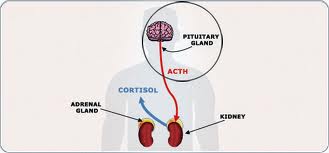
The diagram shows how adrenocorticotropin hormone is secreted in Cushing's disease.

“We were surprised by the scan, as TR4 and ACTH were not known to be functionally linked,” says senior author Ronald M. Evans, a professor in Salk’s Gene Expression Laboratory and a lead researcher in the Institute’s Helmsley Center for Genomic Medicine. “TR4 is driving the growth and overexpression of ACTH. Targeting this pathway could therapeutically benefit treatment of CD.”

In their study, Evans and his colleagues discovered that forced overexpression of TR4 in both human and mouse cells increased production of ACTH, cellular proliferation and tumor invasion rates. All of these events were reversed when TR4 expression was reduced.

First described more than 80 years ago, Cushing’s disease is a rare disorder that is caused by pituitary tumors or excess growth of the pituitary gland located at the base of the brain. People with CD have too much ACTH, which stimulates the production and release of cortisol, a hormone that is normally produced during stressful situations.

While these pituitary tumors are almost always benign, they result in excess ACTH and cortisol secretion, which can result in various disabling symptoms, including diabetes, hypertension, osteoporosis, obesity and psychological disturbances. Surgical removal of the tumors is the first-line therapy, with remission rates of approximately 80 percent; however, the disease recurs in up to 25 percent of cases.

Drugs such as cabergoline, which is used to treat certain pituitary tumors, alone or in combination with ketoconazole, a drug normally used to treat fungal infections, have been shown to be effective in some patients with Cushing’s disease. More recently, mefipristone-best known as the abortion pill RU-486-was approved by the FDA to treat CD. Despite these advances in medical therapy, the Salk scientists say additional therapeutic approaches are needed for CD.

“Pituitary tumors are extremely difficult to control,” says Michael Downes, a senior staff scientist in the Gene Expression Laboratory and a co-author of the study. “To control them, you have to kill cells in the pituitary gland that are proliferating, which could prevent the production of a vital hormone.”

Previous studies have found that, by itself, TR4 is a natural target for other signaling molecules in the pituitary. Small-molecule inhibitors that have been developed for other cancers could be potentially applied to disrupt this signaling cascade. “Our discovery,” says Evans, a Howard Hughes Medical Institute investigator and holder of the March of Dimes Chair in Molecular and Developmental Biology, “might lead clinicians to an existing drug that could be used to treat Cushing’s disease.

Notes about this neurogenetics and Cushing’s disease research

Other researchers on the study were Li Du, Marvin Bergsneider, Leili Mirsadraei, Stephen H. Young, William H. Yong and Anthony P. Heaney of the David A. Geffen School of Medicine at the University of California, Los Angeles, and Johan W. Jonker of the University of Groningen.

The study was supported by the National Institutes of Health, the Leona M. and Harry B. Helmsley Charitable Trust, the Samuel Waxman Cancer Research Foundation, the Jonsson Comprehensive Cancer Center at UCLA, and Ipsen/Biomeasure.

Contact: Andy Hoang – Salk Institute
Source: Salk Institute press release
Image Source: The ACTH Cushing’s disease diagram is credited to NIDDK/NIH and is available in the public domain.
Original Research: Abstract for “Evidence for orphan nuclear receptor TR4 in the etiology of Cushing disease” by Li Du, Marvin Bergsneider, Leili Mirsadraei, Steven H. Young, Johan W. Jonker, Michael Downes, William H. Yong, Ronald M. Evans, and Anthony P. Heaney in Proceedings of the National Academy of Sciences. Published May 6 2013 doi: 10.1073/pnas.1306182110

From http://neurosciencenews.com/tr4-cushings-disease-acth-neurogenetics-120/

Cushing’s Media

Novartis is re-sharing these Cushing’s disease resources for Rare Disease Day:

Mutations Drive Unrestrained Secretion

The USP8 mutations identified in adenomas of the pituitary gland lead to overproduction of ACTH. Panel A: ACTH-producing cells in a normal gland. The other panels show cells non-mutant (B) or mutant (C) for USP8. Credit: S. Sbiera, Universität Würzburg

The USP8 mutations identified in adenomas of the pituitary gland lead to overproduction of ACTH. Panel A: ACTH-producing cells in a normal gland. The other panels show cells non-mutant (B) or mutant (C) for USP8. Credit: S. Sbiera, Universität Würzburg

Benign tumors in the pituitary gland lead to uncontrolled secretion of the stress hormone cortisol by the cells of the adrenal cortex. An international research effort has now characterized a new mechanism that triggers the syndrome.

Many individuals who suffer from Cushing syndrome are easy to recognize: They tend to be overweight particularly around the waist, and have round faces and bull necks. In addition to these obvious features, most of them have high blood pressure, develop muscle weakness, become diabetic and are extremely susceptible to infection. Cushing syndrome can often be treated effectively by surgical intervention, but patients succumb to infections or cardiovascular disease if the condition is left untreated.

In their efforts to understand how benign tumors in the pituitary provoke the development of Cushing’s disease, researchers based in Munich, Würzburg and Tokyo led by Professor Martin Reincke (Director of LMU’s Medical Clinic IV at Munich University Medical Center) have now pinpointed a novel molecular mechanism responsible for the condition. The results of the study have just appeared in Nature Genetics.

The perils of incessant secretion

All of the symptoms that typify Cushing syndrome are attributable to the unregulated secretion of the hormone cortisol – generally referred to as cortisone. Cortisol is normally released into the bloodstream only in stress situations, and helps the organism to cope with the challenge. However, when secreted in an uncontrolled fashion, the result is physiological havoc. Cortisol is synthesized in, and secreted by specialized cells in the adrenal cortex in response to the binding of a different hormone, the adrenocorticotropic hormone (ACTH). ACTH in turn is produced in the pituitary gland. Excessive cell proliferation in the pituitary can result in the formation of benign tumors (adenomas), which may lead to overproduction of ACTH and a corresponding increase in the level of circulating cortisol. However, the connecting links between the two processes are incompletely understood.

“We have now shown that tumor cells in more than one-third of patients with Cushing’s disease carry a mutation in one specific gene, which codes for an enzyme called ubiquitin-specific protease 8,” says Martin Fassnacht (Würzburg University Hospital), one of the authors of the publication. The mutation was discovered in the course of a detailed genetic characterization of benign tumors of the pituitary gland that overproduced ACTH.

Protease defect sets off a chain reaction

Ubiquitin-specific protease 8 (USP8) is one of a family of enzymes which play a key role in the destruction of proteins that are required only transiently by cells. One such protein is the receptor for epidermal growth factor (EGF), which is degraded and disposed of only when the USP8 gene is inactive, and no USP8 protein is present. The collaboration found that the effect of the mutations identified in pituitary tumor tissues is to keep the USP8 permanently active. As a consequence, the EGF receptor escapes demolition, and is instead recycled to its site of action on the cell membrane. The upshot of this is a life-threatening chain reaction, in which unrestrained synthesis of ACTH leads to uninhibited secretion of cortisol. “The identification of mutations in USP8 is a significant finding, because it opens up entirely new diagnostic and therapeutic approaches to the management of Cushing’s disease,” Martin Reincke adds.

Long-term focus on Cushing’s disease

Indeed, this is not the first time that the collaboration between the teams in Munich and Würzburg has shed light on the pathogenesis of Cushing’s disease. The two groups have previously identified mutations in a gene that is expressed in the adrenal cortex as a frequent cause of the pathological secretion of cortisol in a different patient population. The results of that study appeared in February 2014 in the “New England Journal of Medicine“. And only last week, a paper providing a detailed characterization of the molecular effects of the latter set of mutations was published in “Nature Communications“.

More information: “Mutations in the deubiquitinase gene USP8 cause Cushing’s disease.” Nature Genetics (2014) DOI: 10.1038/ng.3166

Pituitary ACTH Hypersecretion (Cushing’s Disease) – Pipeline Review, H2 2014

Global Markets Direct’s, ‘Pituitary ACTH Hypersecretion (Cushing’s Disease) – Pipeline Review, H2 2014’, provides an overview of the Pituitary ACTH Hypersecretion (Cushing’s Disease)’s therapeutic pipeline.

This report provides comprehensive information on the therapeutic development for Pituitary ACTH Hypersecretion (Cushing’s Disease), complete with comparative analysis at various stages, therapeutics assessment by drug target, mechanism of action (MoA), route of administration (RoA) and molecule type, along with latest updates, and featured news and press releases. It also reviews key players involved in the therapeutic development for Pituitary ACTH Hypersecretion (Cushing’s Disease) and special features on late-stage and discontinued projects.

Global Markets Direct’s report features investigational drugs from across globe covering over 20 therapy areas and nearly 3,000 indications. The report is built using data and information sourced from Global Markets Direct’s proprietary databases, Company/University websites, SEC filings, investor presentations and featured press releases from company/university sites and industry-specific third party sources, put together by Global Markets Direct’s team. Drug profiles/records featured in the report undergoes periodic updation following a stringent set of processes that ensures that all the profiles are updated with the latest set of information. Additionally, processes including live news & deals tracking, browser based alert-box and clinical trials registries tracking ensure that the most recent developments are captured on a real time basis.

The report enhances decision making capabilities and help to create effective counter strategies to gain competitive advantage. It strengthens R&D pipelines by identifying new targets and MOAs to produce first-in-class and best-in-class products.

Note*: Certain sections in the report may be removed or altered based on the availability and relevance of data for the indicated disease.

Scope

– The report provides a snapshot of the global therapeutic landscape of Pituitary ACTH Hypersecretion (Cushing’s Disease)
– The report reviews key pipeline products under drug profile section which includes, product description, MoA and R&D brief, licensing and collaboration details & other developmental activities
– The report reviews key players involved in the therapeutics development for Pituitary ACTH Hypersecretion (Cushing’s Disease) and enlists all their major and minor projects
– The report summarizes all the dormant and discontinued pipeline projects
– A review of the Pituitary ACTH Hypersecretion (Cushing’s Disease) products under development by companies and universities/research institutes based on information derived from company and industry-specific sources
– Pipeline products coverage based on various stages of development ranging from pre-registration till discovery and undisclosed stages
– A detailed assessment of monotherapy and combination therapy pipeline projects
– Coverage of the Pituitary ACTH Hypersecretion (Cushing’s Disease) pipeline on the basis of target, MoA, route of administration and molecule type
– Latest news and deals relating related to pipeline products

Reasons to buy

– Provides strategically significant competitor information, analysis, and insights to formulate effective R&D development strategies
– Identify emerging players with potentially strong product portfolio and create effective counter-strategies to gain competitive advantage
– Develop strategic initiatives by understanding the focus areas of leading companies
– Identify and understand important and diverse types of therapeutics under development for Pituitary ACTH Hypersecretion (Cushing’s Disease)
– Plan mergers and acquisitions effectively by identifying key players of the most promising pipeline
– Devise corrective measures for pipeline projects by understanding Pituitary ACTH Hypersecretion (Cushing’s Disease) pipeline depth and focus of Indication therapeutics
– Develop and design in-licensing and out-licensing strategies by identifying prospective partners with the most attractive projects to enhance and expand business potential and scope
– Modify the therapeutic portfolio by identifying discontinued projects and understanding the factors that drove them from pipeline

Read the full report: http://www.reportlinker.com/p02458443-summary/view-report.html