Subclinical Cushing’s syndrome and cardiovascular disease

Guido Di Dalmazi and colleagues1 reported that in patients with adrenal incidentalomas and either stable mild hypercortisolism or worsening of cortisol hypersecretion, all-cause and cardiovascular disease-specific mortality was higher compared with in those with adrenal incidentalomas that did not secrete cortisol, after a mean follow-up of 7·5 years. Moreover, cortisol concentrations measured after dexamethasone-suppression test were associated with all-cause mortality independent of the presence of traditional cardiovascular disease risk factors.
Subclinical Cushing’s syndrome is the most common hormonal abnormality in patients with adrenal incidentalomas (prevalence 1—29%).2 The proportion of adrenal incidentalomas that progress to subclinical Cushing’s syndrome is low (1·7%) and most are lesions of 3 cm or larger.2 Progression to overt Cushing’s syndrome is controversial (because both spontaneous normalisation of hypersecretion and stable disease have been reported during follow-up) and spontaneous normalisation of hypersecretion has been reported in 50% of cases.2 Results of the study by Di Dalmazi and co-workers1 are important because they show, for the first time, that patients with subclinical Cushing’s syndrome are at increased risk of cardiovascular disease and all-cause mortality (mainly attributable to cardiovascular disease). The association of cortisol with all-cause mortality might also be attributable to its potential role in the pathogenesis of metabolic syndrome.3
Findings of previous studies have shown an increased prevalence of cardiovascular disease risk factors in patients with subclinical Cushing’s syndrome, but data for optimum management are conflicting. Some criteria—such as large (>4—6 cm) adrenal incidentalomas, features suggestive of malignancy (eg, heterogeneity, irregular shape, calcification or necrosis, invasion to adjacent tissues), or potentially lethal hormonal hypersecretion (ie, pheochromocytomas)—support the need for adrenalectomy. However, universal surgical management of patients with subclinical Cushing’s syndrome has not been accepted.24 Uncertainty about the most effective management strategy for subclinical Cushing’s syndrome is attributable to the variable definitions used, and the small sample size and retrospective nature of most studies.4 Only one prospective study has been published so far showing that laparoscopic adrenalectomy is more beneficial than is conservative management for the normalisation or improvement of cardiovascular disease risk factors, such as diabetes, dyslipidaemia, hypertension, and obesity.5
Prospective studies and registries are needed to document the effect of different approaches on the incidence of cardiovascular disease events and mortality in patients with adrenal incidentalomas and subclinical Cushing’s syndrome. Until then, individualised treatment seems prudent. Surgical management of subclinical Cushing’s syndrome can be suggested in young patients (age <50 years) and in those with cardiovascular disease risk factors or bone disease associated with hypercortisolism that are of recent onset, difficult to control with drugs, or show progression over time.4
Another message from Di Dalmazi’s study1 is that hormonal deterioration might develop even after 4—5 years, which most studies reported as a reasonable and safe follow-up.2 This possibility should be kept in mind for the management of patients with adrenal incidentalomas, especially if clinical signs of Cushing’s syndrome develop or if cardiovascular disease risk factors become evident or increase in severity (ie, hormonal hypersecretion).
We declare that we have no competing interests.

References

1 Di Dalmazi GVicennati VGarelli S, et alCardiovascular events and mortality in patients with adrenal incidentalomas that are either non-secreting or associated with intermediate phenotype or subclinical Cushing’s syndrome: a 15-year retrospective studyLancet Diabetes Endocrinol 2014published online Jan 29 http://dx.doi.org/10.1016/S2213-8587(13)70211-0.
2 Anagnostis PKaragiannis ATziomalos KKakafika AIAthyros VGMikhailidis DPAdrenal incidentaloma: a diagnostic challengeHormones (Athens) 20098163-184PubMed
3 Anagnostis PAthyros VGTziomalos KKaragiannis AMikhailidis DPClinical review: The pathogenetic role of cortisol in the metabolic syndrome: a hypothesisJ Clin Endocrinol Metab 200994:2692-2701PubMed
4 Terzolo MPia AReimondo GSubclinical Cushing’s syndrome: definition and managementClin Endocrinol (Oxf) 20127612-18PubMed
5 Toniato AMerante-Boschin IOpocher GPelizzo MRSchiavi FBallotta ESurgical versus conservative management for subclinical Cushing syndrome in adrenal incidentalomas: a prospective randomized studyAnn Surg 2009249388-391PubMed
a Division of Endocrinology, Police Medical Centre, Thessaloniki, 54 640, Greece
b Department of Endocrinology and Metabolism, Agios Pavlos General Hospital, Thessaloniki, Greece
c Second Propedeutic Department of Internal Medicine, Medical School, Aristotle University of Thessaloniki, Hippokration Hospital, Thessaloniki, Greece
d Department of Clinical Biochemistry (Vascular Prevention Clinic) Royal Free Hospital Campus, University College London Medical School, University College London, London, UK

Cushing’s Awareness Challenge: Day 10

robin-tests

Gee, I’m an underachiever. LOL I only had one IPSS and one pituitary surgery.

While I was at NIH, my MRIs still showed nothing, so they did an Inferior Petrosal Sinus Sampling Test. That scared me more than the prospect of surgery. (This test carries the risk of stroke and uncontrollable bleeding from the incision points.) Catheters were fed from my groin area to my pituitary gland and dye was injected. I could watch the whole procedure on monitors.

I could not move during this test or for several hours afterwards to prevent uncontrollable bleeding from a major artery. The test did show where the tumor probably was located.

Also done were more sophisticated dexamethasone suppression tests where drugs were administered by IV and blood was drawn every hour (they put a heplock in my arm so they didn’t have to keep sticking me). I got to go home for a weekend and then went back for the surgery – the Transsphenoidal Resection. I fully expected to die during surgery (and didn’t care if I did) so I signed my will and wrote last letters to those I wanted to say goodbye to.

During the time I was home just before surgery, a college classmate of mine (I didn’t know her) did die at NIH of a Cushing’s-related problem. I’m so glad I didn’t find out until a couple months later!

maryo colorful zebra

Cushing’s Awareness Challenge, Day 7

A Cushing’s diagnosis can be a long and frustrating event with testing, repeat testing, redoing testing.

Sometimes, I think that this was the path that some of my UFCs took on the way to my diagnosis:


cushie-diagnosis


It took three years from 1983 to 1986 before doctors would consider testing me for Cushing’s, even though I was sure that this was what my problem was.

My first 24-hour urine free cortisol was run by a Hematologist/Oncologist.  After that, things seemed to move a little better, if not faster.  That UFC got me to my first endo.

The Endocrinologist, of course, didn’t trust the other test so I was back to square one. He ran his own multitude of tests. He had to draw blood at certain times like 9 AM. and 5 PM. There was a dexamethasone suppression test where I took a pill at 10 p.m. and gave blood at 9 am the next day.

ufcI collected gallons of urine in BIG boxes (Fun in the fridge!). Those were from 6 a.m. to 6 a.m. to be delivered to his office by 9 a.m. same day. I was always worried that I’d be stopped in rush hour and the police would ask about what was in that big container. I did those daily for a week.

When the endo confirmed that I had Cushing’s in 1987 he sent me to a local hospital where they repeated all those same tests for another week and decided that it was not my adrenal gland (Cushing’s Syndrome) creating the problem. The doctors and nurses had no idea what to do with me, so they put me on the brain cancer ward.

When I left this hospital after a week, we didn’t know any more than we had before.

As luck would have it, NIH (National Institutes of Health, Bethesda, Maryland) was doing a clinical trial of Cushing’s. I live in the same area as NIH so it was not too inconvenient but very scary at first to think of being tested there. At that time I only had a choice of NIH, Mayo Clinic and a place in Quebec to do this then-rare pituitary surgery called a Transsphenoidal Resection. I chose NIH – closest and free. After I was interviewed by the Doctors there, I got a letter that I had been accepted into the clinical trial. The first time I was there was for 6 weeks as an inpatient. More of the same tests.

Six weeks of daily UFC testing.  To this day, I still remember nurses waking me just after 6 am to “close out your urine”.  Sounded like a bank account!

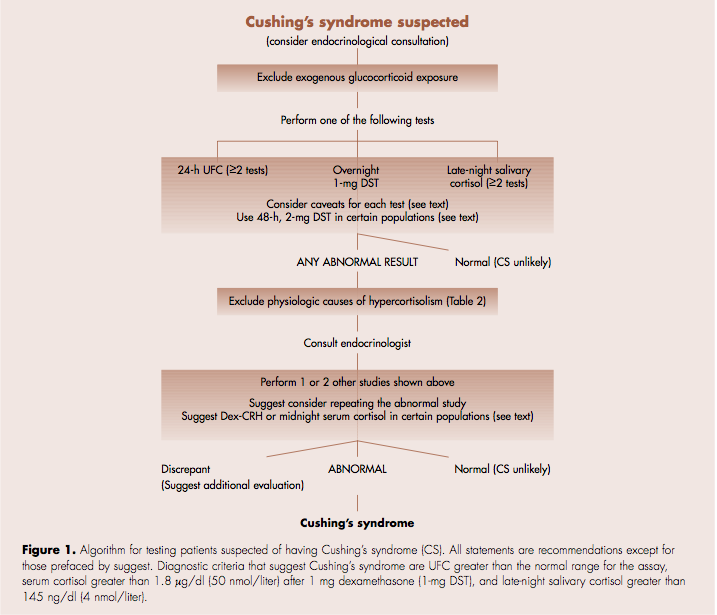
The testing pathway today looks a little more organized but it still takes far too long:

testing-cushings


When to think Cushing’s syndrome in type 2 diabetes

ESTES PARK, COLO. – Diabetes mellitus, osteoporosis, and hypertension are conditions that should boost the index of suspicion that a patient with some cushingoid features may in fact have endogenous Cushing’s syndrome, Dr. Michael T. McDermott said at a conference on internal medicine sponsored by the University of Colorado.

An estimated 1 in 20 patients with type 2 diabetes has endogenous Cushing’s syndrome. The prevalence of this form of hypercortisolism is even greater – estimated at up to 11% – among individuals with osteoporosis. In hypertensive patients, the figure is 1%. And among patients with an incidentally detected adrenal mass, it’s 6%-9%, according to Dr. McDermott, professor of medicine and director of endocrinology and diabetes at the University of Colorado.

“Endogenous Cushing’s syndrome is not rare. I suspect I’ve seen more cases than I’ve diagnosed,” he observed. “I’ve probably missed a lot because I failed to screen people, not recognizing that they had cushingoid features. Not everyone looks classic.”

There are three screening tests for endogenous Cushing’s syndrome that all primary care physicians ought to be familiar with: the 24-hour urine cortisol test, the bedtime salivary cortisol test, and the overnight 1-mg dexamethasone suppression test.

“I think if you have moderate or mild suspicion, you should use one of these tests. If you have more than moderate suspicion – if a patient really looks like he or she has Cushing’s syndrome – then I would use at least two screening tests to rule out endogenous Cushing’s syndrome,” the endocrinologist continued.

The patient performs the bedtime salivary cortisol test at home, obtaining samples two nights in a row and mailing them to an outside laboratory. The overnight dexamethasone suppression test entails taking 1 mg of dexamethasone at bedtime, then measuring serum cortisol the next morning. A value greater than 1.8 mcg/dL is a positive result.

Pregnant women constitute a special population for whom the screening method recommended in Endocrine Society clinical practice guidelines (J. Clin. Endocrinol. Metab. 2008;93:1526-40) is the 24-hour urine cortisol test. That’s because pregnancy is a state featuring high levels of cortisol-binding globulins, which invalidates the other tests. In patients with renal failure, the recommended screening test is the 1-mg dexamethasone suppression test. In patients on antiepileptic drugs, the 24-hour urine cortisol or bedtime salivary cortisol test is advised, because antiseizure medications enhance the metabolism of dexamethasone.

Dr. McDermott said that “by far” the most discriminatory clinical features of endogenous Cushing’s syndrome are easy bruising, violaceous striae on the trunk, facial plethora, and proximal muscle weakness.

“They’re by no means specific. You’ll see these features in people who don’t have Cushing’s syndrome. But those are the four things that should make you really consider Cushing’s syndrome in your differential diagnosis,” he stressed.

More widely recognized yet actually less discriminatory clinical features include facial fullness and the “buffalo hump,” supraclavicular fullness, central obesity, hirsutism, reduced libido, edema, and thin or poorly healing skin.

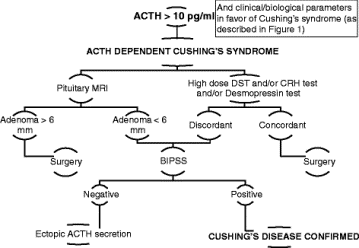
Endogenous Cushing’s syndrome can have three causes. An adrenocorticotropic hormone (ACTH)-secreting pituitary adenoma accounts for 80% of cases. A cortisol-secreting adrenal tumor is the cause of 10%. And another 10% are due to an ectopic ACTH-secreting tumor, most commonly a bronchial carcinoid tumor.

Once the primary care physician has a positive screening test in hand, it’s typical to refer the affected patient to an endocrinologist in order to differentiate which of the three causes is present. This is accomplished based upon the results of a large, 8-mg dexamethasone suppression test coupled with measurement of plasma ACTH levels.

Dr. McDermott recommended as a good read on the topic of evaluating a patient with endogenous Cushing’s syndrome a recent review article that included a useful algorithm (N. Engl. J. Med. 2013;368:2126-36).

He reported having no financial conflicts.

bjancin@frontlinemedcom.com

From http://www.clinicalendocrinologynews.com

Cushing’s Disease – Rare Disease Quick Facts

cushings-diagnosis


Cushing’s disease is a rare condition due to excess cortisol levels that result from a pituitary tumor secreting adrenocorticotropic hormone (ACTH), which stimulates cortisol secretion.  Cushing’s disease should not be confused with Cushing’s syndrome which is increased cortisol levels but that increase can be due to any number of factors. However, Cushing’s disease is the most common form of Cushing’s syndrome.

Symptoms

The symptoms related to Cushing’s disease and Cushing’s syndrome are the same, since both are related to an excess of cortisol. Also, symptoms vary extensively among patients and that, with the inherent fluctuation in hormone levels make it difficult to diagnosis both conditions.

Changes in physical characteristics of the body

  • Fullness and rounding of the face
  • Added fat on back of neck (so-called “buffalo hump”)
  • Easy bruising
  • Purplish stretch marks on the abdomen (abdominal striae)
  • Excessive weight gain, especially in abdominal region
  • Red cheeks
  • Excess hair growth on the face, neck, chest, abdomen and thighs

Changes in physiology/psychology

  • Generalized weakness and fatigue
  • Menstrual disorder
  • Decreased fertility and/or sex drive
  • High blood pressure that is often difficult to treat
  • Diabetes mellitus
  • Mood and behavior disorders

Diagnosis

The early stages of Cushing’s disease may be difficult to recognize. However, if it is suspected, diagnosis is generally a 2 stage process. First to determine if cortisol levels are high, and if so, why they are high.

Tests to confirm high cortisol levels:

  • 24-hour urine cortisol
  • Dexamethasone suppression test (low dose)

Tests to determine cause:

  • Blood ACTH level
  • Brain MRI
  • Corticotropin-releasing hormone test
  • Dexamethasone suppression test (high dose)
  • Petrosal sinus sampling

Treatment

Surgery

  • Most patients with Cushing’s disease undergo surgery to remove the pituitary adenoma offers.
  • If the tumor is isolated to the pituitary, cure rates of 80-85% are common.
  • If the tumor has spread to nearby organs, cure rates of 50-55% are common.

Medicine (approved orphan drugs)

Signifor (pasireotide)

  • Approved for patients with Cushing’s disease for whom pituitary is not an option or surgery has been ineffective.
  • Signifor is a somatostatin receptor agonist that leads to inhibition of ACTY secretion (and subsequently decreased cortisol levels).

Korlym (mifepristone)

  • Approved for patients with Cushing’s syndrome who have type 2 diabetes or glucose intolerance and have failed surgery (or not candidates for surgery).
  • Korlym is a glucocorticoid receptor antagonist which in turn blocks the effects of the high levels of cortisol in the body. Korlym is used to treat high glucose levels due to elevated cortisol.

Medicines used but not indicated for Cushing’s disease include

Mitoden

ketoconazole

Metyrapone

Etomidate

Radiation

  • Radiation therapy may be used in some patients and can be very effective in controlling the growth of these tumors.

Prognosis

In most cases, treatment can cure Cushing’s disease. If not treated properly, the chronic hypercortisolism can lead to excess morbidity and mortality due to increased cardiovascular and other risk factors.

For more information

National Library of Medicine, National Institute of Health

Cushing’s Disease Information (provided by Novartis Pharmaceuticals)


Images courtesy of the open access journal Orhanet Journal for Rare Diseases.  Castinetti et al. Orphanet J Rare Dis. 2012 7:41   doi:10.1186/1750-1172-7-41

– See more at: http://www.raredr.com/front-page-medicine/articles/cushings-disease-rare-disease-quick-facts-0