Cushing’s disease best treated by endocrinologist

Dear Dr. Roach: I was told that I have Cushing’s disease, which has caused diabetes, high blood pressure, hunger, weight gain and muscle loss. I was never sick before this, and I did not have any of those things. I am told I have a tumor on my right adrenal gland. I have been to numerous doctors, but most have not been too helpful. They seem to try to treat the diabetes or blood pressure, but nothing else. They seem not to be familiar with Cushing’s. I tell them which medication works, but they still give me new medication. I have an endocrinologist and am scheduled to meet a urologist.

I have managed to go to physical therapy, exercise every day and lose over 50 pounds. I am not happy with the advice I’m getting. I was told that surgery to remove the tumor will fix everything, but that I would need to take steroids for either a short term or for life. My body is already making too much cortisol. I have 50 more pounds to lose. I work hard to keep the weight down. I feel like a science experiment. Within a week, I have had three different medications. I could not tell which was causing the side effects and making me dehydrated. I am not sure surgery is right for me, because they said it can be done laparoscopically, but if they can’t do it that way, they will have to cut me all the way across, which may take a long time to heal and may get infected.

Do you know what tests will confirm the diagnosis? Would surgery fix all these problems? I had the 24-hour urine test, the saliva test and blood tests. I want to know if it may be something else instead of Cushing’s. I’m not on anything for the high cortisol levels.

– A.L.

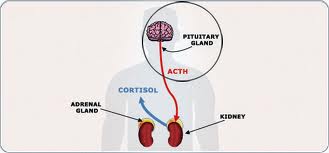
A: It sounds very much like you have Cushing’s syndrome, which is caused by excess cortisone, a hormone that has many effects. It is called Cushing’s disease when the underlying cause is a pituitary tumor that causes the adrenal gland to make excess cortisone. (Cortisone and cortisol are different names for the same chemical, also called a glucocorticoid.) Cushing’s syndrome also may be caused by an adenoma (benign tumor) of the adrenal gland, which sounds like the case in you.

The high amounts of cortisone produced by the adrenal tumor cause high blood pressure, glucose intolerance or frank diabetes, increased hunger, obesity (especially of the abdomen – large bellies and skinny limbs are classic), dark-colored striae (stretch marks), easy bruising, a reddish face and often weakness of arm and leg muscles. When full-blown, the syndrome is easy to spot, but many people don’t have all the characteristics, especially early in the course of the disease.

Your endocrinologist is the expert in diagnosis and management, and has done most of the tests. I am somewhat surprised that you haven’t yet seen a surgeon to have the tumor removed. Once it is removed, the body quickly starts to return to normal, although losing the weight can be a problem for many.

I have seen cases in my training where, despite many tests, the diagnosis was still uncertain. The endocrinologist orders a test where the blood is sampled from both adrenal veins (which contain the blood that leaves the adrenal glands on top of the kidneys). If the adrenal vein on the side of the tumor has much more cortisone than the opposite side, the diagnosis is certain.

By DR. KEITH ROACH For the Herald & Review at http://herald-review.com/news/opinion/editorial/columnists/roach/dr-roach-cushing-s-disease-best-treated-by-endocrinologist/article_38e71835-464d-5946-aa9c-4cb1366bcee3.html

Past News Items: My 37-year-old daughter has Addison’s disease.

old-news


Because, sometimes Old News is still valid!

From Tuesday, September 16, 2008

DEAR DR. DONOHUE: My 37-year-old daughter has Addison’s disease. Many doctors saw her when she was hospitalized a year ago. She had to go back to the hospital because of stomach upset, back pain and dehydration. Her skin has darkened. She was told she would be fine after she started steroids. This hasn’t happened. She is constantly sick. Do you have any good news? — L.K.

ANSWER: With Addison’s disease, the adrenal glands have stopped producing their many hormones. Those hormones include cortisone and aldosterone. Cortisone gives us energy, combats inflammation and figures into many of the body’s most important functions. Aldosterone is essential for blood pressure maintenance. Without adrenal gland hormones, the skin darkens, especially the elbow skin and the creases in the hands.

Treatment is straightforward: Replace the missing hormones. Maybe the dosage of her hormone medicines needs revision. If she’s hasn’t shortly turned the corner, she should get a second opinion from an endocrinologist, a specialist in this kind of illness.

From http://www.kilgorenewsherald.com/news/2008/0916/advice/009.html

HOME | Sitemap | Adrenal Crisis! | Abbreviations | Glossary | Forums | Donate | Bios | Add Your Bio | Add Your Doctor | MemberMap | CushieWiki

Why Was This Woman Gaining Weight Despite Her Diet?

“I just can’t seem to lose weight,” the 59-year-old woman said quietly. She had tried everything, she told the young doctor, who was training to be an endocrinologist at Mount Sinai Hospital in New York City. Weight Watchers. Exercise. She ate more vegetables, less fat, then fewer carbs. But still she was gaining weight, 30 pounds during the past seven months, including 12 in the past two weeks. She had never been skinny, she continued, but shapely. In her mid-40s, she started gaining weight, slowly at first, then rapidly. She was considering bariatric surgery, but she wanted to make sure she wasn’t missing something obvious. She had low thyroid hormones and had to take medication. Could her thyroid be off again?

The doctor asked her about symptoms associated with a low thyroid-hormone level. Fatigue? Yes, she was always tired. Changes in her hair or skin? No. Constipation? No. Do you get cold easier? Never. Indeed, these days she usually felt hot and sweaty.

It was probably not the thyroid, the doctor said. She asked if the woman had any other medical problems. She had high blood pressure and high cholesterol — both well controlled with medications. She also had obstructive sleep apnea, a disorder in which the soft tissue at the back of the throat collapse during sleep, cutting off air flow and waking the person many times throughout the night. She had a machine that helped keep her airway open, and she used it every night. She also had back pain, knee pain and carpal-tunnel syndrome. The pain was so bad that she had to retire from her job years before she was ready.

Big, Bigger, Biggest

The doctor examined her, then went to get Dr. Donald Smith, an endocrinologist and director of lipids and metabolism at Mount Sinai’s cardiovascular institute. After hearing a summary of the case, Smith asked the patient if she had anything to add. She did: She didn’t understand why she was getting so much bigger. Her legs were huge. She used to have nice ankles, but now you could hardly see them. Her doctor had given her a diuretic, but it hadn’t done a thing. Everything was large — her feet, her hands, even her face seemed somehow bigger. She hardly recognized the woman in the mirror. Her doctors just encouraged her to keep trying to lose weight.

Worth a Thousand Words

“Let me show you a picture,” she said suddenly and reached over to her purse. The patient’s sister had made a comment recently that led the patient to wonder whether the changes she saw in the mirror were more than simple aging. The patient pulled out a photograph of an attractive middle-aged woman and handed it to Smith. That was me eight years ago, she told him. Looking at the two faces, it was hard to believe they belonged to the same woman. Smith suspected this was something more than the extra pounds.

Two possibilities came to mind. Each was a disease of hormonal excess; each caused rapid weight gain. The first was Cushing’s disease, caused by overproduction of one of the fight-or-flight hormones, cortisol. The doctor looked at the patient, seeking clues. On her upper back, just below her neck, the woman had a subtle area of enlargement. This discrete accumulation of fat, called a buffalo hump, can occur with normal weight gain but is frequently seen in patients with Cushing’s. Do you bruise more easily these days? he asked. Cushing’s makes the skin fragile. No, she said. Did she have stretch marks on her stomach from the weight gain? The rapid expansion of the abdomen can cause the fragile skin to develop dark purple stretch lines. No. So maybe it wasn’t Cushing’s.

Find out the answer at http://www.nytimes.com/interactive/2016/04/17/magazine/17mag-diagnosis.html#/#7

Pituitary Incidentaloma Treatment Guideline

0276f-pituitary-gland


It is unclear how many people have pituitary incidentaloma, but imaging and autopsy studies indicate they are quite common and occur in up to one-third of patients. Fortunately, the vast majority of these serendipitously discovered tumors are clinically insignificant.

A management guideline in the Annals of Endocrinology brings endocrinologists up to date on current thinking about pituitary incidentaloma management.   Endocrinologists classify these tumors as micro- or macro-. Microincidentalomas are discovered in around 10% of patients, often upon CT after a fall, and are less than 1 cm in diameter. They may grow, but only 5% proceed to macroincidentaloma.

Currently, experts recommend assessing nonfunctioning (NF) microincidentaloma clinically for signs of hypersecretion (hyperprolactinemia, acromegaly or Cushing’s syndrome), with subsequent systematic prolactin and IGF-1 assay.   Pituitary incidentalomas that are larger than 1 cm at discovery—macroincidentalomas—are more likely to grow, with 25% and 24%-40% of patients having larger tumors at 4 and 8 years after diagnosis respectively.

Concerns escalate and closer surveillance is needed if a macroadenoma is in contact with the optic chiasm. With any NF macroincidentaloma, experts recommend assessing patients for signs of hormonal hypersecretion or hypopituitarism. Then, laboratory screening for hypersecretion or hormonal deficiency is needed, as is ophthalmologic assessment (visual acuity and visual field) if the lesion is near the optic chiasm (OC).   Surveillance differs by tumor size, with 5 mm the cutoff for NF microincidentaloma.

Tumors smaller than that require no surveillance, and those larger need to be monitored with MRI at 6 months and then 2 years. Endocrinologists should revisit macroincidentaloma distant from the optic chiasm with MRI at 1 year and conduct hormonal exploration (for anterior pituitary deficiency), then monitor every 2 years.   Proximity to the optic chiasm often creates a need for surgery or increased vigilance. MRI is recommended at 6 months, with hormonal and visual assessment, then annual MRI and hormonal and visual assessment every 6 months.

Specific types of pituitary incidentaloma call for surgery: evolutive NF microincidentaloma, NF macroincidentaloma associated with hypopituitarism or showing progression, incidentaloma compressing the optic chiasm, possible malignancy, non-compliant patient, pregnancy desired in the short-term, or context at risk of apoplexy.

Few guidelines are published for pituitary incidentaloma, and this one is enhanced with a decision tree that walks endocrinologist through the recommendations. –

See more at: http://www.hcplive.com/medical-news/pituitary-incidentaloma-treatment-guideline#sthash.0DqxeTru.dpuf

Given Adrenal Symptoms, Blood Test Recommended

adrenal-glands


Q: My husband’s recent CT scan of his stomach and digestive system revealed that he has nodules on both adrenal glands. It was suggested that he undergo a blood test to determine whether the nodules are producing hormones.

For 21 months, he has experienced high blood pressure, nausea, diarrhea, anxiety and abdominal pain. Could this be the source of his problems? If so, what course of action would you recommend?

A: The adrenal gland is responsible for the production of several essential hormones.

Tumors, or nodules, of the adrenal glands are common. They can be categorized into those that make hormones and those that don’t, and also by whether the tumors are benign or malignant.

The most common, by far, are benign, nonfunctioning tumors. These are usually discovered on an ultrasound or a CT scan obtained for some other reason.

More than 4 percent of people have an adrenal mass, and 85 percent are nonfunctional.

The symptoms that your husband has, however, raise a concern that he might have a hormone-producing tumor.

Four types of hormones are commonly produced by adrenal tumors: cortisone, aldosterone, sex hormones (estrogen or androgens) and catecholamines (epinephrine and norepinephrine).

A cortisone-producing adrenal tumor causes Cushing’s syndrome. It usually causes weight gain, especially in the abdomen; skin changes, including striae, or “stretch marks”; high blood pressure; and a predisposition to diabetes. Anxiety and abdominal pain are uncommon.

Aldosterone raises blood pressure, so a person with a functioning adrenal tumor making aldosterone usually has high blood pressure, but the other symptoms you mention for your husband aren’t common for this type of tumor.

Adrenal tumors that make epinephrine and the related norepinephrine are called pheochromocytomas. Hypertension is almost universal with this condition, and anxiety is frequently reported.

Tumors that produce sex hormones are rare, and they are present in men with androgen excess or feminization, in the case of estrogen-secreting tumors.

Although your husband’s symptoms aren’t specific for any one condition, the combination of his symptoms and adrenal nodules concerns me.

I agree with the recommendation to look for excess amounts of hormones in the blood. This can often be achieved with a simple blood test; however, a catheter is occasionally placed in the adrenal vein to sample blood coming from the gland (and its nodule) directly.

By comparing one side against the other, doctors can determine which side might be producing excess hormones.

An endocrinologist is the expert most likely to be familiar with these conditions.

Dr. Roach answers letters only in his North America Syndicate column but provides an order form of available health newsletters at http://www.rbmamail.com. Write him at 628 Virginia Dr., Orlando, FL 32853-6475; or ToYour GoodHealth@med. cornell.edu.

From http://www.dispatch.com/content/stories/life_and_entertainment/2015/07/27/given-adrenal-symptoms-blood-test-recommended.html