Differences Between Cushing’s Syndrome and Cushing’s Disease

What’s the difference between Cushing’s Disease and Cushing’s Syndrome?

disease-syndrome

Cushing’s syndrome is a hormonal disorder

Cortisol is a normal hormone produced in the outer portion of the adrenal glands. When functioning normally, cortisol helps the body respond to stress and change. It mobilizes nutrients, modifies the body’s response to inflammation, stimulates the liver to raise blood sugar, and helps control the amount of water in the body. Cortisol production is regulated by the adrenocorticotrophic hormone (ACTH), produced in the pituitary gland. Spontaneous overproduction of cortisol in the adrenals is divided into two groups – those attributed to an excess of ACTH and those that are independent of ACTH.

Cushing’s syndrome is the term used to describe a group of symptoms that occur when a persons’ cortisol levels are too high (known as hypercortisolism) for too long. The majority of people have Cushing’s syndrome because they are regularly taking certain medicine(s) that continually add too much cortisol to the body. Doctors call this an “exogenous” (outside the body) cause of Cushing’s syndrome. Other people have Cushing’s syndrome because something is causing the adrenal gland(s) to overproduce cortisol. Doctors call this an “endogenous” (inside the body) cause of Cushing’s syndrome.

Cushings-causes.png

Cushing’s disease is a form of Cushing’s syndrome

Cushing’s disease is the most common form of endogenous Cushing’s syndrome. It is caused by a tumor in the pituitary gland that secretes excessive amounts of a hormone called Adrenocorticotropic hormone, or ACTH. Fortunately, this type of tumor is typically benign. Unlike a cancerous (malignant) tumor, a benign tumor stays in its original location and will not spread. After you are diagnosed with Cushing’s syndrome, it is important that your doctor continues the diagnostic process to determine the cause of hypercortisolism.

From the message boards It is not only a tumor that causes Cushings Disease—many of us have the rarer form of this rare disease which is Pituitary Hyperplasia. It also causes CD and may be nodular (shown on MRI s a tumor) or dispersed (meaning spread throughout the gland).

How a pituitary tumor causes Cushing’s disease

Pituitary.jpg

ACTH is a hormone produced in your pituitary gland. ACTH travels to your adrenal glands and signals them to produce cortisol.

Pituitary adenomas are benign tumors of the pituitary gland which secrete increased amounts of ACTH, causing excessive cortisol production. Most patients have a single adenoma. First described in 1912 by neurosurgeon Harvey Cushing in his book The Pituitary Body and its Disorders, Cushing’s disease is the most common cause of spontaneous Cushing’s syndrome, accounting for 60 to 70 percent of cases.

If a person has Cushing’s disease, it means that a group of abnormal cells has built up in the pituitary gland to form an ACTH-producing pituitary tumor. These abnormal cells produce ACTH, just as normal pituitary gland cells do—only far too much. The excess ACTH travels to adrenal glands. The adrenal glands are then bombarded with signals to produce more and more cortisol. As a result, the adrenal glands continuously secrete too much cortisol.

Ectopic ACTH Syndrome

Some benign or malignant (cancerous) tumors that arise outside the pituitary can produce ACTH. This condition is known as ectopic ACTH syndrome. Lung tumors cause more than 50 percent of these cases. Other less common types of tumors that can produce ACTH are thymomas, pancreatic islet cell tumors, and medullary carcinomas of the thyroid.

Adrenal Tumors

Adrenal glands.jpg

An abnormality of the adrenal glands such as an adrenal tumor may cause Cushing’s syndrome. Most of these cases involve non-cancerous tumors called adrenal adenomas, which release excess cortisol into the blood.

Adrenocortical carcinomas, or adrenal cancers, are the least common cause of Cushing’s syndrome. Cancer cells secrete excess levels of several adrenal cortical hormones, including cortisol and adrenal androgens. Adrenocortical carcinomas often cause very high hormone levels and rapid onset of symptoms.

Familial Cushing’s syndrome

Most cases of Cushing’s syndrome are not genetic. However, some individuals may develop Cushing’s syndrome due to an inherited tendency to develop tumors of one or more endocrine glands. In Primary Pigmented Micronodular Adrenal Disease, children or young adults develop small cortisol-producing tumors of the adrenal glands. In Multiple Endocrine Neoplasia Type I (MEN I), hormone secreting tumors of the parathyroid glands, pancreas and pituitary occur. Cushing’s syndrome in MEN I may be due to pituitary, ectopic or adrenal tumors.

Risk factors

Obesity, type 2 diabetes, poorly controlled blood glucose (blood sugar levels), and high blood pressure may increase the risk of developing this disorder.

Adapted from http://www.cushiewiki.com/index.php?title=Cushing%27s_Disease_or_Syndrome

When to think Cushing’s syndrome in type 2 diabetes

ESTES PARK, COLO. – Diabetes mellitus, osteoporosis, and hypertension are conditions that should boost the index of suspicion that a patient with some cushingoid features may in fact have endogenous Cushing’s syndrome, Dr. Michael T. McDermott said at a conference on internal medicine sponsored by the University of Colorado.

An estimated 1 in 20 patients with type 2 diabetes has endogenous Cushing’s syndrome. The prevalence of this form of hypercortisolism is even greater – estimated at up to 11% – among individuals with osteoporosis. In hypertensive patients, the figure is 1%. And among patients with an incidentally detected adrenal mass, it’s 6%-9%, according to Dr. McDermott, professor of medicine and director of endocrinology and diabetes at the University of Colorado.

“Endogenous Cushing’s syndrome is not rare. I suspect I’ve seen more cases than I’ve diagnosed,” he observed. “I’ve probably missed a lot because I failed to screen people, not recognizing that they had cushingoid features. Not everyone looks classic.”

There are three screening tests for endogenous Cushing’s syndrome that all primary care physicians ought to be familiar with: the 24-hour urine cortisol test, the bedtime salivary cortisol test, and the overnight 1-mg dexamethasone suppression test.

“I think if you have moderate or mild suspicion, you should use one of these tests. If you have more than moderate suspicion – if a patient really looks like he or she has Cushing’s syndrome – then I would use at least two screening tests to rule out endogenous Cushing’s syndrome,” the endocrinologist continued.

The patient performs the bedtime salivary cortisol test at home, obtaining samples two nights in a row and mailing them to an outside laboratory. The overnight dexamethasone suppression test entails taking 1 mg of dexamethasone at bedtime, then measuring serum cortisol the next morning. A value greater than 1.8 mcg/dL is a positive result.

Pregnant women constitute a special population for whom the screening method recommended in Endocrine Society clinical practice guidelines (J. Clin. Endocrinol. Metab. 2008;93:1526-40) is the 24-hour urine cortisol test. That’s because pregnancy is a state featuring high levels of cortisol-binding globulins, which invalidates the other tests. In patients with renal failure, the recommended screening test is the 1-mg dexamethasone suppression test. In patients on antiepileptic drugs, the 24-hour urine cortisol or bedtime salivary cortisol test is advised, because antiseizure medications enhance the metabolism of dexamethasone.

Dr. McDermott said that “by far” the most discriminatory clinical features of endogenous Cushing’s syndrome are easy bruising, violaceous striae on the trunk, facial plethora, and proximal muscle weakness.

“They’re by no means specific. You’ll see these features in people who don’t have Cushing’s syndrome. But those are the four things that should make you really consider Cushing’s syndrome in your differential diagnosis,” he stressed.

More widely recognized yet actually less discriminatory clinical features include facial fullness and the “buffalo hump,” supraclavicular fullness, central obesity, hirsutism, reduced libido, edema, and thin or poorly healing skin.

Endogenous Cushing’s syndrome can have three causes. An adrenocorticotropic hormone (ACTH)-secreting pituitary adenoma accounts for 80% of cases. A cortisol-secreting adrenal tumor is the cause of 10%. And another 10% are due to an ectopic ACTH-secreting tumor, most commonly a bronchial carcinoid tumor.

Once the primary care physician has a positive screening test in hand, it’s typical to refer the affected patient to an endocrinologist in order to differentiate which of the three causes is present. This is accomplished based upon the results of a large, 8-mg dexamethasone suppression test coupled with measurement of plasma ACTH levels.

Dr. McDermott recommended as a good read on the topic of evaluating a patient with endogenous Cushing’s syndrome a recent review article that included a useful algorithm (N. Engl. J. Med. 2013;368:2126-36).

He reported having no financial conflicts.

bjancin@frontlinemedcom.com

From http://www.clinicalendocrinologynews.com

Cushing’s Syndrome is Hazardous to Your Health

morbidity

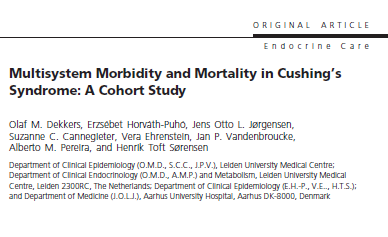
People with Cushing’s syndrome, even when treated, have higher morbidity and mortality rates that comparable controls. That is the conclusion of a new study published in the June issue of the Journal of Clinical Endocrinology Metabolism. The study by Olaf Dekkers et al, examined data records from the Danish National Registry of Patients and the Danish Civil Registration System of 343 patients with benign Cushing’s syndrome of adrenal or pituitary origin (i.e., Cushing’s disease) and a matched population comparison cohort (n=34,300).  Due to the lengthy delay of many patients being diagnosed with Cushing’s syndrome, morbidity was investigated in the 3 years before diagnosis while  morbidity and mortality were assessed during complete follow-up after diagnosis and treatment.

The study found that mortality was twice as high in Cushing’s syndrome patients (HR 2.3, 95% CI 1.8-2.9) compared with controls over a mean follow-up period of 12.1 years. Furthermore, patients with Cushing’s syndrome were at increased risk for:

  • venous thromboembolism (HR 2.6, 95% CI 1.5-4.7)
  • myocardial infarction (HR 3.7, 95% CI 2.4-5.5)
  • stroke (HR 2.0, 95% CI 1.3-3.2)
  • peptic ulcers (HR 2.0, 95% CI 1.1-3.6)
  • fractures (HR 1.4, 95% CI 1.0-1.9)
  • infections (HR 4.9, 95% CI 3.7-6.4).

The study also found that this increased multimorbidity risk was present before diagnosis indicating that it was due to cortisol overproduction rather than treatment.

Many of the Cushing’s syndrome patients underwent surgery to remove the benign tumor. For this group, the investigators performed a sensitivity analysis of the  long-term mortality and cardiovascular risk in this  subgroup (n=186)  considered to be cured after operation (adrenal surgery and patients with pituitary surgery in combination with a diagnosis of hypopituitarism in the first 6 months after operation).  The risk estimates for mortality (HR 2.31, 95% CI 1.62-3.28), venous thromboembolism (HR 2.03, 95% CI 0.75-5.48), stroke (HR 1.91, 95% CI 0.90-4.05), and acute myocardial infarction (HR 4.38, 95% CI 2.31-8.28) were also increased in this subgroup one year after the operation.

The standard treatment for endogenous Cushing’s syndrome is surgery. This past year, Signifor (pasireotide) was approved for treatment of adults patients with Cushing’s disease for whom pituitary surgery is not an option or has not been curative.  Cushing’s disease, which accounts for the majority of Cushing’s syndrome patients, is defined as the presence of an ACTH producing tumor on the pituitary grand. In the study by Dekker’s et al, the percentage of patients with Cushing’s disease is not known. We look forward to reexamination of this dataset in a few years following the introduction of more treatment options for Cushing’s disease as well as an analysis that explores the differences in mortality/morbidity rates in the different subsets of patients that make of Cushing’s syndrome (Cushing’s disease, ectopic Cushing’s syndrome, Exogenous Cyshing’s syndrome).

References

Dekkers OM, Horvath-Pujo, Jorgensen JOL, et al, Multisystem morbidity and mortality in Cushing’s syndrome: a cohort study. J Clin Endocrinol Metab 2013 98(6): 2277–2284. doi: 10.1210/jc.2012-3582

– See more at: http://www.raredr.com/medicine/articles/cushing%E2%80%99s-syndrome-hazardous-your-health-0

PharmaForm announces commercial manufacturing contract for Corcept’s Korlym™

PharmaForm announced  that Corcept Therapeutics Inc. has chosen PharmaForm as their primary commercial manufacturer for their newly approved drug product, Korlym™. The U.S. Food and Drug Administration approved Corcept’s Korlym™ on February 17th, 2012 for patients with endogenous Cushing’s syndrome.

PharmaForm, a full-service contract provider of development and manufacturing for the pharmaceutical and biotech industry, has worked with Corcept for several years as a contract provider for services in the development, optimization and validation of the manufacturing process for Corcept’s Korlym™.

Read the entire article here: http://www.marketwatch.com/story/pharmaform-announces-commercial-manufacturing-contract-for-corcepts-korlym-2012-03-26