Through The Art Of Makeup, People With Rare Pituitary Disorders Now Have Unique Resources To Help Address Common Physical And Emotional Changes

Did you know that applying contour powder on certain areas of your face, like the outer rim of the jaw, along the hairline or along the hollows of the cheek, can help make enlarged features less noticeable? Seems like a basic makeup tip, right? Well, to a person with a pituitary disorder that dramatically changes one’s facial features, this type of information may make a major difference – not only physically, but also psychologically.

This is why Novartis has teamed up with Kevyn Aucoin Beauty (KAB) to bring The Highlights Project to those living with acromegaly and Cushing’s disease. The program offers a variety of virtual tools such as makeup suggestions from professional artists and video demonstrations. These resources address common concerns expressed by patients while also educating about these rare, but serious pituitary disorders.

Kevyn Aucoin, founder of KAB and famed Hollywood makeup legend, was diagnosed with acromegaly in 2001 at the age of 40 and passed away less than 12 months later. Aucoin believed in the transformative nature of makeup and saw it as a reflection of both inner and outer beauty. In this spirit, The Highlights Project features a series of makeup tutorials, tips and inspirations designed to help enhance the self-image of pituitary patients. The program also includes the perspective of a psychotherapist who specializes in helping patients with acromegaly and Cushing’s disease.

Like so many other people with acromegaly and Cushing’s disease, Kevyn went undiagnosed for years and faced both emotional and physical challenges as a result of his condition. “Through Kevyn Aucoin Beauty’s partnership with Novartis on The Highlights Project, we hope that we can inspire others living with these pituitary disorders to see their own beauty and view makeup as Kevyn did, not as a mask, but as a tool for discovery,” said Desiree Tordecilla, Executive Vice President, Kevyn Aucoin Beauty.

Acromegaly and Cushing’s disease are pituitary disorders caused by the presence of a noncancerous tumor on the pituitary gland. The symptoms often include highly visual physical changes in the body. For people with acromegaly, enlarged facial features, jaw and brow protrusions, thickening of the skin and skin tags are common. People with Cushing’s disease frequently experience uncontrollable weight gain, facial fullness and redness, a buffalo hump, acne and oily skin. Beyond the external physical changes, these conditions often also cause serious health complications such as cardiovascular issues, fatigue, muscle weakness and cognitive changes. Those living with uncontrolled acromegaly and Cushing’s disease are also at an increased risk of death. Due to the rare nature of these diseases, receiving an accurate diagnosis can be difficult and may take several years – therefore, education and awareness is critical.

The Highlights Project aims to provide support and help those with acromegaly and Cushing’s disease manage the physical manifestations and psychosocial challenges often associated with these conditions.

“As someone who was self-conscious about how unfeminine my facial features appeared, I was amazed by the impact the simple makeup tricks I picked up from The Highlights Project had on my self-esteem,” said Shannon Goodson, who was diagnosed with acromegaly in 2008. “Staying positive, educating yourself about the condition and monitoring hormone levels to ensure the disease is under control are the first steps to empowering yourself and understanding that you are so much more than your diagnosis.”

The mission of The Highlights Project is to help put a face to the challenges those with acromegaly and Cushing’s disease may encounter and serve as a vessel for learning. Novartis is committed to helping to transform the care of rare pituitary conditions and bringing meaningful solutions to patients. To help support acromegaly and Cushing’s disease patients, and learn more about The Highlights Project, visit TheHighlightsProject.com. For more information about these diseases, visit AcromegalyInfo.com and CushingsDisease.com.
Read more from Journal Sentinel: http://www.jsonline.com/sponsoredarticles/health-wellness/through-the-art-of-makeup-people-with-rare-pituitary-disorders-now-have-unique-resources-to-help-address-common-physical-and-emotional-changes8087390808-251841151.html#ixzz2wtDUV9iF


Botch-up Costs Doctor an Adrenal Gland

Chennai, India: The state consumer forum has asked a Coimbatore hospital to pay 15 lakh to a doctor whose adrenal gland was surgically removed after a botched-up diagnosis.

In May 2006, A Indumathi, an ophthalmologist, started showing symptoms like rapid weight gain, hypertension, joint pain, puffiness of face and fatigue. She approached Kovai Medical Centre & Hospital in Coimbatore, where the consultant endocrinologist conducted various tests. Her condition was diagnosed as Cushing’s syndrome, a hormonal disorder, and she was advised to undergo surgery for removal of the left adrenal gland.

On September 18, she was operated on. However, the symptoms persisted and the doctor told her it would take some more time to get relief. She waited three more months, but when her condition worsened, she approached the doctor again. He asked her to undergo another surgery for removing her right adrenal gland.

Not willing to take a chance, Indumathi approached Christian Medical College, Vellore, in December, where doctors told her she was suffering from Cushing’s disease, not syndrome. After a month of treatment, she recovered.

She then approached the state commission saying she was misdiagnosed and because of the wrong surgery, she has to regularly go for blood tests for the rest of her life and could develop life-threatening complications. She said she also incurred medical expense of around 5 lakh and had to leave her medical practice for six months.

Denying the charges, the hospital said tests conducted on her showed she was suffering from Cushing’s syndrome. She, being a doctor, was aware of the test reports and gave consent for surgery, it said.

The state consumer disputes redressal commission bench comprising its president Justice(rtd )RRegupati and judicial member J Jayaram, in a recent order, said after a wrong diagnosis and surgery, the hospital should have been more diligent in reassessment but instead suggested removing the right adrenal gland. The bench said the hospital wrongly diagnosed her and removed “a precious, healthy adrenal gland.”

Stating it was a case of “gross negligence and deficiency in service,” the bench asked the hospital and two doctors to pay Indumathi 4 lakh towards medical and travelling expense, 1 lakh for loss of professional income and 10 lakh for “lifelong mental agony.”

From http://timesofindia.indiatimes.com/city/chennai/Botch-up-costs-doctor-a-gland-hospital-fined-Rs-15-lakh/articleshow/29925290.cms

Remaining calm = Reducing illness

Have you ever noticed that when you are “stressed” you can feel either emotionally/physically depleted or energized?  When our body is under stress the brain responds by producing epheniphrine or adrenaline, sending signals to our adrenal glands, increasing the rate at which our heart beats while releasing oxygen to our muscles.  The long term response to this process produces cortisol (aka the stress hormone) facilitating the release of energy throughout our body.  However, when our body isn’t properly balanced these hormones can wreak havoc on our wellness possibly resulting in one of three conditions:  Cushing’s syndrome, Cushing’s disease or Addison’s disease.

adrenal-glandsThe actual Adrenal glands sit physically atop both kidneys, taking on a triangular shape and a roundish rectangular type shape.  These glands are responsible for our sex hormones and cortisol, helping us respond to stress amongst other functions.  When our body is under stress, physically and/or nutritionally, it responds one of two ways:  Produces too much or too little of the cortisol hormone.  Our Adrenal glands also contribute to regulating our blood sugar, blood pressure, salt and water.

Adrenal disorders can cause our body to make too much or not enough of these hormones, bringing about adrenal gland related syndromes and disease.  Cushing’s syndrome results from our body making too much versus Addison’s disease produces too little.

Cushing’s syndrome vs. Cushing’s disease

Glucocorticoids (naturally produced in our body or received through medicine) are groups of corticosteroids (cortisol or dexamethasone) involved in metabolizing our carbohydrate and protein.  When taken synthetically (i.e. treatment of allergies, skin problems, and respiratory problems) or over-produced naturally, the side effects can result in “Cushing’s syndrome”.

Cushing’s syndrome can occur one of two ways:  Endogenous or Exogenous.  Endogenous is caused by the body (usually through tumors).  Exogenous is caused by medication.  In both cases, the body produces too much cortisol.

Symptoms: Severe fatigue/muscle weakness, high blood sugar and high blood pressure, upper body obesity, thin arms/legs, bruising easily

Treatment:  The cure and treatment for Cushing’s disease can come through medicine, surgery, or by lowering the dosage of your current synthetic hormone treatment.  Cushing’s syndrome can be cured.

Cushing’s disease is the most common form of endogenous Cushing’s syndrome and is likely treatable.  Caused by a tumor in the pituitary gland secreting too much Adrenocorticotropic hormone (ACTH), this type of tumor does not spread and can be removed through surgery.

Nutrition:  See a nutritionist or dietician for your condition.  Mostly, avoid excess sodium.  High blood sugar (hyperglycemia) and high blood pressure can easily occur with this condition.  Bone loss density is common with this condition, so be extra aware of your calcium (800 – 1200 mg per day, based upon age) and Vitamin D intake (5mcg from age 0-50, increasing up to 10 mcg 50-71, and 15 mcg after 71).  Eating healthy, balanced and whole food (versus processed) is extremely important.

(Resource:  http://www.aboutcushings.com/understanding-cushings-disease/causes-and-differences.jsp)

Addison’s disease

Opposite from Cushing’s syndrome, Addison’s disease doesn’t make “enough” of the sex hormones and cortisol.  The result of this disease causes our immune system to attack our tissue, damaging our adrenal glands.

Symptoms:  Weight loss, muscle weakness, increasingly worse fatigue, low blood pressure and patchy or dark skin.

Treatment:  If left untreated, the condition can be fatal.  Lifetime hormone treatment is usually required. Addison disease patients should always carry medical/emergency ID on them, listing their medication, dosage and disease

Lab tests can confirm that you have Addison’s disease. If you don’t treat it, it can be fatal. You will need to take hormone pills for the rest of your life. If you have Addison’s disease, you should carry an emergency ID. It should say that you have the disease, list your medicines and say how much you need in an emergency.”

(Ref: http://www.nlm.nih.gov/medlineplus/cushingssyndrome.html, NIH: National Institute of Neurological Disorders and Stroke)                                                                                                                                                                                                                                        Learning how to balance our stress-filled lives is extremely important to our overall health.  Healthy nutrition always contributes benefits to our overall wellness.  We can overwhelm our endocrine system by simply not eating nutritionally.  Understanding that “Food is a drug” is vitally important to how we help our body naturally heal itself.  The above two conditions are the result of our body not handling the stress we are putting it through, causing our body to producing too much or too little of the sex hormones and cortisol.

Unless we first address what we can do naturally through nutrition, the medicine we consume will only do so much in helping our body heal completely.  You simply cannot continue doing the same thing over and over again, expecting the medicine to do all the work.  Some diseases are brought upon us through our environment (emotionally as well as physically) as well as our diet/nutrition.  Reviewing our entire wellness is always wisdom whenever we’re diagnosed with anything.

Certainly listen to your doctor and their advice.  But also ask your doctor to refer you to a nutritionist or clinical/registered dietician for a complete evaluation that includes a review of your nutritional diet/wellness.  Too often we reach for a pill or a procedure to “fix” our health problems, ignoring what we should be doing on our own to help our body heal.  Medical intervention is the result of providing our body with what it cannot produce on its own.  Nutrition should always be the “natural” medicine we take, as well as what we might need through prescribed medication.

Adapted from (Spelling errors corrected) http://hamptonroads.com/2013/10/remaining-calm-reducing-illness

Prince George’s woman works to raise awareness about rare disease

Lanham resident to speak at Patient Education Day event about Cushing’s disease

By Sophie Petit Staff Writer
stacy

Greg Dohler/The Gazette

Lanham resident Stacey L. Hardy, a survivor of Cushing’s disease, will speak about her experience with the pituitary disorder at an upcoming event at Johns Hopkins Hospital.

Stacy L. Hardy of Lanham described herself as athletic, which is why she became concerned when in 1996 she mysteriously gained 240 pounds that took five doctors 14 years to determine she had a potentially fatal disease.

Now Hardy said she wants to raise awareness among others who may unknowingly have Cushing’s disease, but are unaware of the symptoms and treatment.

It wasn’t until 2010 that Hardy, now 43, was diagnosed with the disease, a rare disorder that causes the body to release too much cortisol, the body’s stress or “fight or flight” hormone, said Gary Wand, a pituitary gland specialist at The Johns Hopkins Hospital in Baltimore.

Excess cortisol causes weight gain, especially in the stomach, extreme fatigue, muscle aches, anxiety and depression, he said.

“I didn’t even know what Cushing’s was. I was ready to just live with [the symptoms],” Hardy said, adding that by the time she was diagnosed she felt so tired she could barely move.

At 5 feet, 4 inches tall, Hardy said she reached 365 pounds during her struggle with the disease.

“We knew something for a while wasn’t right, but I never thought it would be something like that,” said Hardy’s daughter, Paij Hardy, 21, a student at Baltimore City Community College.

Just three out of every one million people are diagnosed with Cushing’s each year, said Wand, who estimates he sees 30 patients per year worldwide.

In 2011, Hardy underwent 16 hours of surgery at Sinai Hospital in Baltimore to remove four tumors from her pituitary gland, located at the base of the brain that controls the release of cortisol.

Today, she is 100 pounds lighter, with the weight still rapidly coming off, and said she is determined to serve as a lifelong support and education source for her fellow “cushies” — others with Cushing’s disease.

Hardy will speak Saturday at the Johns Hopkins Pituitary Gland Center’s fifth annual Patient Education Day, an event to raise awareness about the disease, Wand said.

Since the pituitary gland is the size of a kidney bean, Hardy underwent several brain scans before doctors, who previously suggested she might have leukemia or needed to diet and exercise more, could tell there were tumors on her gland, she said.

Hardy’s experience with delayed diagnosis and misdiagnosis is not unique, Wand said.

Cushing’s is a “subtle” disease, which is difficult to diagnose, and not everyone exhibits the same symptoms, he said.

If left untreated for more than a decade, the disease is fatal, but removing the pituitary gland tumors has proved extremely successful, Wand said.

“I’m evidence that there’s help out there,” Hardy said. “I can move. I can almost run. I can bend over and pick up a box. Oh my goodness, I can dance.”

From http://www.gazette.net/article/20130926/NEWS/130929354/1077/prince-george-x2019-s-woman-works-to-raise-awareness-about-rare&template=gazette

Cushing’s Disease – Rare Disease Quick Facts

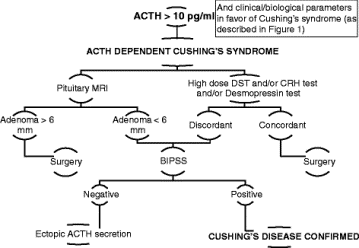
cushings-diagnosis


Cushing’s disease is a rare condition due to excess cortisol levels that result from a pituitary tumor secreting adrenocorticotropic hormone (ACTH), which stimulates cortisol secretion.  Cushing’s disease should not be confused with Cushing’s syndrome which is increased cortisol levels but that increase can be due to any number of factors. However, Cushing’s disease is the most common form of Cushing’s syndrome.

Symptoms

The symptoms related to Cushing’s disease and Cushing’s syndrome are the same, since both are related to an excess of cortisol. Also, symptoms vary extensively among patients and that, with the inherent fluctuation in hormone levels make it difficult to diagnosis both conditions.

Changes in physical characteristics of the body

  • Fullness and rounding of the face
  • Added fat on back of neck (so-called “buffalo hump”)
  • Easy bruising
  • Purplish stretch marks on the abdomen (abdominal striae)
  • Excessive weight gain, especially in abdominal region
  • Red cheeks
  • Excess hair growth on the face, neck, chest, abdomen and thighs

Changes in physiology/psychology

  • Generalized weakness and fatigue
  • Menstrual disorder
  • Decreased fertility and/or sex drive
  • High blood pressure that is often difficult to treat
  • Diabetes mellitus
  • Mood and behavior disorders

Diagnosis

The early stages of Cushing’s disease may be difficult to recognize. However, if it is suspected, diagnosis is generally a 2 stage process. First to determine if cortisol levels are high, and if so, why they are high.

Tests to confirm high cortisol levels:

  • 24-hour urine cortisol
  • Dexamethasone suppression test (low dose)

Tests to determine cause:

  • Blood ACTH level
  • Brain MRI
  • Corticotropin-releasing hormone test
  • Dexamethasone suppression test (high dose)
  • Petrosal sinus sampling

Treatment

Surgery

  • Most patients with Cushing’s disease undergo surgery to remove the pituitary adenoma offers.
  • If the tumor is isolated to the pituitary, cure rates of 80-85% are common.
  • If the tumor has spread to nearby organs, cure rates of 50-55% are common.

Medicine (approved orphan drugs)

Signifor (pasireotide)

  • Approved for patients with Cushing’s disease for whom pituitary is not an option or surgery has been ineffective.
  • Signifor is a somatostatin receptor agonist that leads to inhibition of ACTY secretion (and subsequently decreased cortisol levels).

Korlym (mifepristone)

  • Approved for patients with Cushing’s syndrome who have type 2 diabetes or glucose intolerance and have failed surgery (or not candidates for surgery).
  • Korlym is a glucocorticoid receptor antagonist which in turn blocks the effects of the high levels of cortisol in the body. Korlym is used to treat high glucose levels due to elevated cortisol.

Medicines used but not indicated for Cushing’s disease include

Mitoden

ketoconazole

Metyrapone

Etomidate

Radiation

  • Radiation therapy may be used in some patients and can be very effective in controlling the growth of these tumors.

Prognosis

In most cases, treatment can cure Cushing’s disease. If not treated properly, the chronic hypercortisolism can lead to excess morbidity and mortality due to increased cardiovascular and other risk factors.

For more information

National Library of Medicine, National Institute of Health

Cushing’s Disease Information (provided by Novartis Pharmaceuticals)


Images courtesy of the open access journal Orhanet Journal for Rare Diseases.  Castinetti et al. Orphanet J Rare Dis. 2012 7:41   doi:10.1186/1750-1172-7-41

– See more at: http://www.raredr.com/front-page-medicine/articles/cushings-disease-rare-disease-quick-facts-0