Cushing Syndrome in Children: Growth after Surgical Cure

Cushing syndrome (CS) occurs only rarely in children, but when it does, it causes weight gain and stunting. In young children, adrenal tumors are usually the cause while in adolescents, pituitary tumors are more likely.

The September 2014 issue of Endocrine-Related Cancer examines growth patterns in 19 pediatric patients with ACTH-dependent CS (CD) and 18 patients with a form of ACTH-independent CS, micronodular adrenal hyperplasia (MAH). The researchers gathered data at the time of surgery and also followed up one year later.

Patients in the CD and the MAH groups had similar demographic characteristics, baseline heights and BMI scores before surgery. All patients experienced significant improvements in height and BMI after surgery. Patients with MAH, however, fared significantly better than those with CD and had better post-operative growth.

The researchers propose several reasons:

  • When ACTH-secreting pituitary adenoma requires extensive surgical exploration, remaining pituitary cells often lose some of their function.
  • CD patients tend to be older and have consistent and increased glucocorticoid exposure; they develop vertebral fractures more often leading to compromised skeletal and overall growth potential. MAH patients often have cyclical CS, with intermittent hypercortisolism and an overall milder CS.
  • CD patients often need a longer-than-expected course of therapy with steroids after surgery, which alters metabolism and growth.
  • CD patients have been shown to have advance bone age because of ACTH-induced metabolic changes.

The authors indicate that CS patients are often considered for growth hormone therapy once the underlying problem is corrected. They remind clinicians that MAH patients are less likely to need growth hormone. They recommend close monitoring for CD patients, and early intervention with growth hormone if growth does not meet expectation. –

See more at: http://www.hcplive.com/articles/Cushing-Syndrome-in-Children-Growth-after-Surgical-Cure

Cushing’s Awareness Challenge, Day 3: Symptoms

robin-symptoms


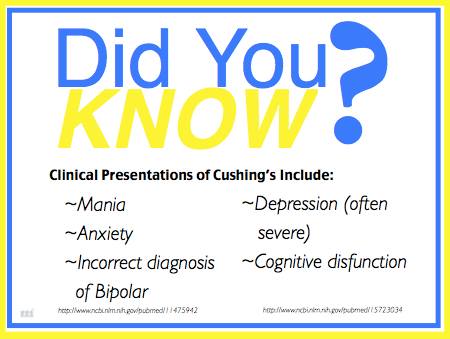
Robin has made another excellent graphic of some of the symptoms of Cushing’s.  There are far too many to be listed in any image, as shown by the list at http://www.cushings-help.com/toc.htm#symptoms


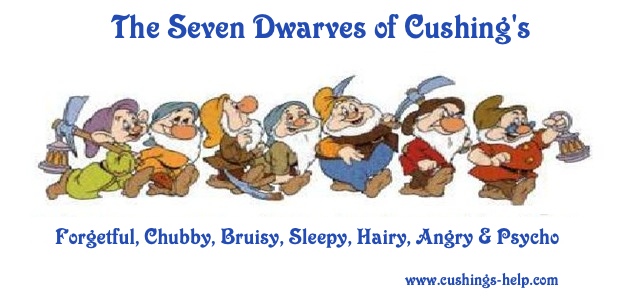
Just to be silly, a few years ago, I did my own version of Cushing’s symptoms:


The Seven Dwarves of Cushing's

Mifepristone in children with refractory Cushing’s disease

Introduction

This study is being done to examine the effects of a medication called mifepristone in children with Cushing’s disease. This medication has been approved by the Food and Drug Administration (FDA) for use in adult patients with Cushing’s syndrome. It is not FDA approved for use in children.

The study will investigate how children’s bodies absorb and process mifepristone, how it works in children and what effect it has on the use of sugar in the body, on the child’s weight and on growth hormone. An important part of the study is to determine the proper dosing and to evaluate the side effects of mifepristone in children.

Children 6 to 17 years old will be enrolled in the study if they have had surgery for Cushing’s disease and currently have elevated cortisol levels.

To get started, please click here.

Headache and pituitary disease A systematic review

Clinical Endocrinology, 08/15/2013  Evidence Based Medicine  Review Article

Kreitschmann–Andermahr I et al. –

English: Cavernous sinus

English: Cavernous sinus (Photo credit: Wikipedia)

Headache is very common in pituitary disease and is reported to be present in more than a third of all patients with pituitary adenomas.

Tumour size, cavernous sinus invasion, traction or displacement of intracranial pain–sensitive structures such as blood vessels, cranial nerves and dura mater, and hormonal hypersecretion are implicated causes.

Some studies suggest that oversecretion of GH and prolactin may be important for the development of headaches and treatment, particularly with somatostatin analogues, has been shown to improve symptoms in these patients.

Otherwise, treatment rests on general treatment options for headaches based an accurate clinical history and a precise classification which includes assessment of the patient’s psychosocial risk factors.

From PubMed

Approach to testing growth hormone (GH) secretion in obese subjects.

Source

Faculty of Medicine, University of Belgrade, Department of Neuroendocrinology, Clinical Center Serbia, Dr Subotic 13, 11000 Belgrade, Serbia. popver@eunet.rs

Abstract

Identification of adults with GH deficiency (GHD) is challenging because clinical features of adult GHD are not distinctive and because clinical suspicion must be confirmed by biochemical tests.

Adults are selected for testing for adult GHD if they have a high pretest probability of GHD, ie, if they have hypothalamic-pituitary disease, if they have received cranial irradiation or central nervous system tumor treatment, or if they survived traumatic brain injury or subarachnoid hemorrhage.

Testing should only be carried out if a decision has already been made that if deficiency is found it will be treated. There are many pharmacological GH stimulation tests for the diagnosis of GHD; however, none fulfill the requirements for an ideal test having high discriminatory power; being reproducible, safe, convenient, and economical; and not being dependent on confounding factors such as age, gender, nutritional status, and in particular obesity.

In obesity, GH secretion is reduced, GH clearance is enhanced, and stimulated GH secretion is reduced, causing a false-positive result. This functional hyposomatotropism in obesity is fully reversed by weight loss. In conclusion, GH stimulation tests should be avoided in obese subjects with very low pretest probability.

PMID:
23650336
[PubMed – in process]

J Clin Endocrinol Metab. 2013 May;98(5):1789-96. doi: 10.1210/jc.2013-1099.

From http://www.ncbi.nlm.nih.gov/pubmed/23650336