Ectopic Cushing’s Syndrome From a Corticotropin-Releasing Hormone-Secreting Medullary Thyroid Carcinoma: a Rare Pitfall af Inferior Petrosal Sinus Sampling

Abstract

Summary

This case report describes a rare presentation of ectopic Cushing’s syndrome (CS) due to ectopic corticotropin-releasing hormone (CRH) production from a medullary thyroid carcinoma (MTC).

The patient, a 69-year-old man, presented with symptoms of muscle weakness, facial plethora, and easy bruising.

An inferior petrosal sinus sampling test (IPSS) demonstrated pituitary adrenocorticotrophic hormone (ACTH) secretion, but a whole-body somatostatin receptor scintigraphy (68Ga-DOTATOC PET/CT) revealed enhanced uptake in the right thyroid lobe which, in addition to a grossly elevated serum calcitonin level, was indicative of an MTC. A 18F-DOPA PET/CT scan supported the diagnosis, and histology confirmed the presence of MTC with perinodal growth and regional lymph node metastasis.

On immunohistochemical analysis, the tumor cell stained positively for calcitonin and CRH but negatively for ACTH. Distinctly elevated plasma CRH levels were documented. The patient therefore underwent thyroidectomy and bilateral adrenalectomy.

This case shows that CS caused by ectopic CRH secretion may masquerade as CS due to a false positive IPSS test. It also highlights the importance of considering rare causes of CS when diagnostic test results are ambiguous.

Learning points

  • Medullary thyroid carcinoma may secrete CRH and cause ectopic CS.
  • Ectopic CRH secretion entails a rare pitfall of inferior petrosal sinus sampling yielding a false positive test.
  • Plasma CRH measurements can be useful in selected cases.

Background

The common denominator of Cushing’s syndrome (CS) is autonomous hypersecretion of cortisol (1) and it is subdivided into ACTH-dependent and ACTH-independent causes. The majority of CS cases are ACTH-dependent (80–85%) with a pituitary corticotroph tumor as the most prevalent cause (Cushing’s disease), and less frequently an ectopic ACTH-producing tumor (2). The gold standard method to ascertain the source of ACTH secretion in CS patients is inferior petrosal sinus sampling (IPSS) with measurement of plasma ACTH levels in response to systemic corticotropin-releasing hormone (CRH) stimulation (3). The IPSS has a very high sensitivity and specificity of 88–100% and 67–100%, respectively (4), but pitfalls do exist, including the rare ectopic CRH-producing tumor, which may yield a false positive test result (3). Here, we describe a very rare case masquerading as CS including a positive IPSS test.

Case presentation

A 69-year-old man presented at a local hospital with a 6-month history of progressive fatigue, muscle weakness and wasting, easy bruising, facial plethora, and fluid retention. His serum potassium level was 2.6 mmol/L (reference range: 3.5–4.2 mmol/L) without a history of diuretics use. His previous medical history included spinal stenosis, benign prostatic hyperplasia, and hypertension. An electromyography showed no sign of polyneuropathy and an echocardiography showed no signs of heart failure with an ejection fraction of 55%. MRI of the spine revealed multiple compression fractures, and the patient underwent spinal fusion and decompression surgery; during this admission he was diagnosed with type 2 diabetes (HbA1c: 55 mmol/mol). After spine surgery, the patient developed a pulmonary embolism and initiated treatment with rivaroxaban.

Establishing the diagnosis of ACTH-dependent CS

Six months after his spine surgery, the patient was referred to the regional department of endocrinology for osteoporosis management. Blood tests revealed a low serum testosterone level with non-elevated luteinizing hormone (LH) and follicle-stimulating hormone (FSH) levels (Table 1). An overnight 1 mg dexamethasone suppression test was positive with a morning cortisol level of 254 nmol/L and three consecutive 24-h urinary cortisol levels were markedly elevated with mean level of ≈600 nmol/24 h (reference range: 12–150 nmol/24 h). A single plasma ACTH was 37 ng/L (Table 1).

Table 1Baseline endocrine assessment.

Parameters Patient’s values Reference range
ACTH, ng/L 37 7–64
UFC, nmol/day 588 12–150
Urinary cortisol, nmol/L 600 171–536
OD, nmol/L 254 <50
Free testosterone, nmol/L 0.061 0.17–0.59
HbA1c, mmol/mol 55 <48
FSH, IU/L 7.4 1.2–15.8
LH, IU/L 2.2 1.7–8.6

ACTH, adrenocorticotropin; FSH, follicle-stimulating hormone; IU, international units; LH, luteinizing hormone; OD, plasma cortisol levels after a 1 mg overnight dexamethasone suppression test; UFC, urine free cortisol hormone.

Differential diagnostic tests

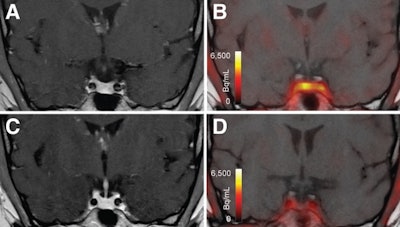
The patient was referred to a tertiary center for further examinations. Ketoconazole treatment was started to alleviate the consequences of hypercortisolism. A pituitary MRI revealed an intrasellar microtumor with a maximal diameter of 6 mm and an IPSS was ordered. A whole-body somatostatin receptor scintigraphy (68Ga-DOTATOC PET/CT) was also performed to evaluate the presence of a potential neuroendocrine tumor. This revealed multiple areas of enhanced uptake including the right thyroid lobe and cervical lymph nodes in the neck (with CT correlates), as well as in the duodenum (with no CT correlate). Concomitantly, a grossly elevated serum calcitonin level of 528 pmol/L (reference range <2.79 pmol/L) was measured.

Subsequently, the IPSS revealed pituitary ACTH secretion with a central-to-peripheral ACTH ratio >3 (Table 2). The right petrosal sinus was not successfully catheterized; thus, lateralization could not be determined.

To corroborate the diagnosis MTC, a 18F-DOPA PET/CT scan (FDOPA) was performed (5), which showed pathologically enhanced uptake in the right thyroid lobe and regional lymph nodes (Fig. 1). An ultrasound-guided core needle biopsy from the thyroid nodule was inconclusive; however, the patient underwent total thyroidectomy and regional lymph node resection, from which histology confirmed the diagnosis of disseminated MTC. Standard replacement with levothyroxine, calcium, and vitamin D was initiated. A blood sample was collected, and genomic DNA was extracted. The DNA analysis for RET germline mutation was negative.

Figure 1View Full Size
Figure 1
18F-DOPA PET/CT scan with pathologically enhanced uptake in the right thyroid lobe (large blue arrow on the left side) and regional lymph nodes (small blue arrows).

Citation: Endocrinology, Diabetes & Metabolism Case Reports 2023, 3; 10.1530/EDM-23-0057

Table 2Results from the inferior petrosal sinus sampling.*

Time (min) Left IPSS Peripheral L/P
-5 42 36 1.2
-1 116 33 3.5
2 120 32 3.8
5 209 28 7.5
7 180 43 4.2
10 529 34 15.6
15 431 37 11.6

*Data represents ACTH levels in ng/L. IPSS Inferior petrosal sampling ACTH Adrenocorticotropin hormone CRH Corticotropin-releasing hormone, L/P Ratio of left (L) inferior petrosal sinus to peripheral venous ACTH concentrations.

Pathology

Total thyroidectomy and bilateral cervical lymph node dissection (level six and seven) were performed. Macroscopic evaluation of the right thyroid lobe revealed a 24 mm, irregular solid yellow tumor. Microscopically the tumor showed an infiltrating architecture with pseudofollicles and confluent solid areas. Calcification was prominent, but no amyloid deposition was seen. The tumor cells were pleomorphic with irregular nuclei and heterogenic chromatin structure. No mitotic activity or necrosis was observed. On immunohistochemical analysis, the tumor cells expressed thyroid transcription factor 1 and stained strongly for carcinoembryonic antigen and calcitonin; tumor cells were focally positive for cytokeratin 19. The tumor was completely negative for ACTH, thyroid peroxidase, and the Hector Battifora mesothelial-1 antigen. Further analysis revealed positive immunostaining for CRH (Fig. 2). The Ki-67 index was very low (0–1%), indicating a low cellular proliferation. Molecular testing for somatic RET mutation was not performed.

Figure 2View Full Size
Figure 2
Histopathological findings and immunohistochemical studies of MTC. (A) Microscopic features of medullary thyroid carcinoma. (B) Polygonal tumor cells (hematoxylin and eosin, ×40). (C) Tumor cells stain for calcitonin (×20). (D) Immunohistochemical stain (×400) for CRH showing cells being positive (brown). (E) Pituitary tissue from healthy control staining positive for ACTH in comparison to (F) ACTH-negative cells MTC tissue from the patient (×20).

Citation: Endocrinology, Diabetes & Metabolism Case Reports 2023, 3; 10.1530/EDM-23-0057

No malignancy was found in the left thyroid lobe and there was no evidence of C-cell hyperplasia. Regional lymph node metastasis was found in 13 out of 15 nodes with extranodal extension.

Outcome and follow-up

Follow-up

Serum calcitonin levels declined after neck surgery but remained grossly elevated (118 pmol/L 3 weeks post surgery) and cortisol levels remained high. Ketoconazole treatment was poorly tolerated and not sufficiently effective. Plasma levels of CRH were measured by a competitive-ELISA kit (EKX-KIZI6R-96 Nordic BioSite), according to the instructions provided by the manufacturer. The intra- and interassay %CV (coefficient of variability) were below 8% and 10%, respectively, and the assay sensitivity was 1.4 pg/mL. The plasma CRH was distinctly elevated compared to in-house healthy controls both before and after thyroid surgery (Fig. 3).

Figure 3View Full Size
Figure 3
Plasma CRH levels before and after total thyroidectomy compared to three healthy controls.

Citation: Endocrinology, Diabetes & Metabolism Case Reports 2023, 3; 10.1530/EDM-23-0057

The patient subsequently underwent uneventful bilateral laparoscopic adrenalectomy followed by standard replacement therapy with hydrocortisone and fludrocortisone. The symptoms and signs of his CS gradually subsided. Pathology revealed bilateral cortical hyperplasia as expected.

The patient continues follow-up at the Department of Oncology and the Department of Endocrinology and Internal Medicine. At 13-month follow-up, 68Ga-DOTATOC shows residual disease with pathologically enhanced uptake in two lymph nodes, whereas the previously described focal DOTATOC uptake in the duodenum was less pronounced (still no CT correlate). Serum calcitonin was 93 pmol/L at the 13-month follow-up.

Discussion

Diagnostic challenges remain in the distinction between pituitary and ectopic ACTH-dependent CS, and several diagnostic tools are used in combination, none of which is infallible, including IPSS (6). Our case and others illustrate that ectopic CRH secretion may yield a false positive IPSS test result (3). Measurement of circulating CRH levels is relevant if an ectopic CRH producing tumor is suspected, but the assay is not routinely available in clinical practice (Lynnette K Nieman M. Measurement of ACTH, CRH, and other hypothalamic and pituitary peptides https://www.uptodate.com/contents/measurement-of-acth-crh-and-other-hypothalamic-and-pituitary-peptides: UpToDate; 2019). In our case, the presence of elevated plasma CRH levels after thyroidectomy strengthened the indication for bilateral adrenalectomy.

The most common neoplasm causing ectopic CS is small-cell lung cancer, whereas MTC accounts for 2–8% of ectopic cases (7). The development of CS in relation to MTC is generally associated with advanced disease and poor prognosis of an otherwise relatively indolent cancer (8), and the clinical progression of CS is usually rapid, why an early recognition and rapid control of hypercortisolemia and MTC is necessary to decrease morbidity and mortality (79). Our case does have residual disease; however, he remains progression-free with stable and relatively low calcitonin levels within 1-year follow-up.

Only a very limited number of cases of ectopic tumors with either combined ACTH and CRH secretion or isolated CRH secretion have been reported, with ectopic CRH secretion accounting for less than 1% of CS (9).

An ACTH- or CRH-producing tumor can be difficult to localize and may include gastric ACTH/CRH-secreting neuroendocrine tumors (9). In our case, the 68Ga-DOTATOC identified a possible duodenal site, in addition to the MTC, but an upper gastrointestinal endoscopy revealed no pathological findings and there was no CT correlate. Thus, we concluded that the most likely and sole source of ectopic CRH was the MTC and its metastases.

To our knowledge, no official guidelines for managing ectopic ACTH-dependent CS have been established. In a recent publication by Alba et al. (10), the authors demonstrated a clinical algorithm (The Mount Sinai Clinical Pathway, MSCP) and recommendation for the management of CS due to ectopic ACTH secretion.

Essentially, our approach in this particular case followed these recommendations, including source location by CT and 68Ga-DOTATATE PET/CT imaging, acute management with ketoconazole, and finally, bilateral adrenalectomy as curative MTC surgery was not possible. In retrospect, performance of the IPSS could be questioned in view of the MTC diagnosis. In real time, however, a pituitary MRI performed early in the diagnostic process revealed a microadenoma, which prompted the IPSS. In parallel, a somatostatin receptor scintigraphy (68Ga-DOTATOC PET/CT) was also done, which raised the suspicion of an MTC.

Conclusion

We report a very rare case of an ectopic CS caused by a CRH-secreting MTC. Although IPSS has stood the test of time in the differential diagnosis of ACTH-dependent CS, this case illustrates a rare pitfall.

Declaration of interest

The authors declare that there is no conflict of interest that could be perceived as prejudicing the impartiality of the research reported.

Funding

This research did not receive any specific grant from any funding agency in the public, commercial, or not-for-profit sector.

Patient consent

Written informed consent for publication of their clinical details was obtained from the patient.

Author contribution statement

JOJ and MJO are the physicians responsible for the patient. LR performed the thyroidectomy and bilateral adrenalectomy. SHM and SLA assessed and reassessed the histopathology and the immunohistochemical analysis. MB measured plasma CRH. VM, JOJ, and MJO drafted the manuscript. All authors contributed to critical revision of the manuscript.

References

Minimally Invasive Approaches Lead to High Remission Rates in Children

Minimally invasive diagnostic methods and transnasal surgery may lead to remission in nearly all children with Cushing’s disease, while avoiding more aggressive approaches such as radiation or removal of the adrenal glands, a study shows.

The study, “A personal series of 100 children operated for Cushing’s disease (CD): optimizing minimally invasive diagnosis and transnasal surgery to achieve nearly 100% remission including reoperations,” was published in the Journal of Pediatric Endocrinology and Metabolism.

Normally, the pituitary produces adrenocorticotropic hormone (ACTH), which stimulates the adrenal glands to produce cortisol. When a patient has a pituitary tumor, that indirectly leads to high levels of cortisol, leading to development of Cushing’s disease (CD).

In transnasal surgery (TNS), a surgeon goes through the nose using an endoscope to remove a pituitary tumor. The approach is the first-choice treatment for children with Cushing’s disease due to ACTH-secreting adenomas — or tumors — in the pituitary gland.

Micro-adenomas, defined as less than 4 mm, are more common in children and need surgical expertise for removal. It is necessary to determine the exact location of the tumor before conducting the surgery.

Additionally, many surgeons perform radiotherapy or bilateral adrenalectomy (removal of both adrenal glands) after the surgery. However, these options are not ideal as they can be detrimental to children who need to re-establish normal growth and development patterns.

Dieter K. Lüdecke, a surgeon from Germany’s University of Hamburg, has been able to achieve nearly 100% remission while minimizing the need for pituitary radiation or bilateral adrenalectomy. In this study, researchers looked at how these high remission rates can be achieved while minimizing radiotherapy or bilateral adrenalectomy.

Researchers analyzed 100 patients with pediatric CD who had been referred to Lüdecke for surgery from 1980-2009. Data was published in two separate series — series 1, which covers patients from 1980-1995, and series 2, which covers 1996-2009. All the surgeries employed direct TNS.

Diagnostic methods for CD have improved significantly over the past 30 years. Advanced endocrine diagnostic investigations, such as testing for levels of salivary cortisol in the late evening and cortisol-releasing hormone tests, have made a diagnosis of CD less invasive. This is particularly important for excluding children with obesity alone from children with obesity and CD. Methods to determine the precise location of micro-adenomas have also improved.

The initial methodology to localize tumors was known as inferior petrosal sinus sampling (IPSS), an invasive procedure in which ACTH levels are sampled from the veins that drain the pituitary gland.

In series 1, IPSS was performed in 24% of patients, among which 46% were found to have the wrong tumor location. Therefore, IPSS was deemed invasive, risky, and unreliable for this purpose.

All adenomas were removed with extensive pituitary exploration. Two patients in series 1 underwent early repeat surgery; all were successful.

Lüdecke introduced intraoperative cavernous sinus sampling (CSS), an improved way to predict location of adenomas. This was found to be very helpful in highly select cases and could also be done preoperatively for very small adenomas.

In series 2, CSS was used in only 15% of patients thanks to improved MRI and endocrinology tests. All patients who underwent CSS had correct localization of their tumors, indicating its superiority over IPSS.

In series 2, three patients underwent repeat TNS, which was successful. In these recurrences, TNS minimized the need for irradiation. The side effects of TNS were minimal. Recurrence rate in series 1 was 16% and 11% in series 2.

While Lüdecke’s patients achieved a remission rate of 98%, other studies show cure rates of 45-69%. Only 4% of patients in these two series received radiation therapy.

“Minimally invasive unilateral, microsurgical TNS is important functionally for both the nose and pituitary,” the researchers concluded. “Including early re-operations, a 98% remission rate could be achieved and the high risk of pituitary function loss with radiotherapy could be avoided.”

From https://cushingsdiseasenews.com/2018/09/04/minimally-invasive-methods-yield-high-remission-in-cushings-disease-children/

New ACTH Detection Method Improves Cure Rates in Cushing’s Disease Patients

Researchers have identified a new, quick method for detecting ACTH-producing tumors – called Elecsys – that can improve the cure rates of Cushing’s disease patients undergoing surgery.

The study, “Long-term outcomes of tissue-based ACTH-antibody assay–guided transsphenoidal resection of pituitary adenomas in Cushing disease,” was published in the Journal of Neurosurgery.

Transsphenoidal resection (TSR) – a surgical procedure performed through the nose and sphenoid sinus to remove a pituitary tumor – has been the method of choice for treatment for Cushing’s disease.

However, it often fails to localize the tumor with precision, leading to an incomplete resection (removal). This is likely a result of the preoperative methods used to guide surgeons before surgery, which include both magnetic resonance imaging (MRI) and a minimally invasive procedure called bilateral inferior petrosal sinus sampling (BIPSS) that measures ACTH in the veins that drain the pituitary gland.

However, both “suffer from suboptimal sensitivity and thus allow for incomplete resections, specially if pathological frozen sections fail to identify tumor,” researchers wrote.

MRI, for example, detects only 50 percent of Cushing’s adenomas, limiting surgeons’ ability to conduct curative TSR surgeries. Therefore, better diagnostic and tumor localization techniques are needed to increase the likelihood that initial surgeries can remove the entire tumor and cure patients.

A team of researchers at Yale School of Medicine evaluated a new method for guiding tumor localization during TSR. The method – a double-antibody sandwich assay for ACTH – is performed in the operating room in resected pituitary samples from patients. ACTH (adrenocorticotropic hormone) is a hormone produced in the pituitary gland in the brain, that simulated cortisol production in the adrenal glands. In patients with Cushing disease the pituitary gland releases too much ACTH.

In the new method – called Elecsys – samples are squeezed between sandwich-like system composed of two antibodies that recognize two sections of the ACTH protein. The three-step procedure is quick, allowing doctors to analyze samples in the operating room and determine if they have removed the entire tumors.

The performance and outcomes associated with the Elecsys were assessed by reviewing data of tissue samples from 14 patients with ACTH-secreting adenomas, who underwent TSR surgeries between 2009 and 2014.

“The intraoperative TSR protocol was modified with the introduction of the ACTH assay such that if either the assay or the frozen-section pathology returned results positive for tumor, that area of the gland was resected,” the researchers explained.

The new ACTH method detected tumor tissue and was capable of distinguishing it from normal tissue with a 95% sensitivity and 71.3% specificity. These values are comparable to those using the standard method for tumor localization, which requires frozen sections of the tumor. This suggests that the test can be used either in conjunction with or in place of frozen sections.

Also, 85.7% of the patients achieved long-term disease remission, with the remission rate exceeding the rate with previous methods (71.9%).

Overall, “these preliminary findings reflect the promising potential of tissue-based ACTH-antibody-guided assay for improving the cure rates of Cushing’s disease patients undergoing TSR. Further studies with larger sample sizes, further refinements of assay interpretation, and longer-term follow-ups are needed,” the study concluded.

From https://cushingsdiseasenews.com/2017/10/19/acth-detection-method-improved-cure-rates-cushings-disease-study-shows/

Diagnosis and Differential Diagnosis of Cushing’s Syndrome

D. Lynn Loriaux, M.D., Ph.D.

N Engl J Med 2017; 376:1451-1459April 13, 2017DOI: 10.1056/NEJMra1505550

More than a century ago, Harvey Cushing introduced the term “pluriglandular syndrome” to describe a disorder characterized by rapid development of central obesity, arterial hypertension, proximal muscle weakness, diabetes mellitus, oligomenorrhea, hirsutism, thin skin, and ecchymoses.1 Cushing knew that this syndrome was associated with adrenal cancer,2 and he suspected that some cases might have a pituitary component.

On September 6, 1911, he performed a craniotomy on one of his patients (referred to as Case XLV) but found no pituitary tumor.3 In his description of the case, he goes on to say that “we may perchance be on the way toward the recognition of the consequences of hyperadrenalism.”2 With time, it became clear that the disorder could be caused by small basophilic adenomas of the pituitary gland,4 and the pluriglandular syndrome became known as Cushing’s syndrome.

Fuller Albright provided the next conceptual advance in an extraordinary report, published in the first volume of the Laurentian Hormone Conference, “The Effects of Hormones on Osteogenesis in Man”5:

It has been our concept that protoplasm in general, like the protoplasmic matrix of bone, is constantly being anabolized and catabolized at one and the same time; a factor which increases catabolism would lead to very much the same net result as a factor which inhibits anabolism, but there would be some differences; it is my belief that the “S” hormone [cortisol] is anti-anabolic rather than catabolic. . . . The anti-anabolism . . . is contrasted with the increased anabolism due to an excess of the “N” hormone [testosterone] in the adreno-genital syndrome. This anti-anabolism of protoplasm in Cushing’s syndrome accounts for not only the osteoporosis, but the muscular weakness, the thin skin, probably the easy bruisability, and possibly the atrophy of the lymphoid tissues and thymus.

Nonetheless, in the intervening years, the physical examination of patients suspected to have glucocorticoid excess focused on the anabolic changes, essentially to the exclusion of the antianabolic changes. With the rapid increase in the rate of obesity in the general population, Cushing’s syndrome can no longer be reliably separated from the metabolic syndrome of simple obesity on the basis of anabolic signs alone. However, the antianabolic changes in Cushing’s syndrome are very effective in making this distinction. This review focuses on the problems introduced into the diagnosis and differential diagnosis of Cushing’s syndrome by the obesity epidemic and on ways to alter the traditional approach, using the antianabolic changes of excess cortisol to separate patients with Cushing’s syndrome from obese patients with the insulin-resistant metabolic syndrome.

PHYSICAL EXAMINATION

Andreas Vesalius (1514–1564) published his transformational work on human anatomy, De Humani Corporis Fabrica Libri Septem, in 1543. It is the book that corrected many of Galen’s anatomical errors. The book was met with considerable hostility. As an example, Jacobus Sylvius (Jacques Dubois, 1478–1555), the world’s leading anatomist at the time and Vesalius’s former mentor, on being asked his opinion of the work, replied, “Galen is not wrong. It is man that has changed, and not for the better.”6 This was not true then, but it is true now.

Approximately one third of the U.S. population is obese. The worldwide prevalence of the metabolic syndrome among obese persons is conservatively estimated at 10%; that is, approximately 12 million people have the obesity-related metabolic syndrome.7,8 The clinical picture of this syndrome is almost the same as that of Cushing’s syndrome.9,10 The prevalence of undiagnosed Cushing’s syndrome is about 75 cases per 1 million population, or 24,000 affected persons. On the basis of these prevalence estimates, the chance that a person with obesity, hypertension, hirsutism, type 2 diabetes, and dyslipidemia has Cushing’s syndrome is about 1 in 500. In Harvey Cushing’s era, when obesity was rare, making the diagnosis of Cushing’s syndrome was the most certain aspect of the management of this disorder. Today, making the diagnosis is the least certain aspect in the care of patients with Cushing’s syndrome.

The metabolic syndrome caused by glucocorticoid hypersecretion can be differentiated from the obesity-associated metabolic syndrome with the use of a careful assessment of Albright’s antianabolic effects of cortisol. These effects — osteopenia, thin skin, and ecchymoses — are present in patients with Cushing’s syndrome but not in patients with simple obesity.

Patients in whom osteoporosis is diagnosed radiographically are more likely to have Cushing’s syndrome than those who do not have osteoporosis, with a positive likelihood ratio of 11.11-13 Today, a z score of −2 at the lumbar spine supports this criterion. Skinfold thickness is conveniently measured with an electrocardiographic caliper that has the points dulled with a sharpening stone and the screws tightened so that the gap is maintained when the caliper is removed from the skinfold. The skin over the proximal phalanx of the middle finger of the nondominant hand is commonly used for this measurement


(Figure 1 FIGURE 1Measurement of Skinfold Thickness.). A thickness of less than 2 mm is considered to be thin skin. Patients who have thin skin are more likely to have Cushing’s syndrome, with a positive likelihood ratio of 116


(Figure 2 FIGURE 2 Comparison of Skinfold Thickness in Patients with Cushing’s Syndrome and Those with Other Conditions Related to Insulin Resistance.).13-15 Finally, patients who have three or more ecchymoses that are larger than 1 cm in diameter and not associated with trauma such as venipuncture are more likely to have Cushing’s syndrome than are patients without such findings, with a positive likelihood ratio of 4.13,16

If we know the prevalence of undiagnosed Cushing’s syndrome in the population of persons with the obesity-related metabolic syndrome, we can begin to calculate the probability that a person has Cushing’s syndrome, using the likelihood ratios for the antianabolic features observed on physical examination. Likelihood ratios can be converted into probabilities with the use of Bayes’ theorem. This conversion is markedly facilitated by the Fagan nomogram for this purpose.17

The prevalence of undiagnosed Cushing’s syndrome is not known, but it can be estimated. Two persons per 1 million population die from adrenal cancer every year.18 The current life span for patients with adrenocortical carcinoma, after diagnosis, is between 2 and 4 years.19,20 Allowing 3 years to make the diagnosis, the prevalence of undiagnosed Cushing’s syndrome is 6 cases per million. In most case series of Cushing’s syndrome, an average of 8% of patients have adrenal carcinoma.21 If 6 per million is 8% of the group, the total Cushing’s syndrome group is 75 persons per million, or 24,000 persons. If all 24,000 patients are included in the metabolic syndrome group, comprising 12 million people, the prevalence of Cushing’s syndrome is 0.002, or 0.2%. With a probability of 0.2% and a likelihood ratio of 116 for thin skin, 18 for osteopenia, and 4 for ecchymoses, the probability that a patient with these three findings has Cushing’s syndrome is 95%.

URINARY FREE CORTISOL

The diagnosis of all endocrine diseases requires a clinical presentation that is compatible with the disease, as well as identification of the pathophysiological cause. An assessment for excess glucocorticoid effects can be made by measuring the 24-hour urinary free cortisol level.22 There are two kinds of free cortisol: plasma protein-unbound cortisol and cortisol unconjugated to sulfuric or hyaluronic acid. Protein-unbound cortisol is filtered in the glomerulus and then reabsorbed in the collecting system. About 3% of filtered cortisol ends up in the urine. This free cortisol in the urine is unconjugated. Thus, the urinary free cortisol level is a direct reflection of the free, bioactive cortisol level in plasma. The free cortisol level is quantified in a 24-hour urine sample by averaging the increased secretion of cortisol in the morning and the decreased secretion in the afternoon and at night. Urinary creatinine is also measured to determine whether the collection is complete. Creatinine levels of less than 1.5 g per day for men and less than 1 g per day for women indicate incomplete collection, and the test should be repeated in patients with these levels.

Unconjugated cortisol can be extracted directly from urine with a nonpolar lipid solvent. After extraction, the cortisol is purified by means of high-pressure liquid chromatography and then quantified with a binding assay, usually radioimmunoassay. Free cortisol also can be quantitated directly by means of mass spectroscopy. The urinary free cortisol assay of choice uses high-pressure liquid chromatographic separation followed by mass spectrometric quantitation.23 With the use of this assay, the urinary free cortisol level in healthy adults ranges from 8 to 51 μg per 24 hours (mean [±SD], 23±8). Clinical depression increases urinary free cortisol excretion, and most studies show that the level of urinary free cortisol ranges from 10 to 60 μg per day in patients with typical clinical signs and symptoms of depression. If we use 60 μg per day as the cutoff between normal values (<60 μg per day) and elevated values (≥60 μg per day), urinary free cortisol excretion of 62 μg per day or more has a positive likelihood ratio of 11.24 Thus, in a patient presenting with obesity, hypertension, type 2 diabetes, and hirsutism who has thin skin, osteopenia, ecchymoses, and an elevated urinary free cortisol level, the probability of Cushing’s syndrome is 1 (100%). For such patients, the clinician should move directly to a differential diagnostic evaluation.

DEXAMETHASONE-SUPPRESSION TEST

The dexamethasone-suppression test is commonly used in the diagnosis of Cushing’s syndrome. This test was developed by Grant Liddle in the early 1960s as a differential diagnostic test to separate corticotropin-dependent from corticotropin-independent Cushing’s syndrome. This is now done by measuring the plasma corticotropin level. Unfortunately, dexamethasone suppression has continued to be used as a screening test for Cushing’s syndrome.

The control group for this test comprises patients with obesity and depression in whom cortisol secretion is not suppressed in response to an oral dose of 1 mg of dexamethasone at midnight. Of the current U.S. population of 360 million people, approximately one third (120 million people) are obese. Of those who are obese, 10% (12 million people) have depression. In half these patients (6 million people), the plasma cortisol level will not be suppressed in response to a dexamethasone challenge. On the basis of my estimate of the current prevalence of undiagnosed Cushing’s syndrome (24,000 cases) and the estimate of the at-risk population (6 million persons), the positive predictive value of the dexamethasone-suppression test is only 0.4%. Thus, this test should not influence what the physician does next and should no longer be used for this purpose.

OUTLIERS

For patients with convincing evidence of Cushing’s syndrome on physical examination and an elevated 24-hour urinary free cortisol level, the differential diagnostic process outlined below should be initiated. However, a small group of patients will not meet these criteria.

Some patients have a strongly positive physical examination but low or zero urinary free cortisol excretion. Plasma corticotropin levels are suppressed in these patients. These patients are receiving exogenous glucocorticoids. The glucocorticoid must be identified, and a plan must be made for its discontinuation. Sometimes the glucocorticoid is being given by proxy (e.g., by a parent to a child), and no history of glucocorticoid administration can be found. Nevertheless, the glucocorticoid must be identified and discontinued.

Other patients have few or no clinical signs of Cushing’s syndrome but do have elevated urinary free cortisol excretion. Plasma corticotropin is measurable in these patients. They are usually identified during an evaluation for arterial hypertension. All such patients should undergo inferior petrosal sinus sampling to determine the source of corticotropin secretion. Ectopic sources are almost always neoplastic and are usually in the chest.25 Patients with eutopic secretion usually have the syndrome of generalized glucocorticoid resistance.26

Finally, a few patients have convincing findings on physical examination coupled with a normal urinary free cortisol level. In such cases, the clinician should make sure that urinary free cortisol is being measured with high-performance liquid chromatography and mass spectrometry, that renal function is normal, and that the collections are complete. “Periodic” Cushing’s syndrome must be ruled out by measuring urinary free cortisol frequently over the course of a month.27 If these efforts fail, the patient should be followed for a year, with urinary free cortisol measurements performed frequently. No additional tests should be performed until the situation is sorted out. More tests would be likely to lead to an unnecessary surgical procedure.

DIFFERENTIAL DIAGNOSIS

The differential diagnosis of Cushing’s syndrome is shown in Figure 3

FIGURE 3Differential Diagnosis of Cushing’s Syndrome.. If plasma corticotropin is measurable, the disease process is corticotropin-dependent. If corticotropin is not measurable, the process is corticotropin-independent.

Corticotropin-dependent causes of Cushing’s syndrome are divided into those in which the corticotropin comes from the pituitary (eutopic causes) and those in which the corticotropin comes from elsewhere (ectopic causes). This differentiation is made with the measurement of corticotropin in inferior petrosal sinus plasma and the simultaneous measurement of corticotropin in peripheral (antecubital) plasma immediately after corticotropin-releasing hormone stimulation of pituitary corticotropin secretion. In samples obtained 4, 6, and 15 minutes after stimulation with corticotropin-releasing hormone, eutopic corticotropin secretion is associated with a ratio of the central-plasma corticotropin level to the peripheral-plasma corticotropin level of 3 or more. Ectopic corticotropin secretion is associated with a central-to-peripheral corticotropin ratio of less than 3. The positive predictive value of this test is 1 (Figure 4

FIGURE 4Maximal Ratio of Corticotropin in Inferior Petrosal Sinus Plasma to Corticotropin in Peripheral Plasma in Patients with Cushing’s Syndrome, Ectopic Corticotropin Secretion, or Adrenal Disease.).28

Although some authorities suggest that inferior petrosal sinus sampling can safely be bypassed in patients with corticotropin-dependent Cushing’s syndrome and a well-defined pituitary adenoma, I disagree. The incidence of nonfunctioning pituitary microadenomas is between 15% and 40%.29 This means that up to 40% of patients with ectopic secretion of corticotropin have an incidental pituitary abnormality. If it is assumed that the pituitary abnormality is responsible for corticotropin secretion, 15 to 40% of patients with ectopic secretion of corticotropin will be misdiagnosed and submitted to a transsphenoidal exploration of the sella turcica and pituitary gland. The prevalence of ectopic corticotropin secretion in the population of patients with undiagnosed Cushing’s syndrome is about 10%, accounting for 2400 patients. Up to 40% of these patients, or 960, have an incidental pituitary tumor. The mortality associated with transsphenoidal microadenomectomy is 1%.30 If all 360 to 960 patients undergo this procedure, there will be up to 10 deaths from an operation that can have no benefit. For this reason alone, all patients with corticotropin-dependent Cushing’s syndrome should undergo inferior petrosal sinus sampling to confirm the source of corticotropin secretion before any surgical intervention is contemplated.

Patients with eutopic corticotropin secretion are almost certain to have a corticotropin-secreting pituitary microadenoma. An occasional patient will have alcohol-induced pseudo–Cushing’s syndrome. The slightest suggestion of alcoholism should lead to a 3-week abstinence period before any surgery is considered.31

Patients with ectopic corticotropin secretion are first evaluated with computed tomography (CT) or magnetic resonance imaging (MRI) of the chest. In two thirds of these patients, a tumor will be found.25 If nothing is found in the chest, MRI of the abdominal and pelvic organs is performed. If these additional imaging studies are also negative, there are two options: bilateral adrenalectomy or blockade of cortisol synthesis. If blockade is chosen, the patient should undergo repeat scanning at 6-month intervals.32 If no source is found by the end of the second year, it is unlikely that the source will ever be found, and bilateral adrenalectomy should be performed for definitive treatment (Doppman JL: personal communication).

Corticotropin-independent Cushing’s syndrome is usually caused by an adrenal neoplasm. Benign tumors tend to be small (<5 cm in diameter) and secrete a single hormone, cortisol. The contralateral adrenal gland is suppressed by the cortisol secreted from the tumorous gland. If the value for Hounsfield units is less than 10 and the washout of contrast material is greater than 60% at 15 minutes, the tumor is almost certainly benign.33 Such tumors can be treated successfully with laparoscopic adrenalectomy.

The syndromes of micronodular and macronodular adrenal dysplasia usually affect both adrenal glands. The nodules secrete cortisol. Corticotropin is suppressed, as is the internodular tissue of the adrenal glands. Percutaneous bilateral adrenalectomy, followed by glucocorticoid and mineralocorticoid treatment, is curative.

Adrenal tumors secreting more than one hormone (i.e., cortisol and androgen or estrogen) are almost always malignant. Surgical removal of all detectable disease is indicated, as is a careful search for metastases. If metastases are found, they should be removed. This usually requires an open adrenalectomy. It goes without saying that adrenal tumors, nodules, and metastases should be treated by the most experienced endocrine cancer surgeon available.

If the plasma cortisol level on the morning after a transsphenoidal microadenomectomy is 0, the operation was a success. The patient should be treated with oral hydrocortisone, at a dose of 12 mg per square meter of body-surface area once a day in the morning, and a tetracosactide (Cortrosyn) stimulation test should be performed at 3-month intervals. When the tetracosactide-stimulated plasma cortisol level is higher than 20 μg per deciliter (551 μmol per liter), cortisol administration can be stopped. The same rule applies in the case of a unilateral adrenalectomy. If the adrenalectomy is bilateral, cortisol, at a dose of 12 to 15 mg per square meter per day, and fludrocortisone (Florinef), at a dose of 100 μg per day, should be prescribed as lifelong therapy.

SUMMARY

The obesity epidemic has led to necessary changes in the evaluation and treatment of patients with Cushing’s syndrome. The most dramatic change is the emphasis on the antianabolic alterations in Cushing’s syndrome, which can provide a strong basis for separating patients with Cushing’s syndrome from the more numerous patients with obesity and the metabolic syndrome. More can be done along these lines. Likelihood ratios are known for proximal muscle weakness and can be known for brain atrophy and growth failure in children.

The dexamethasone-suppression test, although still very popular, no longer has a role in the evaluation and treatment of patients with Cushing’s syndrome. Only three biochemical tests are needed: urinary free cortisol, plasma corticotropin, and plasma cortisol measurements. Urinary free cortisol excretion is the test that confirms the clinical diagnosis of Cushing’s syndrome. To be trustworthy, it must be performed in the most stringent way, with the use of high-pressure liquid chromatography followed by mass spectrometric quantitation of cortisol. Measurement of plasma corticotropin is used to separate corticotropin-dependent from corticotropin-independent causes of Cushing’s syndrome and to separate eutopic from ectopic secretion of corticotropin. Inferior petrosal sinus sampling should be performed in all patients with corticotropin-dependent Cushing’s syndrome because of the high prevalence of nonfunctioning incidental pituitary adenomas among such patients. Measurement of plasma cortisol has only one use: determining the success or failure of transsphenoidal microadenomectomy or adrenalectomy. If the plasma cortisol level is not measurable on the morning after the operation (<5 μg per deciliter [138 μmol per liter]), the procedure was a success; if it is measurable, the operation failed. The surgeon must not administer intraoperative or postoperative synthetic glucocorticoids until the plasma cortisol level has been measured.

Successful evaluation of a patient who is suspected of having Cushing’s syndrome requires an endocrinologist who is skilled in physical diagnosis. Also required is a laboratory that measures urinary free cortisol using high-performance liquid chromatography and mass spectrometry and that can measure plasma cortisol and plasma corticotropin by means of radioimmunoassay.

Inferior petrosal sinus sampling is performed by an interventional radiologist. The treatment for all causes of Cushing’s syndrome, other than exogenous glucocorticoids, is surgical, and neurosurgeons, endocrine surgeons, and cancer surgeons are needed. This level of multidisciplinary medical expertise is usually found only at academic medical centers. Thus, most, if not all, patients with Cushing’s syndrome should be referred to such a center for treatment.

Disclosure forms provided by the author are available with the full text of this article at NEJM.org.

No potential conflict of interest relevant to this article was reported.

SOURCE INFORMATION

From the Division of Endocrinology, Diabetes, and Clinical Nutrition, Oregon Health and Science University, Portland.

Address reprint requests to Dr. Loriaux at the Division of Endocrinology, Diabetes, and Clinical Nutrition, Oregon Health and Science University, 3181 SW Sam Jackson Park Rd., L607, Portland, OR 97239-3098, or at .

From http://www.nejm.org/doi/full/10.1056/NEJMra1505550

Adrenocortical carcinoma masquerading as Cushing’s disease

BMJ Case Reports 2017; doi:10.1136/bcr-2016-217519

Summary

Cushing’s syndrome (CS) can be classified as adrenocorticotropic hormone (ACTH)-dependent or ACTH-independent depending on the ACTH levels.

However, 30% of the patients with CS have ACTH levels in the ‘grey zone’ (5–20 pg/mL), thereby posing a challenge in establishing the aetiological diagnosis. In a patient with full-blown features of Cushing’s syndrome with equivocal ACTH levels, and a pituitary microadenoma on contrast-enhanced MRI sella, can falsely lead to a diagnosis of Cushing’s disease. Pituitary microadenoma, if <6 mm in size, may be an incidental finding (incidentaloma) in this scenario and can be present in ∼3–27% of the healthy population. Therefore, in a patient with CS with equivocal ACTH levels and a pituitary microadenoma, multiple samplings for ACTH and adrenal imaging should be performed to exclude ACTH-independent CS and if required, bilateral inferior petrosal sinus sampling to determine the source of ACTH excess.

Find the entire article here: http://casereports.bmj.com/content/2017/bcr-2016-217519.full