BLA Instead of Second Pituitary Surgery

One of the problems that can arise with a BLA (bilateral adrenalectomy) instead of a repeat pituitary surgery for Cushing’s recurrence is Adrenal Insufficiency.  Another is Nelson’s Syndrome.

Nelson’s syndrome is a rare disorder that occurs in some patients with Cushing’s disease patients as a result of removing both adrenal glands. In Nelson’s syndrome, the pituitary tumor continues to grow and release the hormone ACTH.

This invasive tumor enlarges, often causing visual loss, pituitary failure and headaches. One key characteristic of Nelson’s disease is dark skin pigmentation, resulting from the skin pigment cells responding to the release of ACTH.


AnchorNelson’s Syndrome: Physiology

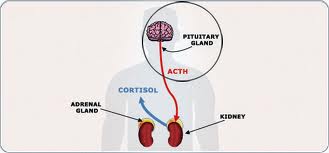
Nelson’s syndrome can develop as a result of a specific treatment (bilateral adrenalecomy) for the pituitary disease called Cushing’s disease. The harmful effects of Cushing’s disease are due to the excessive amount of the hormone cortisol produced by the adrenal glands.

To treat Cushing’s disease, your doctor may recommend removing the adrenal glands, during a procedure called a bilateral adrenalectomy. The procedure will stop cortisol production and provide relief. However, the procedure does not treat the actual tumor. Rapid growth of the pituitary tumor can occur.

In about 15-25 percent of patients who had a bilateral adrenalectomy, Nelson’ syndrome develops within one to four years.


Darkening of Skin Color - Nelson's Syndrome SymptomAnchor

Nelson’s Syndrome: Symptoms

The most obvious symptom of Nelson’s syndrome is the darkening of the skin color (hyperpigmentation).

Macroadenomas

Macroadenomas are large pituitary tumors. Large tumors can compress surrounding structures, primarily the normal pituitary gland and optic (visual) pathways, causing symptoms. The symptoms that result from the compression are independent of the effects of excess growth hormone secretion.
This may result in vision problems:

  • Vision loss. This occurs when macroadenomas grow upward into the brain cavity, compressing the optic chiasm.
  • A loss of the outer peripheral vision, called a bitemporal hemianopsia Bitemporal Hemianopsia - Symptom of Nelson's Syndrome
    • When severe, a patient can only see what is directly in front of them.
    • Many patients do not become aware of their visual loss until it is quite severe.
  • Other visual problems can include:
    • Loss of visual acuity (blurry vision), especially if the macroadenoma grows forward and compresses an optic nerve.
    • Colors not perceived as bright as usual

Pituitary Failure or Hypopituitarism

Increased compression of the normal gland can cause hormone insufficiency, called hypopituitarism. The symptoms depend upon which hormone is involved.


AnchorNelson’s Syndrome: Diagnosis

Most patients with Nelson’s syndrome have undergone a bilateral adrenalectomy for the treatment of Cushing’s disease

Diagnostic testing includes:

  • Hormone testing. Typically, the blood ACTH levels are very elevated. Learn more about hormone testing at the UCLA Pituitary Tumor Program.
  • MRI imaging. Magnetic resonance imaging (MRI) scan of the pituitary gland can detect the presence of an adenoma, a pituitary tumor.

AnchorNelson’s Syndrome: Treatment Options

Surgery for Nelson's Syndrome

Treating Nelson’s syndrome effectively requires an experienced team of experts. Specialists at the UCLA’s Pituitary Tumor Program have years of experience managing the complex coordination and care for treatment of Nelsons’ syndrome.

Treatment options include:

AnchorSurgery for Nelson’s Syndrome

Surgical removal of the pituitary adenoma is the ideal treatment; however, it is not always possible. Surgical removal requires advanced surgical approaches, including delicate procedures involving the cavernous sinus.

If surgery is required, typically the best procedure is through a nasal approach. Our neurosurgeons who specialize in pituitary tumor surgery are experts in the minimally invasive expanded endoscopic endonasal technique. This procedure removes the tumor while minimizing complications, hospital time and discomfort. This advanced technique requires specialized training and equipment.

Very large tumors that extend into the brain cavity may require opening the skull (craniotomy) to access the tumor. Our surgeons are also experts in the minimally invasive “key-hole” craniotomy, utilizing a small incision hidden in the eyebrow.

AnchorRadiation Therapy for Nelson’s Syndrome

Radiation Therapy for Nelson's SyndromeRadiation therapy can be effective in controlling the growth of the tumor. However, if you received radiation therapy in the past, additional radiation may not be safe.

Our Pituitary Tumor Program offers the latest in radiation therapy, including stereotactic radiosurgery. This approach delivers a highly focused dose of radiation to the tumor while leaving the surrounding brain structures unharmed (with the exception of the normal pituitary gland).

One consequence of radiation treatment is that it can cause delayed pituitary failure. This typically occurs several years after treatment, and continued long-term follow-up with an endocrinologist is important. You may require hormone replacement therapy.

Medical Therapy for Nelson’s Syndrome

Medication for Nelson's SyndromeMedical therapies for the treatment of Nelson’s syndrome are currently limited, but include:


  • Somatostatin-analogs (SSAs). These medications are typically used to treat acromegaly. A small number of Nelson’s syndrome patients may respond.
  • Cabergoline. This medication is typically used to treat prolactinomas; you may require a very high dose.
  • Temozolomide. This is a type of chemotherapy used to treat primary brain tumors called glioblastoma.

If you require medication to treat Nelson’s syndrome, our endocrinologists will monitor you closely.

From http://pituitary.ucla.edu/body.cfm?id=53


Crooke’s changes common in patients with Cushing’s syndrome, high cortisol production


Evidence of Crooke hyaline changes in the pituitary gland points to a higher likelihood of Cushing’s syndrome in adults, with the changes in basophil cells occurring in 75% to 80% of patients with the hormonal disorder, according to research in The Journal of Clinical Endocrinology & Metabolism.

In a retrospective review of hospital patient records from adults with Cushing’s syndrome who underwent pituitary surgery, researchers also found that a higher degree of cortisol production, as well as exposure to excess glucocorticoids, are often associated with Crooke’s changes in adults.

“The presence of Crooke’s changes is a clear indication of the presence of Cushing’s syndrome, although the absence of Crooke’s changes does not exclude it,” the researchers wrote.

Edward H. Oldfield, MD, FACS, of the department of neurological surgery at University of Virginia Health System, and colleagues analyzed electronic hospital data from 213 consecutive patients with Cushing’s syndrome who received pituitary surgery between 2008 and March 2014. Researchers reviewed analysis of the normal pituitary tissue included with the specimens obtained at surgery, as well as cortisol production measured by 24-hour urine.

Within the cohort, Crooke’s changes occurred in 74% of patients; Crooke’s changes occurred in 81% of patients with an adrenocorticotropic hormone tumor.

Researchers also found that 91% of patients with an adrenocorticotropic hormone-producing tumor and a urinary free cortisol test at least fourfold the upper limit of normal had evidence of Crooke’s changes vs. 74% of patients with a urine cortisol amount that was less than fourfold the upper limit of normal (P = .008).

“Our results clearly demonstrate a correlation between the degree of cortisol production and the presence of Crooke’s changes,” the researchers wrote. “Patients with cortisol production exceeding fourfold upper limit almost all had Crooke’s changes.”

Researchers said study results indicate that the presence of Crooke’s changes may be used to indicate that a patient has Cushing’s syndrome following a pituitary surgery in which no tumor is found.

“However, the absence of Crooke’s changes does not reliably indicate the absence of Cushing’s syndrome, as 19% of patients with a proven [adrenocorticotropic hormone-producing tumor] did not have Crooke’s changes,” the researchers wrote. by Regina Schaffer

Disclosure: The researchers report no relevant financial disclosures.

From http://www.healio.com/endocrinology/adrenal/news/online/%7B838a3557-f284-4fda-b93d-73dbb4823667%7D/crookes-changes-common-in-patients-with-cushings-syndrome-high-cortisol-production

Cushing’s Awareness Challenge: Day 12

robin-head


Mail!  I get all kinds of email asking questions about a variety of Cushing’s issues.  I’m not a doctor and I don’t play one on TV.  I don’t even play one on the internet.  People are desperate for answers, though, so the questions keep coming and I try to answer the best I can.

Here’s a recent question and answer.  Note that you have to be logged into the message boards to view the links in this post.


Question: My daughter was diagnosed w/ cushings in 2001 at the age of 20 & had the pituitary surgery.

In late 2013 she was diagnosed with a recurrence. I’ve read that that usually happens within 5 years, not a dozen years.

Regardless, there is a new research program but she was told she doesn’t qualify for it. The other medications offered are either exhorbitant ($100-200,000/year), another causes liver damage, another causes uterine problems. A 2nd surgery is not recommended according to  the surgeon (because there would be only a 50% rate of success due to the scar tissue from the original surgery), and radiation is being vetoed as well, being recommended ONLY as a very last possible resort.

Are there other parents who chat & share experience here? Will I find help as a parent here with my frustration over this disease? Are there other patients who communicate here that are from Michigan?  Are there other patients here who are suffering from the recurrence? Don’t get me wrong, I’m happy to find on several sites online today that there are so many success stories; I would just like to know what other options there are that perhaps our Dr. is missing.  Thanks.

My response:

S, since you have a Board Name, I assume that you are a member of the message boards.

There are areas specifically for recurrence – http://cushings.invisionzone.com/index.php?/forum/35-recurrences/

People in Michigan: http://cushings.invisionzone.com/index.php?/topic/13696-michigan/

Parents of patients: http://cushings.invisionzone.com/index.php?/forum/31-parents-spouses-children-and-friends-of-patients/

The more you read, the more you will learn.  Many patients with a recurrence  have a second pituitary surgery.  She might need to get another opinion from another surgeon.

Another option is a BLA – or have her adrenal glands out.  That can cause other issues, though.

The 2 drugs you  mentioned are Signifor and Korlym.  Although both are expensive, each has a patient assistance plan which lowers the cost dramatically.  Doses can vary dramatically so that they don’t necessarily cause liver or uterine issues.

Ketoconazole is another drug that’s sometimes used.

I did a search on the boards and there are 69 topics for Mifepristone (generic Korlym), 51 topics discussing the brand name Korlym, 40 for pasireotide (generic Signifor), 13 for the brand name Signifor, and 69 for keto (the common abbreviation on the boards for ketoconazole)

Here’s a personal experience from a woman on Korlym who likes it: http://cushings.invisionzone.com/index.php?/topic/53342-i-like-korlym/?hl=korlym

So – the information is out there.

I know it’s hard to process all this and make decisions.

I know it’s hard to process all this and make decisions. I had my one pituitary surgery in 1987, before the Internet was available so I had to really research all this in medical texts.

At that time, there weren’t any drug options. Just surgery and radiation. I decided off the bat if I should have a recurrence, I would not do radiation. I’d go for another pituitary surgery first, then a BLA if needed.

But that was then and this is now.  There is way more information which is much easier to find.  There are better surgical options and even some more medical ones.

Good luck!

8e1d2-maryo_colorful_zebra

Cushing’s Awareness Challenge: Day 11

robin-uncontrolled

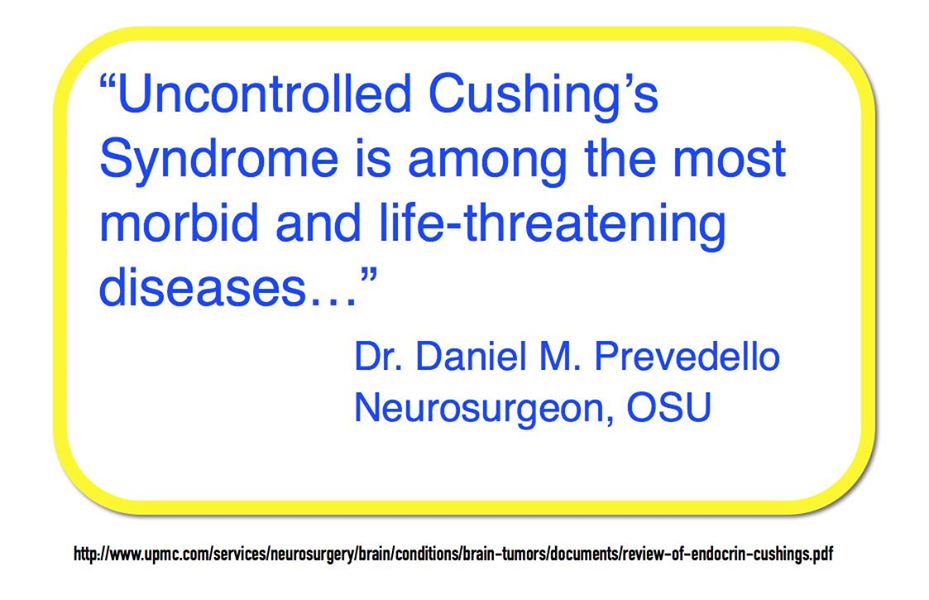
Robin has shared this quote from Dr. Prevedallo.  You can read more at the link at http://brainsurgery.upmc.com/_pdf/Review-of-Endocrin-Cushings.pdf

Over the years, I have seen that this is true, sometimes even for controlled Cushing’s.  Far too many Cushies have died.

Here are some of those that I know of:

Cushing’s is a terrible disease.

There is another Cushie I should add to this list. During the time I was home from NIH just before pituitary surgery, a college classmate of mine (I didn’t know her) did die at NIH of a Cushing’s-related problem. I’m so glad I didn’t find out until a couple months later!  I still have the college alumni magazine that mentioned this.  I’ll have to find that and add it to the In Memory list.

My husband shared a bit about her in my bio:

During the same time Mary was at NIH, another woman had the same operation. She came from Mary’s home town. They were class mates at college. They had the same major. They were the same age. They had the same surgical and medical team. Mary recovered. The other woman died during surgery.


I know we’re always fighting with doctors to get diagnosed, to get treated but reading the stories of these people will hopefully inspire people to fight even harder to be heard.

Stay safe – don’t get added to this list!

8e1d2-maryo_colorful_zebra


Cushing’s Awareness Challenge: Day 10

robin-tests

Gee, I’m an underachiever. LOL I only had one IPSS and one pituitary surgery.

While I was at NIH, my MRIs still showed nothing, so they did an Inferior Petrosal Sinus Sampling Test. That scared me more than the prospect of surgery. (This test carries the risk of stroke and uncontrollable bleeding from the incision points.) Catheters were fed from my groin area to my pituitary gland and dye was injected. I could watch the whole procedure on monitors.

I could not move during this test or for several hours afterwards to prevent uncontrollable bleeding from a major artery. The test did show where the tumor probably was located.

Also done were more sophisticated dexamethasone suppression tests where drugs were administered by IV and blood was drawn every hour (they put a heplock in my arm so they didn’t have to keep sticking me). I got to go home for a weekend and then went back for the surgery – the Transsphenoidal Resection. I fully expected to die during surgery (and didn’t care if I did) so I signed my will and wrote last letters to those I wanted to say goodbye to.

During the time I was home just before surgery, a college classmate of mine (I didn’t know her) did die at NIH of a Cushing’s-related problem. I’m so glad I didn’t find out until a couple months later!

maryo colorful zebra