Webinar on Management Options for Pituitary Tumors March 22

Dr. Andaluz will cover the full breadth of treatment options from managing endocrine function, surgical procedures (transsphenoidal, endoscopic, and keyhole approaches), radiotherapy / radiosurgery, and the importance of getting care at a multidisciplinary center.

Dr. Norberto Andaluz is a neurosurgeon with the Mayfield Clinic and University of Cincinnati Brain Tumor Center. He is also Associate Professor of Neurosurgery at the University of Cincinnati, Surgical Director of the Neuroscience Intensive Care Unit, and Director of Neurotrauma at the University of Cincinnati Neuroscience Institute. He specializes in the treatment of all disorders and diseases of the brain and spine, but in particular, traumatic brain injury, aneurysms, arteriovenous malformations (AVMs), intracerebral hemorrhage, stroke, carotid artery disease, moyamoya disease and brain tumors (with special training in skull base tumors like pituitary adenoma). Dr. Andaluz received his medical degree from Unversidad Nacional de Rosario in Argentina. He completed his residency in neurosurgery at Instituto de Neurología y Neurocirugía at Sanatorio Parque in Rosario, Argentina and earned a fellowship in cerebrovascular surgery from the University of Cincinnati. Professional memberships include the American Heart Association, Congress of Neurological Surgeons, National Neurotrauma Society, Neurocritical Care Society and North American Skull Base Society.

Register at http://pituitary.org/events/webinar-management-options-for-pituitary-tumors

Tiruchi surgeons treat Pakistan national for pituitary tumour

0276f-pituitary-gland


The patient had discovered his condition by chance in Quetta last year.

A team of city-based surgeons has performed a sophisticated surgery on a young Pakistani national to remove a pituitary tumour.

Bakhtiyar Khan, a 30-year-old Pakistani national from the Talli village in Sibi, Balochistan, underwent the surgery here a few days ago.

The surgery was performed by Dr. T.N. Janakiraman, skull base surgeon and managing director, Royal Pearl Hospital and Research Institute, Dr. Uday Chanukya, Dr. Prayatna Kumar, skull base surgeons, and Dr. Balamurugan, anaesthesiologist.

The tumour, in the cavernous sinus — a large collection of thin-walled veins creating a cavity bordered by the temporal bone of the skull and the sphenoid bone in the head, was removed through endoscopic surgery.

“Normally surgeons go through the skull and brain to excise the tumour with the help of surgical microscopic glasses. But this doesn’t ensure the removal of the entire tumour, which is why radiation is recommended after the operation,” Dr. Janakiraman told The Hindu .

“In Bakhtiyar’s case, the tumour had gone into the cavernous sinus. We used his nasal cavity as the entry point, and brought the tumour out through the nose as well. This is a scar-less keyhole surgery that ensures complete excision and doesn’t require us to make a new opening in the skull,” he added.

Dr. Janakiraman, who was trained in the procedure by internationally renowned neurosurgeon Dr. Amin Kassam in the U.S. 10 years ago, has been doing the procedure for the past nine years in Tiruchi.

For the patient’s elder brother, Sardar Khan, the experience has been both exhausting yet exhilarating. A file clerk at the local health centre in Sibi, the Khan brothers had taken their father, who is paralysed, to a doctor in Quetta last year, when the physician there suggested that it was Mr. Bakhtiyar who needed medical attention urgently. “None of us knew that he was unwell,” recounted Mr. Sardar. “We were advised by neurosurgeon Dr. Asghar Khan to seek help in India immediately. I couldn’t believe that I, who had never left my village to see even Lahore or Karachi, had to go to India.”

In a process that took three to six months, Mr. Sardar convinced Mr. Bakhtiyar and his other siblings (they are eight brothers and two sisters) to get ready to meet Dr. Janakiraman, besides applying for passports and organising visas.

The brothers took the Samjhauta Express from Wagah to Delhi on January 31. The Tamil Nadu Sampark Kranti Express brought them to Tiruchi after a 46-hour journey. As a humanitarian gesture, the hospital has waived all fees (in the range of Rs. 1 to 3 lakhs), except the cost of medicines.

“I’m feeling much better now, and my eyesight has improved,” said Mr. Bakhtiyar Khan. After a few days of observation and a final MRI scan, he will be free to travel back home with his brother.

Said a gratified Mr. Sardar: “I haven’t seen much of India, or even of Tiruchi, but to me, Dr. Janakiraman and his team are India. I’d like to thank all my new friends in India for taking such good care of me and my brother.”

From http://www.thehindu.com/news/national/tamil-nadu/tiruchi-surgeons-treat-pakistan-national-for-pituitary-tumour/article8231567.ece

Day 2 Coverage of ENDO 2015

ENDO_2015


OR22-Osteoporosis–Winner: Outstanding Abstract Award

Effects of teriparatide on bone microarchitecture in postmenopausal women with osteoporosis
S Orlov, R Ridout, L Tile, M Kapral, S Cardew, MR Werb, SD Sandler, J Chang, H Hu, E Szabo, C Derzko, A Cheung


FRI 224-247-Metabolic and Genetic Bone Disorders

The effect of vitamin D supplementation on falls and physical performance in elderly women. A randomized clinical trial
S Yousefian, JC Gallagher, SH Tella


The etiology and risk factors analysis in hypercalcemic crisis
H Liao, DL Lorber, E Cohen


LBF 001-014-Late-breaking Thyroid/HPT Axis II

Diagnostic lobectomy for thyroid nodules >4 cm with benign cytology after fine-needle aspiration is associated with improved outcomes at an acceptable cost compared to observation: …
L Lee, E Theodosopoulos, EJ Mitmaker, JA Lee, J Chabot, JH Kuo


LBF 015-023-Late-breaking Reproductive Endocrinology II

Effect of testosterone treatment on cardiac biomarkers in a randomized controlled trial of men with type 2 diabetes
EJ Gianatti, R Hoermann, Q Lam, P Dupuis, JD Zajac, M Grossmann


OR17-Novel Aspects of Adrenal Tumors and the HPA Axis

Epigenetic modulation of DNA Is associated with fatigue, depression and anxiety in patients with Cushing’s syndrome in remission: A genome-wide methylation study
CAM Glad, JC Andersson-Assarsson, P Berglund, R Bergthorsdottir, O Ragnarsson, G Johannsson


Pharmacogenetic analysis of glucocorticoid gene polymorphisms and prediction of daily dexamethasone doses in adults with congenital adrenal hyperplasia
JS Frassei, LG Gomes, RP Moreira, G Madureira, BB Mendonca, TA Bachega


OR20-Pituitary Tumors-New Clinical Considerations

Reduced mortality in patients with GH replacement therapy – a Swedish study based on more than 4,000 patient-years
DS Olsson, AG Nilsson, P Trimpou, B-A Bengtsson, E Andersson, G Johannsson


OR22-Osteoporosis

Denosumab restores cortical bone loss at the 1/3 radius associated with aging and reduces wrist fracture risk: Analyses from the Freedom extension cross-over group
JP Bilezikian, CL Benhamou, CJF Lin, JP Brown, NS Daizadeh, PR Ebeling, A Fahrleitner-Pammer, E Franek, N Gilchrist, PD Miller, JA Simon1, I Valter, AF Zerbini, C Libanati


OR22-Osteoporosis–Winner Clinical Fellows Abstract Award Travel Grants in Womens Health

Estrone may be more important than testosterone and estradiol for bone health and prevention of fractures in post-menopausal women
G Toraldo, TG Travison, X Zhang, KE Broe, S Bhasin, DP Kiel, AD Coviello

Differences Between Cushing’s Syndrome and Cushing’s Disease

What’s the difference between Cushing’s Disease and Cushing’s Syndrome?

disease-syndrome

Cushing’s syndrome is a hormonal disorder

Cortisol is a normal hormone produced in the outer portion of the adrenal glands. When functioning normally, cortisol helps the body respond to stress and change. It mobilizes nutrients, modifies the body’s response to inflammation, stimulates the liver to raise blood sugar, and helps control the amount of water in the body. Cortisol production is regulated by the adrenocorticotrophic hormone (ACTH), produced in the pituitary gland. Spontaneous overproduction of cortisol in the adrenals is divided into two groups – those attributed to an excess of ACTH and those that are independent of ACTH.

Cushing’s syndrome is the term used to describe a group of symptoms that occur when a persons’ cortisol levels are too high (known as hypercortisolism) for too long. The majority of people have Cushing’s syndrome because they are regularly taking certain medicine(s) that continually add too much cortisol to the body. Doctors call this an “exogenous” (outside the body) cause of Cushing’s syndrome. Other people have Cushing’s syndrome because something is causing the adrenal gland(s) to overproduce cortisol. Doctors call this an “endogenous” (inside the body) cause of Cushing’s syndrome.

Cushings-causes.png

Cushing’s disease is a form of Cushing’s syndrome

Cushing’s disease is the most common form of endogenous Cushing’s syndrome. It is caused by a tumor in the pituitary gland that secretes excessive amounts of a hormone called Adrenocorticotropic hormone, or ACTH. Fortunately, this type of tumor is typically benign. Unlike a cancerous (malignant) tumor, a benign tumor stays in its original location and will not spread. After you are diagnosed with Cushing’s syndrome, it is important that your doctor continues the diagnostic process to determine the cause of hypercortisolism.

From the message boards It is not only a tumor that causes Cushings Disease—many of us have the rarer form of this rare disease which is Pituitary Hyperplasia. It also causes CD and may be nodular (shown on MRI s a tumor) or dispersed (meaning spread throughout the gland).

How a pituitary tumor causes Cushing’s disease

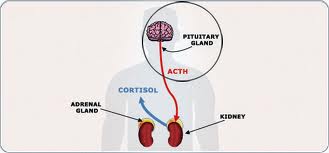
Pituitary.jpg

ACTH is a hormone produced in your pituitary gland. ACTH travels to your adrenal glands and signals them to produce cortisol.

Pituitary adenomas are benign tumors of the pituitary gland which secrete increased amounts of ACTH, causing excessive cortisol production. Most patients have a single adenoma. First described in 1912 by neurosurgeon Harvey Cushing in his book The Pituitary Body and its Disorders, Cushing’s disease is the most common cause of spontaneous Cushing’s syndrome, accounting for 60 to 70 percent of cases.

If a person has Cushing’s disease, it means that a group of abnormal cells has built up in the pituitary gland to form an ACTH-producing pituitary tumor. These abnormal cells produce ACTH, just as normal pituitary gland cells do—only far too much. The excess ACTH travels to adrenal glands. The adrenal glands are then bombarded with signals to produce more and more cortisol. As a result, the adrenal glands continuously secrete too much cortisol.

Ectopic ACTH Syndrome

Some benign or malignant (cancerous) tumors that arise outside the pituitary can produce ACTH. This condition is known as ectopic ACTH syndrome. Lung tumors cause more than 50 percent of these cases. Other less common types of tumors that can produce ACTH are thymomas, pancreatic islet cell tumors, and medullary carcinomas of the thyroid.

Adrenal Tumors

Adrenal glands.jpg

An abnormality of the adrenal glands such as an adrenal tumor may cause Cushing’s syndrome. Most of these cases involve non-cancerous tumors called adrenal adenomas, which release excess cortisol into the blood.

Adrenocortical carcinomas, or adrenal cancers, are the least common cause of Cushing’s syndrome. Cancer cells secrete excess levels of several adrenal cortical hormones, including cortisol and adrenal androgens. Adrenocortical carcinomas often cause very high hormone levels and rapid onset of symptoms.

Familial Cushing’s syndrome

Most cases of Cushing’s syndrome are not genetic. However, some individuals may develop Cushing’s syndrome due to an inherited tendency to develop tumors of one or more endocrine glands. In Primary Pigmented Micronodular Adrenal Disease, children or young adults develop small cortisol-producing tumors of the adrenal glands. In Multiple Endocrine Neoplasia Type I (MEN I), hormone secreting tumors of the parathyroid glands, pancreas and pituitary occur. Cushing’s syndrome in MEN I may be due to pituitary, ectopic or adrenal tumors.

Risk factors

Obesity, type 2 diabetes, poorly controlled blood glucose (blood sugar levels), and high blood pressure may increase the risk of developing this disorder.

Adapted from http://www.cushiewiki.com/index.php?title=Cushing%27s_Disease_or_Syndrome

When to think Cushing’s syndrome in type 2 diabetes

ESTES PARK, COLO. – Diabetes mellitus, osteoporosis, and hypertension are conditions that should boost the index of suspicion that a patient with some cushingoid features may in fact have endogenous Cushing’s syndrome, Dr. Michael T. McDermott said at a conference on internal medicine sponsored by the University of Colorado.

An estimated 1 in 20 patients with type 2 diabetes has endogenous Cushing’s syndrome. The prevalence of this form of hypercortisolism is even greater – estimated at up to 11% – among individuals with osteoporosis. In hypertensive patients, the figure is 1%. And among patients with an incidentally detected adrenal mass, it’s 6%-9%, according to Dr. McDermott, professor of medicine and director of endocrinology and diabetes at the University of Colorado.

“Endogenous Cushing’s syndrome is not rare. I suspect I’ve seen more cases than I’ve diagnosed,” he observed. “I’ve probably missed a lot because I failed to screen people, not recognizing that they had cushingoid features. Not everyone looks classic.”

There are three screening tests for endogenous Cushing’s syndrome that all primary care physicians ought to be familiar with: the 24-hour urine cortisol test, the bedtime salivary cortisol test, and the overnight 1-mg dexamethasone suppression test.

“I think if you have moderate or mild suspicion, you should use one of these tests. If you have more than moderate suspicion – if a patient really looks like he or she has Cushing’s syndrome – then I would use at least two screening tests to rule out endogenous Cushing’s syndrome,” the endocrinologist continued.

The patient performs the bedtime salivary cortisol test at home, obtaining samples two nights in a row and mailing them to an outside laboratory. The overnight dexamethasone suppression test entails taking 1 mg of dexamethasone at bedtime, then measuring serum cortisol the next morning. A value greater than 1.8 mcg/dL is a positive result.

Pregnant women constitute a special population for whom the screening method recommended in Endocrine Society clinical practice guidelines (J. Clin. Endocrinol. Metab. 2008;93:1526-40) is the 24-hour urine cortisol test. That’s because pregnancy is a state featuring high levels of cortisol-binding globulins, which invalidates the other tests. In patients with renal failure, the recommended screening test is the 1-mg dexamethasone suppression test. In patients on antiepileptic drugs, the 24-hour urine cortisol or bedtime salivary cortisol test is advised, because antiseizure medications enhance the metabolism of dexamethasone.

Dr. McDermott said that “by far” the most discriminatory clinical features of endogenous Cushing’s syndrome are easy bruising, violaceous striae on the trunk, facial plethora, and proximal muscle weakness.

“They’re by no means specific. You’ll see these features in people who don’t have Cushing’s syndrome. But those are the four things that should make you really consider Cushing’s syndrome in your differential diagnosis,” he stressed.

More widely recognized yet actually less discriminatory clinical features include facial fullness and the “buffalo hump,” supraclavicular fullness, central obesity, hirsutism, reduced libido, edema, and thin or poorly healing skin.

Endogenous Cushing’s syndrome can have three causes. An adrenocorticotropic hormone (ACTH)-secreting pituitary adenoma accounts for 80% of cases. A cortisol-secreting adrenal tumor is the cause of 10%. And another 10% are due to an ectopic ACTH-secreting tumor, most commonly a bronchial carcinoid tumor.

Once the primary care physician has a positive screening test in hand, it’s typical to refer the affected patient to an endocrinologist in order to differentiate which of the three causes is present. This is accomplished based upon the results of a large, 8-mg dexamethasone suppression test coupled with measurement of plasma ACTH levels.

Dr. McDermott recommended as a good read on the topic of evaluating a patient with endogenous Cushing’s syndrome a recent review article that included a useful algorithm (N. Engl. J. Med. 2013;368:2126-36).

He reported having no financial conflicts.

bjancin@frontlinemedcom.com

From http://www.clinicalendocrinologynews.com