Macroadenoma biochemical behavior in pediatric patients with Cushing’s disease differs from adult cases

Cushing’s disease in children is associated with similar biochemical measures whether the disease is due to macroadenomas or microadenomas, according to a presentation at the AACE 24th Annual Scientific & Clinical Congress.

This contrasts with the disease behavior in adults, in whom macrodenomas demonstrate less glucocorticoid suppression and adrenocorticotropic hormone (ACTH) response to laboratory tests than do microadenomas, according to researchers.

“Children with pituitary macroadenomas are more likely to have the classical response to Cushing’s disease functional testing as microadenomas,”Ricardo Correa, MD, a clinical and research endocrinology fellow at National Institutes of Health, told Endocrine Today.

Correa and colleagues conducted a retrospective review of patients with Cushing’s disease who were younger than 18 years when they were admitted to the NIH between 1997 and 2014. All Cushing’s diagnoses were confirmed by pathology.

Pituitary macroadenoma was identified in 13 patients (69% female) and microadenoma in 74 (58% female). The groups had similar mean age (14 years) and BMI (31.8 kg/m2 and 30.2 kg/m2 for macroadenoma and microadenoma, respectively). The macroadenoma group had a median (25% to 75%) 24-hour urine free cortisol of  263.60 mcg/24 hr (range 170.7-528) compared with 371.6 mcg/ 24 hr (range 244.2-625.3) in the microadenoma group (P = 0.47). Median 24-hr urinary 17-hydroxysteroid excretion in the macroadenoma group was 12.6 mg/24 hr (range 8.9-42.5) and 31.6 mg/24 hr (range 4.3-39.9) in the microadenoma group.

Mean morning serum cortisol was 38.9 ± 40.4 mcg/dL compared with  20.2 ± 15.8 mcg/dL in the macroademona and microadenoma groups, respectively (P = 0.16). Mean morning basal plasma ACTH was 106.3 ± 112.3 pg/mL compared with 49.9±44.3 pg/mL for the macroadenoma and microadenoma groups, respectively (P = 0.11), while ACTH responses to the ovine corticotropin-releasing hormone test revealed no statistically significant differences. Using the high dose dexamethasone suppression test, 58% (7/12) suppressed more than 69% in the macroadenoma group compared to 69% (44/64) in the microadenoma group (P = .51).

“Studies in adult patients have demonstrated that macroadenomas have less glucocorticoid suppressibility after the high-dose dexamethasone suppression test and attenuated ACTH response to CRH compared to pituitary microadenomas,” according to Correa. “However, the present study shows that this is not true in children; although patients with macroadenomas had a tendency for higher baseline serum ACTH and cortisol levels, their responses to dynamic testing were similar to those with microadenomas.”

Reference:

Correa R, et al. Abstract #803. Presented at: AACE 24th Annual Scientific & Clinical Congress; May 13-17, 2015; Nashville, Tenn.

Disclosure: The researchers report no relevant financial disclosures.

From http://www.healio.com/endocrinology/adrenal/news/online/%7Bb4fbf36f-ac88-4eff-9278-90f0a8d1aec2%7D/macroadenoma-biochemical-behavior-in-pediatric-patients-with-cushings-disease-differs-from-adult-cases?sc_trk=internalsearch

Interview May 13 with Michelle B (MichelleB), Cyclic Cushing’s Patient

Hello all, I’m Michelle mother of 3 beautiful children, I work part-time, 33yrs young, non-smoker, non-drinker, overall health is good for the most part…..Where do I even begin.

I just recently received the diagnosis of cyclic Cushing’s. I’m not really sure how long I have actually had Cushing’s because I have had a diagnosis of PCOS since I was 17 yrs. old ( I’m now the ripe young age of 33). However looking back through labs with my endocrinologist who I see every 6 months, my ACTH levels have been elevated for a bit over 1 yr. It was not until recently January of 2015- things were going terribly wrong.

Starting in January I started to feel genuinely unwell, on a regular basis. I cant really explain all my symptoms there were so many different sensations and feelings that were seemingly different daily. However the red flag was I was having blood pressure spikes from really high, to very low back to back. I never had any blood pressure issues so this was a concern that led me to see a cardiologist. Upon tons of testing the cardio MD felt that something was telling my otherwise very healthy heart to do this and I should see a endocrinologist. (thank goodness for him) I contacted my endo and let him know…. the testing began.

I did every test: the midnightcortisol saliva test, dex suppression, 24 hr urine test, CRH stimulation testing. And I did them more than once. Each time it was a different response either, inconclusive, normal high, or high. I was then referred to the head of the Cleveland clinics pituitary department Dr. Kennedy. He said he is having a hard time believing when he looks at me that its Cushing’s. However all my labs say it is. I will say I do fit the mold of PCOS to a tee- which symptoms of that do coincide with Cushing’s but he still said we have to be sure its Cushing’s. To add to the mix I did have a normal MRI as well.

Dr. Kennedy started me on a 2 week midnight cortisol saliva test- Upon completion we noted levels of cortisol all over the place, some Normal, normal on high range, high, and really high. He confirmed with all the other tests this is Cushing’s. Now we are trying to figure out what is next…. and where is this damn little tumor at. he feels that it is most likely in the pituitary from my test results, but we still are not ruling out else where. He is thinking that the next step would be exploratory neurosurgery or the IPSS. I’m not sure what to think of all this, except I want to hope for the best like everyone- and just be cured!!

On a side note during all of this I also had episodes of severe pain in my chest and nausea. I went to see a GI who did an upper endo scope. They found I had eosinpphilic esophagitis. I also have never had any GI problems until now; and they came on suddenly. Im also having pain in my pancreas area- not sure if any of the two are related at all to Cushing’s. But once again I was fine until recently with all these issues at once it seems.

wish me luck on further testing, treatment, and ultimately a CURE!!

interview

Michelle was our guest in an interview on BlogTalk Radio  Wednesday, May 13, 2015.

The archived interview is available now through iTunes Podcasts (Cushie Chats) or BlogTalkRadio. There are currently 83 other past interviews for your listening pleasure!

HOME | Sitemap | Adrenal Crisis! | Abbreviations | Glossary | Forums | Donate | Bios | Add Your Bio

Day Twenty-six, Cushing’s Awareness Challenge 2015

It’s Sunday again, so this is another semi-religious post so feel free to skip it 🙂

I’m sure that many would think that this is a semi-odd choice for all-time favorite hymn.

My dad was a Congregational (now United Church of Christ) minister so I was pretty regular in church attendance in my younger years.

Some Sunday evenings, he would preach on a circuit and I’d go with him to some of these tiny churches.  The people there, mostly older folks, liked the old hymns best – Fanny Crosby and so on.

So, some of my “favorite hymns” are those that I sang when I was out with my Dad.  Fond memories from long ago.

In 1986 I was finally diagnosed with Cushing’s after struggling with doctors and trying to get them to test for about 5 years.  I was going to go into the NIH (National Institutes of Health) in Bethesda, MD for final testing and then-experimental pituitary surgery.

I was terrified and sure that I wouldn’t survive the surgery.

Somehow, I found a 3-tape set of Readers Digest Hymns and Songs of Inspiration and ordered that. The set came just before I went to NIH and I had it with me.

At NIH I set up a daily “routine” of sorts and listening to these tapes was a very important part of my day and helped me get through the ordeal of more testing, surgery, post-op and more.

When I had my kidney cancer surgery, the tapes were long broken, but I had replaced all the songs – this time on my iPod.

Abide With Me was on this tape set and it remains a favorite to this day.  Whenever we have an opportunity in church to pick a favorite, my hand always shoots up and I request page 700.  When someone in one of my handbell groups moves away, we always sign a hymnbook and give it to them.  I sign page 700.

I think that many people would probably think that this hymn is depressing.  Maybe it is but to me it signifies times in my life when I thought I might die and I was so comforted by the sentiments here.

This hymn is often associated with funeral services and has given hope and comfort to so many over the years – me included.

If you abide in Me, and My words abide in you, you will ask what you desire, and it shall be done for you.

~John 15:7

Abide With Me

Words: Henry F. Lyte, 1847.

Music: Eventide, William H. Monk, 1861. Mrs. Monk described the setting:

This tune was written at a time of great sorrow—when together we watched, as we did daily, the glories of the setting sun. As the last golden ray faded, he took some paper and penciled that tune which has gone all over the earth.

Lyte was inspired to write this hymn as he was dying of tuberculosis; he finished it the Sunday he gave his farewell sermon in the parish he served so many years. The next day, he left for Italy to regain his health. He didn’t make it, though—he died in Nice, France, three weeks after writing these words. Here is an excerpt from his farewell sermon:

O brethren, I stand here among you today, as alive from the dead, if I may hope to impress it upon you, and induce you to prepare for that solemn hour which must come to all, by a timely acquaintance with the death of Christ.

For over a century, the bells of his church at All Saints in Lower Brixham, Devonshire, have rung out “Abide with Me” daily. The hymn was sung at the wedding of King George VI, at the wedding of his daughter, the future Queen Elizabeth II, and at the funeral of Nobel peace prize winner Mother Teresa of Calcutta in1997.

Abide with me; fast falls the eventide;

The darkness deepens; Lord with me abide.

When other helpers fail and comforts flee,

Help of the helpless, O abide with me.

Swift to its close ebbs out life’s little day;

Earth’s joys grow dim; its glories pass away;

Change and decay in all around I see;

O Thou who changest not, abide with me.

Not a brief glance I beg, a passing word;

But as Thou dwell’st with Thy disciples, Lord,

Familiar, condescending, patient, free.

Come not to sojourn, but abide with me.

Come not in terrors, as the King of kings,

But kind and good, with healing in Thy wings,

Tears for all woes, a heart for every plea—

Come, Friend of sinners, and thus bide with me.

Thou on my head in early youth didst smile;

And, though rebellious and perverse meanwhile,

Thou hast not left me, oft as I left Thee,

On to the close, O Lord, abide with me.

I need Thy presence every passing hour.

What but Thy grace can foil the tempter’s power?

Who, like Thyself, my guide and stay can be?

Through cloud and sunshine, Lord, abide with me.

I fear no foe, with Thee at hand to bless;

Ills have no weight, and tears no bitterness.

Where is death’s sting? Where, grave, thy victory?

I triumph still, if Thou abide with me.

Hold Thou Thy cross before my closing eyes;

Shine through the gloom and point me to the skies.

Heaven’s morning breaks, and earth’s vain shadows flee;

In life, in death, O Lord, abide with me.


Day Twenty-two, Cushing’s Awareness Challenge 2015

Over the years, we went on several Windjammer Barefoot Cruises.  We liked them because they were small, casual and were fairly easy on the wallet.

They sailed around the Caribbean to a variety of islands, although they sometimes changed itineraries depending on weather, crew, whatever.  One trip we were supposed to go to Saba but couldn’t make port.  A lot of people got off at the next port and flew home.

The captains were prone to “Bedtime Stories” which were often more fiction than true but they added to the appeal of the trip.  We didn’t care if we missed islands or not – we were just there to sail over the waves and enjoy the ride.

The last trip we took with them was about two years before I started having Cushing’s problems.  (You wondered how I was going to tie this together, right?)

The cuise was uneventful, other than the usual mishaps like hitting docks, missing islands and so on.  Until it was a particularly rough sea one day.  I was walking somewhere on deck and suddenly a wave came up over the deck making it very slippery.  I fell and cracked the back of my head on the curved edge of a table in the dining area.  I had the next-to-the-worse headache I have ever had, the worst being after my pituitary surgery. At least after the surgery I got some morphine.

We asked several doctors later if that hit could have contributed to my Cushing’s but doctors didn’t want to get involved in that at all.

The Windjammer folks didn’t fare much better, either. In October 1998, Hurricane Mitch was responsible for the loss of the s/v Fantome (the last one we were on).

All 31 crew members aboard perished; passengers and other crew members had earlier been offloaded in Belize.

The story was recorded in the book The Ship and the Storm: Hurricane Mitch and the Loss of the Fantome by Jim Carrier.  The ship, which was sailing in the center of the hurricane, experienced up to 50-foot (15 m) waves and over 100 mph (160 km/h) winds, causing the Fantome to founder off the coast of Honduras.
This event was similar to the Perfect Storm in that the weather people were more interested in watching the hurricane change directions than they were in people who were dealing with its effects.

I read this book and I was really moved by the plight of those crew members.


I’ll never know if that hit on my head contributed to my Cushing’s but I have seem several people mention on the message boards that they had a traumatic head injury of some type in their earlier lives.


Day Eleven, Cushing’s Awareness Challenge 2015

UVA 2004
Cushing’s Conventions have always been special times for me – we learn a lot, get to meet other Cushies, even get referrals to endos!

As early as 2001 (or before) my pituitary function was dropping.  My former endo tested annually but did nothing to help me with the symptoms.

In the fall of 2002 my endo refused to discuss my fatigue or anything at all with me until I lost 10 pounds. He said I wasn’t worth treating in my overweight condition and that I was setting myself up for a heart attack. He gave me 3 months to lose this weight. Those 3 months included Thanksgiving, Christmas and New Years.  Needless to say, I left his office in tears, again.

Fast forward 2 years to 2004.  I had tried for awhile to get my records from this endo. He wouldn’t send them, even at doctors’ or my requests.

I wanted to go see Dr. Vance at UVa but I had no records so she would’t see me until I could get them.

Finally, my husband went to the former endo’s office and threatened him with a court order. The office manager managed to come up with about 13 pages of records. For going to him from 1986 to 2001 including weeks and weeks at NIH and pituitary surgery, that didn’t seem like enough records to me.

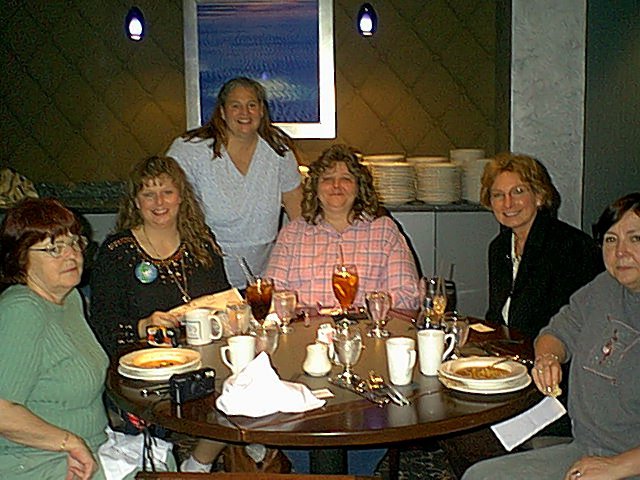
In April of 2004, many of us from the message boards went to the UVa Pituitary Days Convention. That’s where the picture above comes in.  Other pictures from that convention are here.

By chance, we met a wonderful woman named

Read Barbara Craven. She sat at our table for lunch on the last day and, after we learned that she was a dietitian who had had Cushing’s, one of us jokingly asked her if she’d do a guest chat for us. I didn’t follow through on this until she emailed me later. In the email, she asked how I was doing. Usually I say “fine” or “ok” but for some reason, I told her exactly how awful I was feeling.

Barbara emailed me back and said I should see a doctor at Johns Hopkins. I said I didn’t think I could get a recommendation to there, so SHE referred me. The doctor got right back to me, set up an appointment. Between his vacation and mine, that first appointment turned out to be Tuesday, Sept 14, 2004.

Just getting through the maze at Johns Hopkins was amazing. They have the whole system down to a science, moving from one place to another to sign in, then go here, then window 6, then… But it was very efficient.

My new doctor was wonderful. Understanding, knowledgeable. He never once said that I was “too fat” or “depressed” or that all this was my own fault. I feel so validated, finally.

He looked through my records, especially at my 2 previous Insulin Tolerance Tests. From those, he determined that my growth hormone has been low since at least August 2001 and I’ve been adrenal insufficient since at least Fall, 1999 – possibly as much as 10 years! I was amazed to hear all this, and astounded that my former endo not only didn’t tell me any of this, he did nothing. He had known both of these things – they were in the past records that I took with me. Perhaps that was why he had been so reluctant to share copies of those records. He had given me Cortef in the fall of 1999 to take just in case I had “stress” and that was it.

The new endo took a lot of blood (no urine!) for cortisol and thyroid stuff. I went back on Sept. 28, 2004 for arginine, cortrosyn and IGF testing.

He said that I would end up on daily cortisone – a “sprinkling” – and some form of GH, based on the testing the 28th.

For those who are interested, my new endo is Roberto Salvatori, M.D.
Assistant Professor of Medicine at Johns Hopkins

Medical School: Catholic University School of Medicine, Rome, Italy
Residency: Montefiore Medical Center
Fellowship: Cornell University, Johns Hopkins University
Board Certification: Endocrinology and Metabolism, Internal Medicine

Clinical Interests: Neuroendocrinology, pituitary disorders, adrenal disorders

Research Interests: Control of growth hormone secretion, genetic causes of growth hormone deficiency, consequences of growth hormone deficiency.

Although I have this wonderful doctor, a specialist in growth hormone deficiency at Johns Hopkins, in November, 2004, my insurance company saw fit to over-ride his opinions and his test results based on my past pharmaceutical history! Hello??? How could I have a history of taking GH when I’ve never taken it before?

Of course, I found out late on a Friday afternoon. By then it was too late to call my case worker at the drug company, so we had to appeal on Monday. My local insurance person also worked on an appeal, but the whole thing was  just another long ordeal of finding paperwork, calling people, FedExing stuff, too much work when I just wanted to start feeling better by Thanksgiving.

As it turned out the insurance company rejected the brand of hGH that was prescribed for me. They gave me the ok for a growth hormone was just FDA-approved for adults on 11/4/04. The day this medication was approved for adults was the day after my insurance said that’s what is preferred for me. In the past, this form of hGH was only approved for children with height issues. Was I going to be a ginuea pig again?

The new GH company assigned a rep for me, submitted info to pharmacy, and waited for insurance approval, again.

I finally started the Growth Hormone December 7, 2004.

Was the hassle and 3 year wait worth it?

Stay tuned for tomorrow, April 12, 2015 when all will be revealed.

Read

Read Dr. Barbara Craven’s Guest Chat, October 27, 2004

Thanks for reading 🙂

MaryO