Day 5: Cushing’s Awareness Challenge 2015

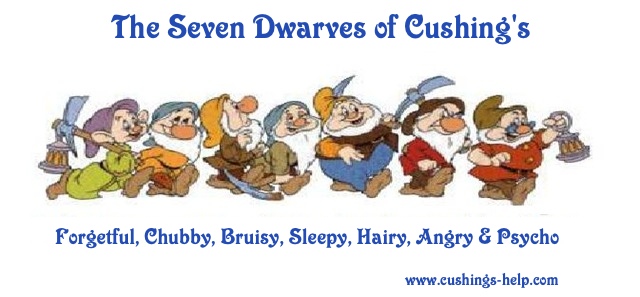
The Seven Dwarves of Cushing's

So, these are only seven of the many, many symptoms of Cushing’s.  I had those above – and I often felt like I looked like one of those little bearded dwarves.

Cushing’s affects every part of the body.  It’s not like when I had kidney cancer and only the kidney was affected.

Here are some of the many areas affected.

  • Progressive obesity and skin changes
  • Weight gain and fatty tissue deposits, particularly around the midsection and upper back, in the face (moon face) and between the shoulders (buffalo hump). Some symptoms such as sudden weight gain, are caused by excess cortisol. The excess cortisol in the body does not increase protein and carbohydrate metabolism. It slows or nearly disables metabolism function, which can cause weight gain (fat accumulation) in the buttocks, abdomen, cheeks, neck, or upper back.
  • Loss of muscle mass. Some areas of the body, such as the arms and legs, will remain thin.
  • Pink or purple stretch marks (striae) on the skin of the abdomen, thighs, breasts and arms
  • Thinning, fragile skin that bruises easily
  • Slow healing of cuts, insect bites and infections
  • Acne

Women with Cushing’s syndrome may experience:

  • Thicker or more visible body and facial hair (hirsutism)
  • Irregular or absent menstrual periods

Men with Cushing’s syndrome may experience:

  • Decreased libido
  • Decreased fertility
  • Erectile dysfunction

Other signs and symptoms include:

  • Fatigue
  • Muscle weakness
  • Depression, anxiety and irritability
  • Loss of emotional control
  • Cognitive difficulties
  • New or worsened high blood pressure
  • Glucose intolerance that may lead to diabetes
  • Headache
  • Bone loss, leading to fractures over time
  • Hyperlipidemia (elevated lipids – cholesterol – in the blood stream)
  • Recurrent opportunistic or bacterial infections
Think you have Cushing’s?  Get to a doctor and don’t give up!

MaryO
         MaryO

Day 1: Cushing’s Awareness Challenge 2015

April is always Cushing’s Awareness Challenge month because Dr. Harvey Cushing was born on the 8th.

30-posts


Thanks to Robin for this wonderful past logo!  I’ve participated in these 30 days for Cushing’s Awareness several times so I’m not quite sure what is left to say this year but I always want to get the word out when I can.

As I see it, there have been some strides the diagnosis or treatment of Cushing’s since last year.  More drug companies are getting involved, more doctors seem to be willing to test, a bit more awareness, maybe.

This year’s logo, also thanks to Robin:

cushie-blogger-2015-large


April Fool's Day

How fitting that this challenge should begin on April Fool’s Day.  So much of Cushing’s  Syndrome/Disease makes us Cushies seem like we’re the April Fool.  Maybe, just maybe, it’s the doctors who are the April Fools…

Doctors tell us Cushing’s is too rare – you couldn’t possibly have it.  April Fools!

All you have to do is exercise and diet.  You’ll feel better.  April Fools!

Those bruises on your legs?  You’re just clumsy. April Fools!

Sorry you’re growing all that hair on your chin.  That happens as you age, you know.  April Fools!

Did you say you sleep all day?  You’re just lazy.  If you exercised more, you’d have more energy. April Fools!

You don’t have stretch marks.  April Fools!

You have stretch marks but they are the wrong [color/length/direction] April Fools!

The hump on the back of your neck is from your poor posture. April Fools!

Your MRI didn’t show a tumor.  You couldn’t have Cushing’s. April Fools!

This is all in your mind.  Take this prescription for antidepressants and go home.  April Fools!

If you have this one surgery, your life will get back to normal within a few months. April Fools!

What?  You had transsphenoidal surgery for Cushing’s?  You wasted your time and money. April Fools!

I am the doctor.  I know everything.  Do not try to find out any information online. You could not have Cushing’s.  It’s too rare…  April FOOL!

All this reminds me of a wonderful video a message board member posted a while ago:

It’s Literally Impossible to Have Cushing’s


So now – who is the April Fool?  It wasn’t me.  Don’t let it be you, either!


Webinar: Psychosocial Aspects of Pituitary Disease

Jessica Diller Martino
Professor – History of Psychology
City University of New York

Register Now!

After registering you will receive a confirmation email with details about joining the webinar.

Contact us at webinar@pituitary.org with any questions or suggestions.

Date: Thursday, March 19, 2015
Time: 10:00 AM – 11:00 AM Pacific Standard Time

Webinar Description:

Please join us on March 19th for a webinar on a topic that is too often ignored: the mental health of pituitary patients. Jessica Diller Kovler, Professor in the History of Psychology at the City University of New York, will join us to discuss psychosocial aspects of pituitary disease.

Learn about the symptoms before and after diagnosis, which symptoms are observed in each type of pituitary dysfunction, and learn ways to cope and connect with others.

Presenter Bio:

Jessica Diller Kovler is a Professor in the History of Psychology at the City University of New York, where she is researching psychosocial aspects of pituitary disease. She is also a medical journalist and former reporter for The New York Times, and has worked collaboratively with the Pituitary Network Association for over a decade.

Myth: “All Cushing’s patients have the exact same symptoms

Myth: “All Cushing’s patients have the exact same symptoms and the level of illness is the same for everyone. If you do not have ALL of the classic symptoms of Cushing’s, then you must NOT have Cushing’s Syndrome/Disease!”

myth-busted

Fact: Everyone does NOT have the exact same symptoms. Not all Cushing’s patients are exactly the same. This is one mistake that non experts tend to make in terms of categorizing patients by whether they meet the exact same classic symptoms or not. Experts have come to learn that each patient should be treated individually. Though there are symptoms that are more prominent in the Cushing’s population, not every patient has to meet every single symptom in order to meet criteria for Cushing’s.

For instance, not all Cushing’s patients become overweight. Everyone does not gain the same amount of weight. There are various theories as to why. One issue is that different patients are diagnosed at different stages of the illness. We know that patients tend not to be diagnosed at the onset of the illness because of doctors’ misconception that Cushing’s patients must be extremely obese to have the disease. So, patients who have not gained as much weight may not be listened to until after the weight has gotten out of control. However, there ARE patients who are diagnosed early enough where there has not been a tremendous amount of weight gain.

I (Karen Ternier Thames), for one, started trying to get help after gaining my first 30 pounds because I KNEW that something was wrong with my body. Had I received an appropriate diagnosis, I probably would not have gained the 150 pounds I ended up gaining in 5 years.

Regardless of the reason, it is a myth that all Cushing’s patients gain the same amount of weight. The following are other additional reasons that an endocrinologist gave me for supposedly not meeting the criteria for Cushing’s when I was misdiagnosed: “1. Your stretch marks are not purple enough”, 2. “Your buffalo hump is not large enough”, 3. “You are not THAT fat!”, 4. “Cushing’s patients do NOT have children”, and 5. ” your face does not look like a classic moon face”. These are some of the reasons why, 2 years earlier, this same doctor dismissed apparently high cortisol levels, and didn’t even tell me, leading to several more years of suffering!

So, not all Cushing’s patients are obese, not all Cushing’s patients gain the same weight at the same rate, not all Cushing’s patients have the same size buffalo hump or the same round moon face. There are variations in these symptoms. IF you are experiencing extreme changes in your body regardless of diet and exercise and its not influenced by external factors, then it is time to speak up!

It is important to raise concern with your doctor if you do have ANY Cushing’s symptoms. Please do not be inhibited if you do not show every single symptom!

Cushings Syndrome/Disease can be healed or cured through change in diet or exercise

Myth: Cushing’s Syndrome/Disease can be healed or cured through change in diet or exercise.

myth-busted

Fact: NO! Caloric intake or lack of exercise has NO impact on weight gain and/ or loss in persons with Cushing’s.

Saying that someone “cheated” on their diet may seem reasonable to some as a reason for weight gain but I assure you that a candy bar or a piece of pie does not make a person with Cushing’s gain weight or get sick. Excess cortisol is the reason for Cushing’s symptoms. Treating the disease is the only way to alleviate symptoms.

The first line of treatment with the highest rate of remission is currently surgery to remove the tumor (s) from the pituitary, adrenal gland, or ectopic source.