Interview May 13 with Michelle B (MichelleB), Cyclic Cushing’s Patient

Hello all, I’m Michelle mother of 3 beautiful children, I work part-time, 33yrs young, non-smoker, non-drinker, overall health is good for the most part…..Where do I even begin.

I just recently received the diagnosis of cyclic Cushing’s. I’m not really sure how long I have actually had Cushing’s because I have had a diagnosis of PCOS since I was 17 yrs. old ( I’m now the ripe young age of 33). However looking back through labs with my endocrinologist who I see every 6 months, my ACTH levels have been elevated for a bit over 1 yr. It was not until recently January of 2015- things were going terribly wrong.

Starting in January I started to feel genuinely unwell, on a regular basis. I cant really explain all my symptoms there were so many different sensations and feelings that were seemingly different daily. However the red flag was I was having blood pressure spikes from really high, to very low back to back. I never had any blood pressure issues so this was a concern that led me to see a cardiologist. Upon tons of testing the cardio MD felt that something was telling my otherwise very healthy heart to do this and I should see a endocrinologist. (thank goodness for him) I contacted my endo and let him know…. the testing began.

I did every test: the midnightcortisol saliva test, dex suppression, 24 hr urine test, CRH stimulation testing. And I did them more than once. Each time it was a different response either, inconclusive, normal high, or high. I was then referred to the head of the Cleveland clinics pituitary department Dr. Kennedy. He said he is having a hard time believing when he looks at me that its Cushing’s. However all my labs say it is. I will say I do fit the mold of PCOS to a tee- which symptoms of that do coincide with Cushing’s but he still said we have to be sure its Cushing’s. To add to the mix I did have a normal MRI as well.

Dr. Kennedy started me on a 2 week midnight cortisol saliva test- Upon completion we noted levels of cortisol all over the place, some Normal, normal on high range, high, and really high. He confirmed with all the other tests this is Cushing’s. Now we are trying to figure out what is next…. and where is this damn little tumor at. he feels that it is most likely in the pituitary from my test results, but we still are not ruling out else where. He is thinking that the next step would be exploratory neurosurgery or the IPSS. I’m not sure what to think of all this, except I want to hope for the best like everyone- and just be cured!!

On a side note during all of this I also had episodes of severe pain in my chest and nausea. I went to see a GI who did an upper endo scope. They found I had eosinpphilic esophagitis. I also have never had any GI problems until now; and they came on suddenly. Im also having pain in my pancreas area- not sure if any of the two are related at all to Cushing’s. But once again I was fine until recently with all these issues at once it seems.

wish me luck on further testing, treatment, and ultimately a CURE!!

interview

Michelle was our guest in an interview on BlogTalk Radio  Wednesday, May 13, 2015.

The archived interview is available now through iTunes Podcasts (Cushie Chats) or BlogTalkRadio. There are currently 83 other past interviews for your listening pleasure!

HOME | Sitemap | Adrenal Crisis! | Abbreviations | Glossary | Forums | Donate | Bios | Add Your Bio

Day Twenty, Cushing’s Awareness Challenge 2015

And today, we talk about pink jeeps and ziplines…

How in the world did we get here in a Cushing’s Challenge?  I’m sliding these in because earlier I linked (possibly!) my growth hormone use as a cause of my cancer – and I took the GH due to Cushing’s issues.  Clear?  LOL


I had found out that I had my kidney cancer on Friday, April 28, 2006 and my surgery on May 9, 2006.  I was supposed to go on a Cushie Cruise to Bermuda on May 14, 2006.  My surgeon said that there was no way I could go on that cruise and I could not postpone my surgery until after that cruise.


I got out of the hospital on the day that they left for the cruise and realized that I wouldn’t have been much (ANY!) fun and I wouldn’t have had any.

An especially amusing thread from that cruise is The Adventures of Penelopee Cruise.  Someone had brought a UFC jug and  decorated her and had her pose around the ship.  The beginning text reads:

Penelopee had a lovely time on Explorer of the Seas which was a five day cruise to Bermuda. She needed something to cheer her up since her brother, Tom, went off the deep end, but that’s another story!

Penelopee wanted to take in all of the sights and sounds of this lovely vessel. Every day she needed to do at least one special thing. Being a Cushie, she didn’t have enough spoons to do too much every day.

On the first day, she went sunning on the Libido deck……she didn’t last too long, only about 10 minutes. Goodness, look at her color! Do you think maybe her ACTH is too high?

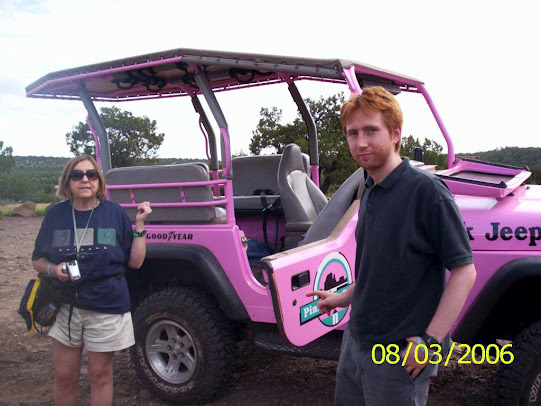
Although I missed this trip, I was feeling well enough to go to Sedona, Arizona in August, 2006.  I convinced everyone that I was well enough to go off-road in a pink jeep,  DH wanted to report me to my surgeon but I survived without to much pain and posed for the header image.

In 2009, I figured I have “extra years” since I survived the cancer and I wanted to do something kinda scary, yet fun. So, somehow, I decided on ziplining. Tom wouldn’t go with me but Michael would so I set this up almost as soon as we booked a Caribbean cruise to replace the Cushie Cruise to Bermuda.

Each person had a harness around their legs with attached pulleys and carabiners. Women had them on their chests as well. In addition, we had leather construction gloves and hard hats.

We climbed to the top of the first platform and were given brief instructions and off we went. Because of the heavy gloves, I couldn’t get any pictures. I had thought that they would take some of us on the hardest line to sell to us later but they didn’t. They also didn’t have cave pictures or T-Shirts. What a missed opportunity!

This was so cool, so much fun. I thought I might be afraid at first but I wasn’t. I just followed instructions and went.

Sometimes they told us to break. We did that with the right hand, which was always on the upper cable.

After the second line, I must have braked too soon because I stopped before I got to the platform. Michael was headed toward me. The guide on the end of the platform wanted me to do some hand over hand maneuver but I couldn’t figure out what he was saying so he came and got me by wrapping his legs around me and pulling me to the platform.

After that, no more problems with breaking!

The next platform was very high – over 70 feet in the air – and the climb up was difficult. It was very hot and the rocks were very uneven. I don’t know that I would have gotten to the next platform if Michael hadn’t cheered me on all the way.

We zipped down the next six lines up to 250-feet between platforms and 85-feet high in the trees, at canopy level. It seemed like it was all over too soon.

But, I did it! No fear, just fun.

Enough of adventures – fun ones like these, and scary ones like transsphenoidal surgery and radical nephrectomy!


Does a normal urine free cortisol result rule out Cushing’s syndrome?

ENDO_2015


March 07, 2015

SAT 379-412-Cushing’s Syndrome

Does a normal urine free cortisol result rule out Cushing’s syndrome?

ST Sharma, LK Nieman

Summary: Researchers conducted this study to assess the diagnostic accuarcy of urine free cortisol (UFC) and 24-hour urine 17-hydroxycorticosteroids (170HCS) in patients with Cushing’s syndrome, concluding that in patients with mild CS, UFC can be falsely normal or only minimally elevated. Further, they found that to help in making a diagnosis and prevent treatment delays, clinicians may consider incorporating multiple collections and use of complimentary screening tests including 24-hour urine 17OHCS and late night salivary cortisol (LNSC) testing.

Methods:

  • For this retrospective study, researchers included all CS patients evaluated at the National Institutes of Health (NIH) from 2009 to 2014.
  • The screening tests used for CS included UFC, 17OHCS, midnight serum cortisol and low dose (1 mg overnight or 2-day 2 mg/day) dexamethasone suppression test (DST).
  • They defined abnormal as values above reference range for UFC, 17OHCS and LNSC, a midnight serum cortisol ≥7.5 mcg/dL, and post-dexamethasone cortisol values ≥1.8 mcg/dL.
  • Hourly 24-hour sampling for cortisol was performed in a few cases with a mild clinical phenotype and equivocal test results.
  • Researchers measured UFC using liquid chromatography/tandem mass spectrometry (LC-MS/MS), and 17OHCS was measured using colorimetric methodology with Porter-Silber reaction (reported as mg/g of creatinine).
  • For this study, they used the mean of the first two UFC and 17OHCS values (appropriate collection by urine volume and creatinine) obtained within 30 days of initial NIH presentation.

Results:

  • In all, 72 patients were diagnosed with CS (aged 18-77 years, 51 females), 51 of whom had CD, 10 had ectopic CS, and 2 had an adrenal source of Cushing’s based on pathology.
  • Biochemical tests such as inferior petrosal sinus sampling (IPSS) suggested ectopic CS, but no tumor was found (occult) in 6 patients.
  • In 2 patients with failed transsphenoidal surgery, IPSS was indicative of a pituitary source, and one patient did not complete evaluation for ACTH-dependent CS.
  • UFC results were available in all patients, 17OHCS in 70, LNSC in 21, midnight serum cortisol in 68, and DST results in 37 patients.
  • UFC was falsely normal in 6 patients and only minimally elevated (<2 x ULN) in 13 patients (normal renal function, no history of cyclicity, all had CD); of these 19 patients, 24-hour 17OHCS was abnormal in all, LNSC was abnormal in 12, midnight serum cortisol was abnormal in 18, and DST was abnormal in 12 patients.
  • Hourly 24-hour sampling for cortisol performed in 3 of these patients revealed abnormal nadir (>7.5 mcg/dL) and mean daily serum cortisol (>9 mcg/dL) levels.

From http://www.mdlinx.com/endocrinology/conference-abstract.cfm/ZZ5BA369FDE9DE4CED82CB6A7CD5BFD1BE/42581/?utm_source=confcoveragenl&utm_medium=newsletter&utm_content=abstract-list&utm_campaign=abstract-ENDO2015&nonus=0

Myth: UFC’s are the Gold Standard for Cushing’s testing

Myth: UFC’s are the Gold Standard for Cushing’s testing

myth-busted

Fact: UFC stands for Urinary Free Cortisol. In layman’s terms this test assesses cortisol by collecting urine for 24 hours. It was once thought that this was the gold standard and the end all and be all in terms of assessing Cushing’s in a patient. What we now know is that this is not necessarily true. Though this test is helpful in assessing for Cushing’s in some patients, not all patients have positive labs with this test, even if they DO, in fact, have Cushing’s.

There are various theories as to why. Cyclical Cushing’s patients also tend to report having a lower prevalence of positive UFCs in their test batteries.

Cushing’s experts understand that the most effective way to test for Cushing’s, especially in cases where it is suspected that the patient is cycling, is to administer multiple test measures across an extended period of time.

The following links may be helpful:

http://www.ncbi.nlm.nih.gov/pmc/articles/PMC2978784/

Click to access LimitationsSC_UFC_dex_mildCS.pdf

http://survivethejourney.blogspot.com/2008/08/when-gold-standard-becomes-tarnished.html

Use late-night salivary cortisol to catch recurrent Cushing’s


AT ICE/ENDO 2014


CHICAGO – Late-night salivary cortisol exceeded normal limits in 10 women with recurrent Cushing’s disease a mean of 3.5 years after transsphenoidal surgery, but their urinary free cortisol remained in normal limits, according to a retrospective review from the Medical College of Wisconsin, Milwaukee.

That adds strength to the notion that late-night salivary cortisol (LNSC) catches recurrent Cushing’s that’s missed by urinary free cortisol, even though UFC remains a standard screening approach in some places.

The study is tiny and retrospective, but at the joint meeting of the International Congress of Endocrinology and the Endocrine Society, lead investigator Dr. Ty Carroll explained why the findings still matter, and also why two LNSC measurements are better than one.

Video: http://www.clinicalendocrinologynews.com/home/article/video-use-late-night-salivary-cortisol-to-catch-recurrent-cushings/d7fad98e9289f9402034e73455b7560c.html