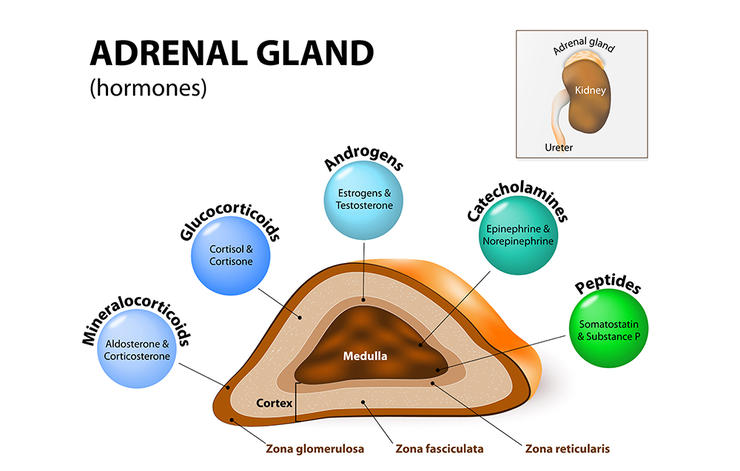
Cortisol gets a bad rap these days. (Guilty!) Yes, this hormone surges when you’re stressed. And yes, chronic stress is bad news for your health. But while too much cortisol can lead to all sorts of stress-related side effects, too little cortisol is equally debilitating.
Just ask someone with Addison’s disease. If you suffer from this condition, your adrenal glands fail to make adequate amounts of cortisol, says Betul Hatipoglu, MD, an endocrinologist at Cleveland Clinic.
Cortisol plays a role in regulating your blood pressure, heart function, digestion, and a lot else, Hatipoglu explains. So if your adrenal glands poop out and your cortisol levels plummet, a lot can go wrong. (In as little as 30 days, you can be a whole lot slimmer, way more energetic, and so much healthier just by following the simple, groundbreaking plan in The Thyroid Cure!)
Here’s what you need to know about this condition—starting with its craziest symptom.
It can make your teeth appear whiter.
Hatipoglu once met with a patient who was suffering from fatigue, belly pain, and mild weight loss. “Her doctors thought she was depressed,” Hatipoglu recalls. Toward the end of their appointment, Hatipoglu noticed the woman’s teeth looked very white. She realized they looked white because the woman’s skin was tan. “I asked her if she’d been on vacation, and she said she hadn’t been in the sun, and that’s when I knew,” Hatipoglu says. Some Addison’s-related hormone shifts can make the skin appear darker, almost like a tan. “Addison’s is the only disease I know of that can cause darkening of the skin,” she says.
Its (other) symptoms are popular ones.
Along with darker skin, other symptoms of Addison’s include nausea, mild-to-severe abdominal or bone pain, weight loss, a lack of energy, forgetfulness, and low blood pressure, Hatipoglu says. Of course, those same symptoms are linked to many other health issues, from thyroid disease to cancer. “It’s very easy to confuse with other disorders, so many people see a lot of doctors before finally receiving a proper diagnosis,” she says. (One exception: For young women who develop Addison’s disease, loss of body hair is a warning sign, Hatipoglu adds.)
It’s rare.
Doctors also miss or misinterpret the symptoms of Addison’s disease because it’s very uncommon. “I’m not sure if it’s quite one in a million, but it’s very rare,” Hatipoglu says. “It makes sense that many doctors don’t think of it when examining a patient with these symptoms.”
It’s often confused with adrenal insufficiency.
A lot of online resources mention Addison’s disease and adrenal insufficiency as though they were two names for the same condition. They’re not the same, Hatipoglu says. While a thyroid issue or some other hormone-related imbalance could mess with your adrenal function, Addison’s disease refers to an autoimmune disorder in which your body attacks and destroys your adrenal glands.
That destruction can happen quickly.
While it takes months or even years for some Addison’s sufferers to lose all hormone production in their adrenal glands, for others the disease can knock out those organs very rapidly—in a matter of days, Hatipoglu says. “That’s very uncommon,” she adds. But compared to other less-severe adrenal issues, the symptoms of Addison’s tend to present more dramatically, she explains. That means a sufferer is likely to experience several of the symptoms mentioned above, and those symptoms will continue to grow worse as time passes.
Anybody can get it.
Addison’s is not picky. It can strike at any age, regardless of your sex or ethnicity, Hatipoglu says. While there’s some evidence that genetics may play a role—if other people in your family have the disease or some other endocrine disorder, that may increase your risk—there’s really no way to predict who will develop the disease, she adds.
Screening for Addison’s is pretty simple.
If your doctor suspects Addison’s, he or she will conduct a blood test to check for your levels of cortisol and another hormone called ACTH. “Usually the results of that screening are very clear,” Hatipoglu says. If they’re not, some follow-up tests can determine for sure if you have the condition.
There are effective treatments.
Those treatments involve taking oral hormone supplements. In extreme cases, if the patient’s body does not properly absorb those supplements, injections may be necessary, Hatipoglu explains. “But patients live a normal life,” she adds. “It’s a treatable disease, and the treatments are effective.”
The pituitary gland works hard to keep you healthy, doing everything from ensuring proper bone and muscle growth to helping nursing mothers produce milk for their babies. Its functionality is even more remarkable when you consider the gland is the size of a pea.
“The pituitary is commonly referred to as the ‘master’ gland because it does so many important jobs in the body,” says Karen Frankwich, MD, a board-certified endocrinologist at Mission Hospital. “Not only does the pituitary make its own hormones, but it also triggers hormone production in other glands. The pituitary is aided in its job by the hypothalamus. This part of the brain is situated above the pituitary, and sends messages to the gland on when to release or stimulate production of necessary hormones.”
These hormones include:
Growth hormone, for healthy bone and muscle mass
Thyroid-stimulating hormone, which signals the thyroid to produce its hormones that govern metabolism and the body’s nervous system, among others
Follicle-stimulating and luteinizing hormones for healthy reproductive systems (including ovarian egg development in women and sperm formation in men, as well as estrogen and testosterone production)
Prolactin, for breast milk production in nursing mothers
Adrenocorticotropin (ACTH), which prompts the adrenal glands to produce the stress hormone cortisol. The proper amount of cortisol helps the body adapt to stressful situations by affecting the immune and nervous systems, blood sugar levels, blood pressure and metabolism.
Antidiuretic (ADH), which helps the kidneys control urine levels
Oxytocin, which can stimulate labor in pregnant women
The work of the pituitary gland can be affected by non-cancerous tumors called adenomas. “These tumors can affect hormone production, so you have too little or too much of a certain hormone,” Dr. Frankwich says. “Larger tumors that are more than 1 centimeter, called macroadenomas, can also put pressure on the area surrounding the gland, which can lead to vision problems and headaches. Because symptoms can vary depending on the hormone that is affected by a tumor, or sometimes there are no symptoms, adenomas can be difficult to pinpoint. General symptoms can include nausea, weight loss or gain, sluggishness or weakness, and changes in menstruation for women and sex drive for men.”
If there’s a suspected tumor, a doctor will usually run tests on a patient’s blood and urine, and possibly order a brain-imaging scan. An endocrinologist can help guide a patient on the best course of treatment, which could consist of surgery, medication, radiation therapy or careful monitoring of the tumor if it hasn’t caused major disruption.
“The pituitary gland is integral to a healthy, well-functioning body in so many ways,” Dr. Frankwich says. “It may not be a major organ you think about much, but it’s important to know how it works, and how it touches on so many aspects of your health.”
Corresponding author: Troy Puar, MRCP (UK), Department of Medicine, Div. of Endocrinology, Radboud University Medical Centre, 6500 HB Nijmegen, The Netherlands. Phone: +31 243614599, Fax: +31 243618809, e-mail: Troy_puar@cgh.com.sg
Recurrence of hypercortisolism in patients after bilateral adrenalectomy for Cushing’s disease is extremely rare.
Patient:
We present a rare case of a 27-year-old man who previously underwent bilateral adrenalectomy for Cushing’s disease with complete clinical resolution. Cushingoid features recurred 12 years later, along with bilateral testicular enlargement. Hormonal tests confirmed ACTH-dependent Cushing’s. Surgical resection of the testicular tumors led to clinical and biochemical remission.
Design and Results:
Gene expression analysis of the tumor tissue by qPCR showed high expression of all key steroidogenic enzymes. Adrenocortical-specific genes were 5.1 x 10⁵ (CYP11B1), 1.8 x 10² (CYP11B2) and 6.3 x 10⁴ (MC2R) times higher than non-steroidogenic fibroblast control. This correlated with urine steroid metabolome profiling showing 2-5 fold increases in the excretion of the metabolites of 11-deoxycortisol, 21-deoxycortisol and total glucocorticoids. Leydig-specific genes were 4.3 x 101 (LHCGR) and 9.3 x 100(HSD17B3) times higher than control and urinary steroid profiling showed 2-fold increased excretion of the major androgen metabolites androsterone and etiocholanolone. These distinctly increased steroid metabolites were suppressed by dexamethasone, but unresponsive to hCG stimulation, supporting the role of ACTH, but not LH, in regulating tumor-specific steroid excess.
Conclusion:
We report bilateral testicular tumors occurring in a patient with recurrent Cushing’s disease 12 years after bilateral adrenalectomy. Using mRNA expression analysis and steroid metabolome profiling, the tumors demonstrated both adrenocortical and gonadal steroidogenic properties, similar to testicular adrenal rest tumors found in patients with congenital adrenal hyperplasia. This suggests the presence of pluripotent cells even in patients without CAH.
Affiliations
1Department of Medicine, Division of Endocrinology, Radboud University Medical Centre, 6500 HB Nijmegen, The Netherlands.
2Department of Endocrinology, Changi General Hospital, Singapore 529889, Singapore.
3Department of Paediatrics, Division of Endocrinology, Radboud University Medical Centre, 6500 HB Nijmegen, The Netherlands.
4Department of Laboratory Medicine, Radboud University Medical Centre, 6500 HB Nijmegen, The Netherlands.
5Department of Pathology, Radboud University Medical Centre, 6500 HB Nijmegen, The Netherlands.
6Department of Radiology, Radboud University Medical Centre, 6500 HB Nijmegen, The Netherlands.
7Institute of Metabolism and Systems Research, University of Birmingham, Birmingham N15 2TT, United Kingdom.
8Centre for Endocrinology, Diabetes, and Metabolism, Birmingham Health Partners, Birmingham B15 2TH, United Kingdom.
Life was good! In fact, life was great! I was married to the love of my life. We had a beautiful little girl. My husband and I had both earned our graduate degrees. I earned my Doctorate in Clinical Psychology and was growing my clinical practice. I loved my work!
In October, 2006, my life was turned upside down when I gained 30 pounds in 30 days! I knew this was not normal at all. I sought answers but my doctor kept insisting that I wasn’t eating the right foods, that I wasn’t exercising hard enough, and finally that it was genetic. However, I was always a thin person, I ate pretty healthy foods, and I was pretty active. Red flags became even greater when my physician put me on prescription weight loss drugs and I STILL gained another 30 pounds. I knew my body and I knew something was wrong but I had no one to validate what was going on.
In January, 2010, to my surprise, I learned that I was miraculously pregnant with our second daughter. I was so sick during that pregnancy and, again, my doctors couldn’t figure out why. My OBGYN was very supportive, yet so concerned. Her solution was to put me on bed rest. I became so ill that she told me that “my only job was to sit still and wait to have a baby”. I did give birth to a healthy baby girl four weeks early. Little did I know, then, how much of a miracle she was.
During the latter part of my pregnancy, while flipping through channels on television, I came across a Cushing’s episode on the health TV show, “Mystery Diagnosis”.
I knew right away that this diagnosis fit everything I had been experiencing: years of weird and unexplained symptoms, gaining 150 pounds for no reason, an onset of diabetes, high blood pressure, and an overall sense of doom.
You see, my friends and family witnessed me go from a vibrant young Clinical Psychologist in practice, to someone whose health deteriorated due to the symptoms of Cushing’s, as I tried for many years to get answers from professionals. As I continued to eat a healthy, 1000 calorie per day diet, engage in exercise with multiple personal trainers, and follow through with referrals to consult with dietitians; I continued to gain weight at a rate of 5 pounds per week and experience rapidly declining health. Finally, after watching that Cushing’s episode of Mystery Diagnosis, I found my answer! Ultimately, I sought the expertise of and treatment from a team of experts at the Seattle Pituitary Center in Seattle, WA. I had brain surgery in Seattle on November 16th, 2011. I want to tell you how I found the people who helped save my life…
On June 9, 2011, I went to my first MAGIC conference. I had never heard of them but someone on one of the online support groups told me about it. At that time, I was working but was very, very sick. We suspected at that time that I had been sick for years! My local endocrinologist was far from a Cushing’s expert. After watching the Cushing’s episode of Mystery Diagnosis, I told the same endocrinologist who had misdiagnosed me for years that I had found my answer. He swore that there was “literally no possible way that I had Cushing’s Disease!” He stated that my “hump wasn’t big enough”, “my stretch marks were not purple enough” and that “Cushing’s patients do not have children!” I told him that I was NOT leaving his office until he started testing me. He finally caved in. To his surprise, I was getting abnormal labs back.
At that time, there was evidence of a pit tumor but it wasn’t showing up on an MRI. So, I had my IPSS scheduled. An IPSS stands for Inferior Petrosal Sinus Sampling. It is done because 60 % of Cushing’s based pituitary tumors are so small that they do not show up on an MRI. Non Cushing’s experts do not know this so they often blow patients off, even after the labs show a high level of ACTH in the brain through blood work. An overproduction of the hormone ACTH from the pituitary communicates to the adrenal glands to overproduce cortisol. Well, the IPSS procedure is where they put catheters up through your groin through your body up into your head to draw samples to basically see which side of your pituitary the extra hormone is coming from, thus indicating where the tumor is. U of C is the only place in IL that does it.
So, back to the MAGIC convention; my husband and I went to this conference looking for answers. We were so confused and scared! Everyone, and I mean everyone, welcomed us with opened arms like we were family! There were brilliant presenters there, including an endocrinologist named Dr. William Ludlam. At that time, he was the director at the Seattle Pituitary Center in Seattle, WA. He is a true Cushing’s expert. Since then, he left in January, 2012 to have a significant impact toward the contribution of research of those impacted by Cushing’s Syndrome. His position was taken over by another brilliant endocrinologist, Dr. Frances Broyles.
I was scheduled to get an IPSS at U of C on June 28th, 2011 to locate the tumor. Two days after the IPSS, I began having spontaneous blackouts and ended up in the hospital for 6 days. The docs out here had no clue what was happening and I was having between 4-7 blackouts a day! My life was in danger and they were not helping me! We don’t know why, but the IPSS triggered something! But, no one wanted to be accountable so they told me the passing out, which I was not doing before, was all in my head being triggered by psychological issues. They did run many tests. But, they were all the wrong tests. I say all the time; it’s like going into Subway and ordering a turkey sandwich and giving them money and getting a tuna sandwich. You would be mad! What if they told you, “We gave you a sandwich!” Even if they were to give you a dozen sandwiches; if it wasn’t turkey, it wouldn’t be the right one. This is how I feel about these tests that they ran and said were all “normal”. The doctors kept telling us that they ran all of these tests so they could cover themselves. Yet, they were not looking at the right things, even though, I (the patient) kept telling them that this was an endocrine issue and had something to do with my tumor! Well, guess how good God is?!!!!
You see, Dr. Ludlam had given me his business card at the conference, which took place two weeks prior to the IPSS. I put it away for a while. But, something kept telling me to pull the card out and contact him. I am crying just thinking about it, Lord!
So, prior to my IPSS, I wrote Dr. Ludlam an e mail asking him some questions. At that time, he told me to send him ALL of my records including labs. I sent him 80 pages of records that day. He called me back stating that he concurred with all of the evidence that I definitely have Cushing’s Disease from a pituitary source. He asked me what I planned to do and I told him that I was having the IPSS procedure done in a few days at the University of Chicago. He told me once I got my results to contact him.
Fast forward, I ended up in the hospital with these blackouts after my IPSS. The doctors, including MY local endocrinologist told me there was no medical evidence for my blackouts. In fact, he told the entire treatment team that he even doubted if I even had a tumor! However, this is the same man who referred me for the IPSS in the first place! I was literally dying and no one was helping me! We reached out to Dr. Ludlam in Seattle and told him of the situation. He told me he knew exactly what was going on. For some reason, there was a change in my brain tumor activity that happened after my IPSS. No one, to this day, has been able to answer the question as to whether the IPSS caused the change in tumor activity. The tumor, for some reason, began shutting itself on and off. When it would shut off, my cortisol would drop and would put me in a state of adrenal insufficiency, causing these blackouts!
Dr. Ludlam said as soon as we were discharged, we needed to fly out to Seattle so that he could help me! The hospital discharged me in worse condition then when I came in. I had a blackout an hour after discharge! But get this…The DAY the hospital sent me home saying that I did not have a pit tumor, my IPSS results were waiting for me! EVIDENCE OF TUMOR ON THE LEFT SIDE OF MY PITUITARY GLAND!!!
Two days later, Craig and I were on a plane to Seattle. I had never in my life been to Seattle, nor did I ever think I would go. We saw the man that God used to save my life, Dr. William Ludlam, the same man who we had met at the MAGIC conference for the first time one month prior! He put me on a combo of medications that would pull me out of crisis. Within one month, my blackouts had almost completely stopped! Unfortunately, we knew this was a temporary fix! He was treating me to carry me over to surgery. You see, his neurosurgeon, Dr. Marc Mayberg was just as amazing. He is one of the top neurosurgeons in the US! Statistically, he has one of the highest success rates!
The problem was that our insurance refused to pay for surgery with an expert outside of IL, stating that I could have surgery anywhere in IL! Most people don’t know that pituitary surgeries are very complicated and need the expertise of a “high volume center” which is where they do at least 50 of these surgeries per year. Dr. Mayberg has performed over 5,000 of these surgeries! By this time, we had learned that we need to fight for the best care! It was what would give me the best chance at life! We thought I would have to wait until January when our insurance would change, to see if I could get the surgery I so desperately needed! I was holding on by a thread!
We began appealing our insurance. At the time the MAGIC foundation had an insurance specialist who was allowed to help us fight our insurance. Her name is Melissa Callahan and she took it upon herself to fight for us as our patient advocate. It was a long and hard battle! But…we finally WON!!!! On November 16th, 2011, Dr. Marc Mayberg found that hidden tumor on the left side of my pituitary gland! He removed the tumor along with 50% of my pituitary gland.
Recovery was a difficult process. They say that it takes about one full year to recover after pituitary surgery for Cushing’s. I was grateful to be in remission, nonetheless. However, about one year after my brain surgery, the Cushing’s symptoms returned. After seven more months of testing that confirmed a recurrence of the Cushing’s, I was cleared for a more aggressive surgery. This time, I had both of my adrenal glands removed as a last resort. By then, we had learned that I had hyperplasia, which is an explosion of tumor cells in my pituitary. It only takes one active cell to cause Cushing’s. Therefore, I could have potentially had several more brain surgeries and the disease would have kept coming back over and over.
As a last resort, my adrenal glands were removed so that no matter how much these cells try to cause my adrenals to produce excessive amounts of cortisol; the glands are not there to receive the message. As a result, I am Adrenally Insufficient for life, which means that my body cannot produce the life sustaining hormone, cortisol, at all. I had my Bilateral Adrenalectomy by world renowned BLA surgeon, Dr. Manfred Chiang, in Wisconsin on August 21st, 2013. I traded Cushing’s Disease for Addison’s Disease, one of the hardest decisions I have ever had to make in my life. However, I knew that I would die with Cushing’s. Recovery from my last surgery was difficult and involved weaning down to a maintenance dose of steroid to replace my cortisol. Now, on a maintenance dose; I still have to take extra cortisol during times of physical or emotional stress to prevent my body from going into shock.
I promised a long time ago that I would pay it forward…give back because so much has been given to me. This is why I have committed my life to supporting the Cushing’s community. I post videos on YouTube as a way of increasing awareness. My channel can be found at http://www.YouTube.com/drnkarenthames
Karen has made 2 videos about her experiences with Cushing’s:
and
Doc Karen will be our guest in an interview on BlogTalk Radio Friday December 2 at 11:00 AM eastern. The Call-In number for questions or comments is (323) 642-1665 .
The archived interview will be available through iTunes Podcasts (Cushie Chats) or BlogTalkRadio. While you’re waiting, there are currently 90 other past interviews to listen to!
Correspondence toDr Paula Casano-Sancho, Pediatric Endocrinology Unit, Sant Joan de Déu Hospital, Passeig Sant Joan de Déu, Santa Rosa 39-57, Esplugues, Barcelona 08950, Spain; pcasano@hsjdbcn.org
Received 14 July 2016
Revised 26 October 2016
Accepted 27 October 2016
Published Online First 21 November 2016
Abstract
In the past decade, several studies in adults and children have described the risk of pituitary dysfunction after traumatic brain injury (TBI). As a result, an international consensus statement recommended follow-up on the survivors. This paper reviews published studies regarding hypopituitarism after TBI in children and compares their results.
The prevalence of hypopituitarism ranges from 5% to 57%. Growth hormone (GH) and ACTH deficiency are the most common, followed by gonadotropins and thyroid-stimulating hormone. Paediatric studies have failed to identify risk factors for developing hypopituitarism, and therefore we have no tools to restrict screening in severe TBI. In addition, the present review highlights the lack of a unified follow-up and the fact that unrecognised pituitary dysfunction is frequent in paediatric population.
The effect of hormonal replacement in patient recovery is important enough to consider baseline screening and reassessment between 6 and 12 months after TBI. Medical community should be aware of the risk of pituitary dysfunction in these patients, given the high prevalence of endocrine dysfunction already reported in the studies. Longer prospective studies are needed to uncover the natural course of pituitary dysfunction, and new studies should be designed to test the benefit of hormonal replacement in metabolic, cognitive and functional outcome in these patients.