Common Asthma Steroids Linked to Side Effects in Adrenal Glands

(Reuters Health) – After stopping steroids commonly prescribed for asthma and allergies, a significant number of people may experience signs of malfunctioning in the adrenal glands, a European study finds.

So-called adrenal insufficiency can be dangerous, especially if the person’s body has to cope with a stress like surgery, injury or a serious illness, the study authors say.

“The takeaway message of the study is that in corticosteroid use there is a substantial risk of adrenal insufficiency,” senior author Dr. Olaf Dekkers, an endocrinologist at Aarhus University in Denmark, said by email. “Patients should be aware of this risk and be informed about potential symptoms.”

Those symptoms can include fatigue, dizziness, weight loss and salt cravings, the authors write in the Journal of Clinical Endocrinology and Metabolism.

Corticosteroids are man-made drugs designed to mimic the hormone cortisol, which the adrenal glands produce naturally. The drugs are usually used to counter inflammation in a wide range of conditions, including asthma, psoriasis, rheumatoid arthritis, lupus, blood cancers and organ transplants.

People with adrenal insufficiency do not make enough of two hormones, cortisol and aldosterone. Cortisol helps the body respond to stress, recover from infections and regulate blood pressure and metabolism. Aldosterone helps maintain the right amounts of salt, potassium and water in the body.

While on steroids, the body often produces less of these hormones naturally, and after coming off the drugs it can take a while for natural production to ramp back up. The result is adrenal insufficiency, which can be treated with medication to replace cortisol or aldosterone.

Dekkers and colleagues analyzed 74 research articles published from 1975 to 2014, covering a total of 3753 study participants, to see how different doses and types of corticosteroid treatment might impact the likelihood of developing adrenal insufficiency after treatment.

Researchers found the risk of adrenal insufficiency was highest when corticosteroids were taken orally or injected, and lower with inhaled, nasal or topical treatment.

When they looked just at patients using steroids for asthma, the researchers found that the risk of adrenal insufficiency was about 7 percent with inhaled corticosteroids, but about 44 percent with other formulations including oral medication.

Only about 2 percent of asthma patients on the lowest dose of steroids experienced adrenal insufficiency, compared with about 22 percent on the highest doses.

Similarly, slightly more than 1 percent of asthma patients on short-term steroids developed adrenal insufficiency, compared with about 27 percent on long-term treatment.

There is no way to safely halt treatment with corticosteroids that can rule out the potential for adrenal insufficiency, Dekkers said.

The side effect is more likely when patients take higher doses of steroids or remain on treatment for longer than three weeks, said Dr. Roberto Salvatori, medical director of the pituitary center at Johns Hopkins Hospital in Baltimore.

“It’s likely, and it’s often overlooked because most often the people who prescribe corticosteroids aren’t endocrinologists; they are in other specialities and they don’t recognize the symptoms of adrenal insufficiency,” said Salvatori, who wasn’t involved in the study.

He gives his patients on corticosteroids medical identification bracelets or necklaces to wear so they can be identified as at risk for adrenal insufficiency in an emergency. “This is a very important issue that’s not on the radar screen,” he said.

To be sure, more physicians are aware of the risk now than in the 1970s, and the standard doses and durations of corticosteroid treatment have been reduced in part because of this risk, said Dr. Douglas Coursin, a professor at the University of Wisconsin School of Medicine and Public Health in Madison. He, too, advises medical alert bracelets for patients on long-term or high-dose treatment.

“In the past, patients with asthma, certain immune diseases, those receiving some cancer therapies and those who had a solid organ transplant received higher doses for longer periods of time,” Coursin, who wasn’t involved in the study, said by email. “Overall, I think the risk may be lower than outlined in the study because of practice changes.”

SOURCE: bit.ly/1PjRHYw Journal of Clinical Endocrinology and Metabolism, online April 6, 2015.

Cushing’s Awareness Challenge 17

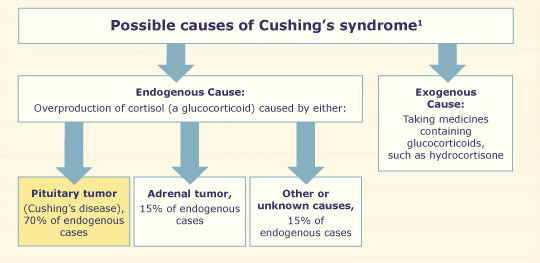
robin-causes

Another of Robin’s wonderful images.

A similar image from the CushieWiki

cushings-causes

No wonder Cushing’s is so hard to diagnose!

maryo colorful zebra

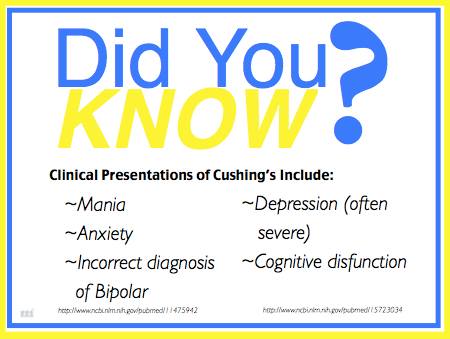
Cushing’s Awareness Challenge, Day 3: Symptoms

robin-symptoms


Robin has made another excellent graphic of some of the symptoms of Cushing’s.  There are far too many to be listed in any image, as shown by the list at http://www.cushings-help.com/toc.htm#symptoms


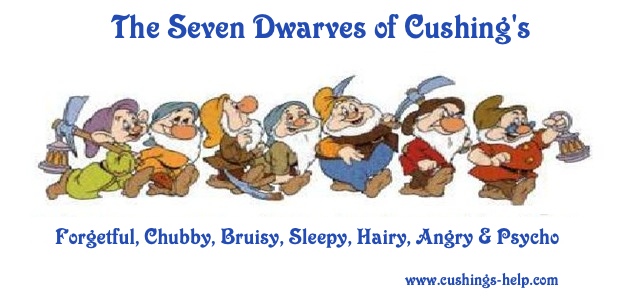
Just to be silly, a few years ago, I did my own version of Cushing’s symptoms:


The Seven Dwarves of Cushing's

The Man Unable to Feel Fear

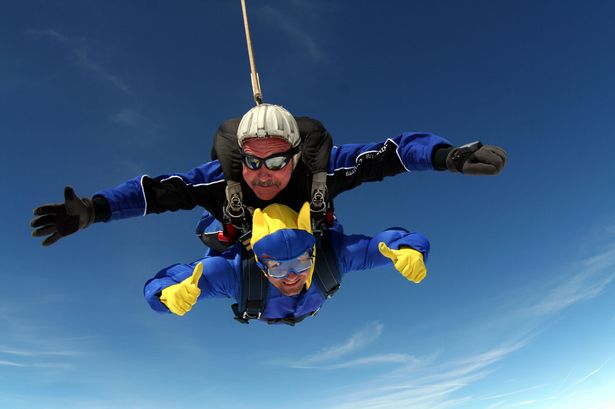
Jordy is a British man who has been dealing with Cushing’s and many surgeries.


Jordy-Cernik

He finds rollercoasters boring, barely broke a sweat zip-wiring off the Tyne bridge and even a parachute jump did not raise his heart rate.

Just a few years ago even the thought of daredevil exploits would have terrified him, but now Jordy Cernik is frightened of nothing.

While that might sound an ideal scenario, the 38-year-old’s new-found bravery is actually the unexpected side-effect of surgery for a rare condition.

Cushing’s Syndrome resulted in the dad-of-two having an operation to remove the gland which produces adrenalin, the hormone which makes us feel scared.

He says: “I would never have had the guts to do any of this, but now nothing fazes me. I’m up for anything – I’m even thinking about doing a wing-walk on a plane too.

“I nearly did a bungee jump a few years ago, but I just couldn’t do it.

“Now I just take whatever is thrown at me and if a challenge helps me raise money for charity, the more daring the better.”

Over the past four months he has completed the parachute jump and zip-wired from the top of Newcastle’s Tyne Bridge and now he is getting ready to complete the last of a trio of challenges – next month’s Bupa Great North Run.

“The doctors didn’t tell me this could be one of the side-effects of the operation,” says Jordy. “But then the condition is so rare I don’t think they know everything about Cushing’s yet.

“Doing the skydive was the ultimate test. I thought that if I was ever going to get scared again then that would be the moment.

“But as we took off in the plane I felt nothing, and when I edged towards the door to jump I felt nothing, and even when I leapt out and pulled my parachute, I didn’t feel scared at all.

“It can be quite frustrating as well though.

“The first time I realised I had changed was when I went on the rides at a theme park with my kids and I just didn’t feel a thing. I just sat there, bored.”

However, the last of his hat-trick of challenges, the Run, will require him to push through the ever-present pain which he has endured for years as a result of Cushing’s.

Britain’s biggest mass participation event, for which The Daily Mirror is a media partner, takes place over a 13.1 mile course from Newcastle to South Shields.

But the syndrome has left Jordy, from Jarrow, near Newcastle, with arthritis, back problems and brittle bones. Worse still, the absence of adrenalin means he now lacks one of the body’s natural painkillers.

“I’m always in pain,” he says. “I’ve just had to learn to zone it out day-to-day and I’m going to have to do that even more when I’m on the run.”

Cushing’s affects around one in 50,000 people in Britain.

It causes a malfunction of the adrenal and pituitary glands which means increased amounts of corticosteroids are produced – often leading to massive, irregular weight gain.

In just three years 5ft 8in Jordy ballooned from 11st 5lb to almost 17st.

While his limbs remained slim, the former Territorial Army recruit saw the pounds pile around the major organs in his torso and head.

“I went through years of hell and I can only describe it as living in someone else’s body,” says the part-time radio presenter and events host.

“I developed this big round moon face and really quite large man boobs, which was so embarrassing.

“But there was absolutely nothing I could do about it. I could go to the gym six days a week and still couldn’t lose any of the weight.

“One of the worst things was that people would stare.

“Sometimes they’d take the mickey – often to try and make me feel better, by making light of things – but it would almost always hurt my feelings.

“And my career as a presenter suffered. I tried to play up to the character of being a big, jolly chap but I always felt I was too fat for TV, which is what I would have liked to do a lot more of.”

But it was the effect on his home life with wife Tracy, 43, and daughters Aimee, seven, and four-year-old Eive that for him was far worse.

“I had other really difficult symptoms which included profuse sweating which meant I couldn’t even hold my kids without wrapping them in towels first,” he says.

“Anyone who has children knows how hard that is, not to be able to do normal things. I often used to be in tears.

“Another symptom was extreme grumpiness, so I would find myself suddenly getting really angry and just exploding at them, plus I was always too exhausted to play with them. It was terrible.”

Jordy believes he can trace his symptoms back 15 years although his Cushing’s was only diagnosed in 2005.

He had visited his local surgery with a string of complaints, but by chance saw a different doctor one day and the syndrome was diagnosed.

“I don’t have any ill-feeling about that,” he says, “because the syndrome can be tricky to spot, partly because it is so rare.”

He went on to have both his pituitary and adrenal glands removed but needed a total of seven operations between 2005 and 2010 and not all went smoothly.

During one to remove his pituitary gland, which is inside the skull, the lining of his brain burst due to the stress of repeated surgery.

And while removing a rib to access the adrenal gland in his torso, his lung was punctured.

That wasn’t the end of the complications. He later developed severe meningitis and ended up on a life-support machine.

“But I still consider myself lucky,” he says. “The doctors told me, ‘You died twice really, you shouldn’t even be here’.”

Things have begun to look up in the past few years, however. The Cushing’s is in remission and Jordy has lost four stone.

His life hasn’t returned to normal entirely – he still has to take 30 pills a day, a cocktail of painkillers and hormones, plus drugs to slow the corrosion of his bones.

He has also been diagnosed with another rare condition, sarcoidosis, which creates nodules of irregular cells in the body and can cause serious complications. He’s convinced he has always had it but it has lain dormant until his body was at its most vulnerable.

At present the nodules can only be found on his skin and he’s being monitored to ensure that it doesn’t spread to his internal organs.

Thanks to the surgery, his life has improved enormously since 2010.

In July he had a breast reduction op which not only improved his appearance but also removed the dangerous accumulation of fat around his heart.

Part of this new chapter involves taking part in the Great North Run and raising money for the Cash for Kids appeal run by his local radio station Metro Radio.

The appeal aims to help children and young people in the North East who are disabled or have special needs, or those who suffer from abuse or neglect.

Jordy’s fundraising goal is a relatively modest £1,000, but for him joining the half marathon’s 56,000 participants on September 15 will be as rewarding as hitting his target.

“I really don’t know if I’ll be able to complete the course.” he says. “But I’m looking forward to it and I’m going to give it my best shot.

“Not feeling fear may feel like the power of a superhero, but what I really need for the Great North Run is superhero strength.”

The Bupa Great North Run is Britain’s biggest mass participation event and is organised by Nova International.

It will include world class athletes Mo Farah, Haile Gebrselassie and Kenenisa Bekele – plus 56,000 other runners.

The event is live on BBC One on Sunday 15th September between 9.30am to 13.30

For more information, visit www.greatrun.org

From  http://www.mirror.co.uk/news/real-life-stories/jordy-cernik-man-unable-fear-2208002#ixzz2cny6XeFr 

Cushing’s, The “Gift” that Keeps on Giving

I had an eye doctor appointment yesterday. No problems, just a routine check, maybe update my contacts to a newer version.

I was completely not ready when the doctor said “cataracts” to me. Say what? I’m not that old.  He mentioned a few other things like macular degeneration but that was less distressing to me somehow than the Cataract Word.

They’re not bad yet.  They’re slow growing.  I won’t need to do anything about them for 7-8 years.  AARRGGHH!

My mother is waiting for her cataract surgery.  Maybe we can do this together, a bonding thing.

When I got home and all the eye drops had worn off, I looked at the brochures he had given me.  One of the symptoms was light insensitivity.  So that explains why I have trouble first thing in the morning and it hurts to open my eyes and other bright lights can be painful.  It’s nice to be validated but…

Then, I turned the page to find contributing factors and came upon the word STEROIDS.  Not again!  Almost all the problems in my life start with the word steroids.  I did a search of the Cushing’s Help boards for “Cataracts” and came up with 84 entries.  How could I have missed this?

From Cigna.com:

The eye conditions glaucoma and cataracts also may occur in Cushing’s syndrome. In Cushing’s disease (tumors on the pituitary gland), your field of vision can be affected. You may have loss of side, or peripheral, vision.