Case study shows chronic marijuana use associated with hypopituitarism

PHOENIX — Results of a case study presented here at the American Association of Clinical Endocrinologists 22nd Scientific and Clinical Congress demonstrate that smoking marijuana may result in serious endocrine complications.

Hormone feedback cycles

Hormone feedback cycles (Photo credit: Wikipedia)

“We really feel that the evidence to-date shows this is a much more serious health problem than we’ve given credit to,” Pinsker said during a press conference. “Marijuana’s always been laughed off: ‘it’s a kid’s drug; they’ll outgrow it.’ In certain communities, it’s so common that people look at it as if they’re having a glass of beer. I think it’s time that physicians start having their antenna up for all the difficulties that come with this drug.”

The patient presented to the emergency department with dyspnea on exertion, increasing fatigue and loss of libido with no previous radiation exposure or head trauma. He had bibasilar rales, gynecomastia and bilateral atrophied testis.

His hormonal evaluation demonstrated low Luteinizing Hormone (0.2 mIU/mL); FSH (1.8 mIU/mL) and testosterone (22 ng/dL), as well as high prolactin (53.3 ng/mL).

Additionally, the patient had ACTH of 6 pg/mL and cortisol of 6.4 ug/dL at 0 minutes and 9.3 ug/dL at 60 minutes following cosyntropin administration.

Further labs revealed low total T3 (30 ng/dL); high T3 resin reuptake (49%); low total T4 (3.94 ng/dL); normal free T4 (0.97 ng/dL) and low TSH (0.22 uIU/mL). Growth hormone was within normal range (5.0 ng/mL) and IGF-I was low (75 ng/mL; Z-score of -1.3). An MRI revealed a slightly enlarged protuberant pituitary gland, but no identified mass lesion.

After being started on cortisone 25 mg in the morning and 12.5 mg at bedtime, as well as levothyroxine 25 mcg daily, the patient’s fatigue and edema improved significantly, according to the abstract.

In this case, severe hypopituitarism occurred from interference between THC, the psychoactive ingredient in marijuana which has the ability to alter neural transmitters in the hypothalamus, and hypothalamic function.

Additionally, studies show that marijuana impairs the release of gonadotropin-releasing hormone (GnRh), resulting in reduced production of testosterone.

Other symptoms seen with prolonged use include cognitive decline in school children and older people, according to Pinsker. “The public will become more attuned to looking for these things. We’re going to have what we call a surveillance bias and we’re going to start discovering that it’s a lot higher than we gave it credit for, both because of increased use and because we’re going to be looking for it.”

The authors conclude that, as many states consider the legalization of marijuana, more study should be conducted with regard to the effects of chronic use of the drug on the endocrine system.

“Of course this is one case report, but I think it should alert further research that needs to be done, “ said Pinsker. “Something prospectively should be done to map this out more scientifically, but this would be difficult in what, to-date, has been an illegal substance.”

For more information:

Pinsker R. Abstract #825. Presented at: the AACE Annual Scientific and Clinical Congress; May 1-5, 2013; Phoenix.

Disclosure: The authors report no relevant financial disclosures.

 From Healio.com

ENDO 2021 Roundup: COVID-19 Risk With Adrenal Insufficiency, Cushing’s Death Risk, Jatenzo Liver Data, and More

Some of the latest research advancements in the field of endocrinology presented at the Endocrine Society’s virtual ENDO 2021 meeting included quantifying diabetic ketoacidosis readmission rateshyperglycemia as a severe COVID-19 predictor, and semaglutide as a weight loss therapy. Below are a few more research highlights:

More Safety Data on Jatenzo

In a study of 81 men with hypogonadism — defined as a serum testosterone level below 300 ng/dL — oral testosterone replacement therapy (Jatenzo) was both safe and effective in a manufacturer-sponsored study.

After 24 months of oral therapy, testosterone concentration increased from an average baseline of 208.3 ng/dL to 470.1 ng/dL, with 84% of patients achieving a number in the eugonadal range.

And importantly, the treatment also demonstrated liver safety, as there were no significant changes in liver function tests throughout the 2-year study — including alanine aminotransferase (28.0 ± 12.3 to 26.6 ± 12.8 U/L), aspartate transaminase (21.8 ± 6.8 to 22.0 ± 8.2 U/L), and bilirubin levels (0.58 ± 0.22 to 0.52 ± 0.19 mg/dL).

Throughout the trial, only one participant had elevation of liver function tests.

“Our study finds testosterone undecanoate is an effective oral therapy for men with low testosterone levels and has a safety profile consistent with other approved testosterone products, without the drawbacks of non-oral modes of administration,” said lead study author Ronald Swerdloff, MD, of the Lundquist Research Institute in Torrance, California, in a statement.

In addition, for many men with hypogonadism, “an oral option is preferred to avoid issues associated with other modes of administration, such as injection site pain or transference to partners and children,” he said. “Before [testosterone undecanoate] was approved, the only orally approved testosterone supplemental therapy in the United States was methyltestosterone, which was known to be associated with significant chemical-driven liver damage.”

Oral testosterone undecanoate received FDA approval in March 2019 following a rocky review history.

COVID-19 Risk With Adrenal Insufficiency

Alarming new data suggested that children with adrenal insufficiency were more than 23 times more likely to die from COVID-19 than kids without this condition (relative risk 23.68, P<0.0001). This equated to 11 deaths out of 1,328 children with adrenal insufficiency compared with 215 deaths out of 609,788 children without this condition (0.828% vs 0.035%).

These young patients with adrenal insufficiency also saw a much higher rate of sepsis (RR 21.68, P<0.0001) and endotracheal intubation with COVID-19 infection (RR 25.45, P<0.00001).

Data for the analysis were drawn from the international TriNetX database, which included patient records of children ages 18 and younger diagnosed with COVID-19 from 60 healthcare organizations in 31 different countries.

“It’s really important that you take your hydrocortisone medications and start stress dosing as soon as you’re sick,” study author Manish Raisingani, MD, of the University of Arkansas for Medical Sciences and Arkansas Children’s in Little Rock, explained during a press conference. “This will help prevent significant complications due to COVID-19 or any other infections. A lot of the complications that we see in kids with adrenal insufficiency are due to inadequate stress dosing of steroids.”

And with kids starting to return back to in-person schooling, “parents should also be reeducated about using the emergency injections of hydrocortisone,” Raisingani added. He noted that the COVID-19 complication rates were likely so high in this patient population because many had secondary adrenal insufficiency due to being on long-term, chronic steroids. Many also had comorbid respiratory illnesses, as well.

Cushing’s Death Risk

In a systematic review and meta-analysis of 87 studies — including data on 17,276 patients with endogenous Cushing’s syndrome — researchers found that these patients face a much higher death rate than those without this condition.

Overall, patients with endogenous Cushing’s syndrome faced a nearly three times higher mortality ratio (standardized mortality ratio 2.91, 95% CI 2.41-3.68, I2=40.3%), with those with Cushing’s disease found to have an even higher mortality risk (SMR 3.27, 95% CI 2.33-4.21, I2=55.6%).

And those with adrenal Cushing’s syndrome also saw an elevated death risk, although not as high as patients with the disease (SMR 1.62, 95% CI 0.08-3.16, I2=0.0%).

The most common causes of mortality among these patients included cardiac conditions (25%), infection (14%), and cerebrovascular disease (9%).

“The causes of death highlight the need for aggressive management of cardiovascular risk, prevention of thromboembolism, and good infection control, and emphasize the need to achieve disease remission, normalizing cortisol levels,” said lead study author Padiporn Limumpornpetch, MD, of the University of Leeds in England, in a statement.

From https://www.medpagetoday.com/meetingcoverage/endo/91808

Endocrine testing in obesity

Affiliations expand

Abstract

Endocrine disorders such as Cushing’s syndrome and hypothyroidism may cause weight gain and exacerbate metabolic dysfunction in obesity. Other forms of endocrine dysfunction, particularly gonadal dysfunction (predominantly testosterone deficiency in men and polycystic ovarian syndrome in women), and abnormalities of the hypothalamic-pituitary-adrenal axis, the growth hormone-IGF-1 system and vitamin D deficiency are common in obesity. As a result, endocrinologists may be referred people with obesity for endocrine testing and asked to consider treatment with various hormones. A recent systematic review and associated guidance from the European Society of Endocrinology provide a useful evidence summary and clear guidelines on endocrine testing and treatment in people with obesity. With the exception of screening for hypothyroidism, most endocrine testing is not recommended in the absence of clinical features of endocrine syndromes in obesity, and likewise hormone treatment is rarely needed. These guidelines should help reduce unnecessary endocrine testing in those referred for assessment of obesity and encourage clinicians to support patients with their attempts at weight loss, which if successful has a good chance of correcting any endocrine dysfunction.

Similar articles

Novel Therapy Eases Cushing’s Symptoms in Pivotal Trial

by Kristen Monaco, Staff Writer, MedPage Today

LOS ANGELES — An investigational therapy improved quality of life and reduced disease symptoms for patients with endogenous Cushing’s syndrome, according to new findings from the phase III SONICS study.

Patients taking oral levoketoconazole twice daily had significant reductions in mean scores for acne (-1.8), peripheral edema (-0.4), and hirsutism (-2.6), all secondary endpoints of the pivotal trial (P<0.03 for all), reported Maria Fleseriu, MD, of Oregon Health and Science University in Portland.

“We’re looking forward to see the results of further studies and to add this therapy to the landscape of Cushing’s,” Fleseriu said here during a presentation of the findings at AACE 2019, the annual meeting of the American Association of Clinical Endocrinologists. “We have a newer medication and still we cannot make a dent in the outcomes of Cushing’s, especially for patient-reported outcomes.”

Free testosterone levels significantly decreased in women taking levoketoconazole (a ketoconazole stereoisomer and potent steroidogenesis inhibitor), from an average of 0.32 ng/dL down to 0.12 ng/dL (0.011 to 0.004 nmol/L, P<0.0001). Men had a non-significant increase: 5.1 ng/dL up to 5.8 ng/dL (0.177 to 0.202 nmol/L).

There were no significant changes from baseline to the end of maintenance for other secondary endpoints in the analysis: moon facies, facial plethora, striae, bruising, supraclavicular fat, irregular menstruation, and dysmenorrhea. However, significant improvements after 6 months of therapy were seen in patient-reported quality of life compared with baseline (mean 10.6 change on the Cushing QOL questionnaire) as well as a significant reduction in depressive symptoms (mean -4.3 change on the Beck Depression Inventory II).

The open-label, multicenter SONICS (Study of Levoketoconazole in Cushing’s Syndrome) trial included 94 adult men and women with a confirmed diagnosis of Cushing’s syndrome and elevated 24-hour mean urinary free cortisol (mUFC) levels at least 1.5 times the upper limit of normal.

In the dose-titration phase of the study (weeks 2 to 21), patients were titrated up to a max dose of 600 mg levoketoconazole twice daily until mUFC normalization. A 6-month maintenance phase followed with no dose increases, but decreases were allowed if adverse events emerged. An additional 6-month extended evaluation phase followed thereafter.

The study met it’s previously reported primary endpoint, with 30% of patients achieving normalized mUFC levels after 6 months of maintenance therapy without a dose increase (95% CI 21%-40%, P=0.0154).

Levoketoconazole was well tolerated, with only 12.8% of patients discontinuing treatment due to adverse events. The most commonly reported adverse events were nausea (31.9%), headache (27.7%), peripheral edema (19.1%), hypertension (17%), and fatigue (16%), some of which were expected due to steroid withdrawal, Fleseriu said.

Serious adverse events were reported in 14 patients, including prolonged QTc interval in two patients, elevated liver function in one patient, and adrenal insufficiency in another, events similar to those seen with ketoconazole (Nizoral) therapy.

Fleseriu explained that drug-drug interaction is a problem in Cushing’s, as all of the available medications prolong QT interval.

She noted that in SONICS, QT prolongation with levoketoconazole was observed in few patients. It’s still a “concern,” said Fleseriu, especially for patients on other drugs that prolong QT.

Although not yet approved, levoketoconazole has received orphan drug designation from the FDA and the European Medicines Agency for endogenous Cushing’s syndrome. The tentative brand name is Recorlev.

The study was supported by Strongbridge Biopharma.

Fleseriu reported relationships with Strongbridge, Millendo Therapeutics, and Novartis. Co-authors also disclosed relevant relationships with industry.

From https://www.medpagetoday.com/meetingcoverage/aace/79465

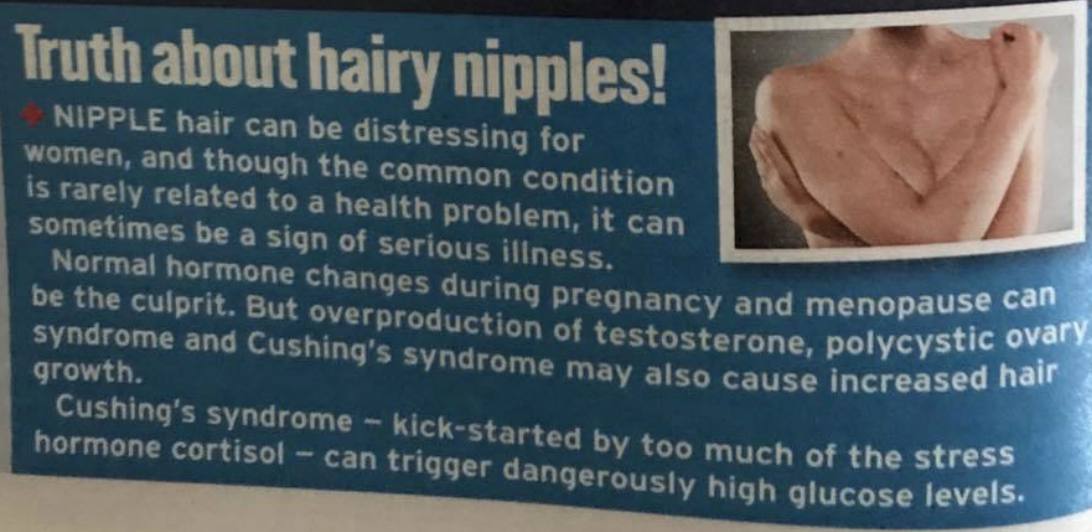
Cushing’s and Hairy Nipples

Hairy nipples are a common condition in women. The amount of hair on the nipples varies, but some women find that the hair becomes long, coarse, and dark, which can be distressing.

Hairy nipples are rarely a cause for concern and are usually not a sign of any underlying health issues. However, occasionally they can signify something more serious, in which case, it is essential to consult a doctor.

Almost every part of a person’s skin is covered in hair and hair follicles. On certain parts of the body, such as the top of the head, the hair usually grows longer and thicker, while on other parts, it is thin and transparent.

Fast facts on hairy nipples:

  • It is not known how common hairy nipples are or how many women have them.
  • Many women do not report the condition and instead manage it themselves.
  • It is possible for hair that used to be fine and light to turn coarse and dark with age.

Causes of hairy nipples in women

There are several underlying reasons that might cause nipple hairs to grow. These are:

Cushing’s syndrome

Cushing’s syndrome is another condition caused by hormonal imbalance. When it occurs, there is an excess of cortisol in the body. In this case, a person may experience several symptoms, such as:

  • increased hair growth
  • abnormal menstrual periods
  • high blood pressure
  • a buildup of fat on the chest and tummy, while arms and legs remain slim
  • a buildup of fat on the back of the neck and shoulders
  • a rounded and red, puffy face
  • bruising easily
  • big purple stretch marks
  • weakness in the upper arms and thighs
  • low libido
  • problems with fertility
  • mood swings
  • depression
  • high blood glucose level

Cushing’s syndrome is fairly rare, and the cause is usually associated with taking glucocorticosteroid medicine, rather than the body overproducing the hormone on its own.

It is possible, however, that a tumor in the lung, pituitary gland, or adrenal gland is the cause.

Also:

Hormonal changes and fluctuations

Hormonal changes in women can cause many different symptoms, one of which is changes in nipple hair growth and color.

Some common hormonal changes happen during pregnancy and menopause.

However, hormonal changes can also occur when a woman is in her 20s and 30s, which may cause nipple hair to change appearance or become noticeable for the first time.

Overproduction of male hormones

It is possible for hormonal imbalances to cause hairy nipples. Overproduction of male hormones, including testosterone, can cause hair growth, while other symptoms include:

  • oily skin that can lead to breakouts and acne
  • menstrual periods stopping
  • increase in skeletal muscle mass
  • male pattern baldness, leading to a woman losing hair on her head

If overproduction of male hormones is suspected, it is a good idea to make an appointment with a doctor who can confirm this with a simple test.

Polycystic ovary syndrome

Polycystic ovary syndrome (PCOS) occurs because of a hormonal imbalance. PCOS is a condition that affects the way the ovaries work.

Common symptoms of PCOS are:

  • infertility
  • irregular menstrual periods
  • ovarian cysts
  • excessive hair growth in unusual places, such as the nipples

PCOS is believed to affect around 1 in 5 women.

Medication

The side effects of particular medicines can cause unusual hair growth.

Medicines, such as testosterone, glucocorticosteroids, and certain other immunotherapy drugs may cause hairy nipples.

What are the treatment options?

Treatment for hairy nipples is not usually necessary for health reasons.

However, many women with the condition prefer to try and reduce or get rid of the appearance of hair on their nipples for cosmetic purposes.

There are several methods by which they can try and do this:

Trimming the nipple hair

Trimming the nipple hair may be enough to reduce its appearance. Small nail scissors are ideal, and hair can be cut close to the skin. It is essential to do this carefully and avoid catching the skin.

Trimming will need to be carried out regularly when the hair grows back.

Tweezing the nipple hair

Tweezing nipple hair is an effective way to get rid of unwanted nipple hair. However, this option can be painful as the skin around the nipple area is particularly soft and sensitive.

It is also important to bear in mind that the hair will return, and tweezing the hair increases the risk of infection and ingrown hairs.

Shaving the nipple hair

Shaving is another option to reduce the appearance of nipple hair. However, it is advisable to do so with caution to avoid nicking the sensitive skin.

This option also carries an increased risk of developing ingrown hairs and infection.

Waxing

Sugaring or waxing is a good hair removal option, though either one is likely to be painful. A salon is the best place to get this treatment type, as doing this at home may cause damage to the skin. Infection and ingrown hairs are again a risk.

Laser hair removal

These popular treatments can help to reduce the hair growth and slow or even prevent regrowth for a while. However, they can be painful, too.

Laser treatment is by far the most expensive option, as it will need to be performed by a plastic surgeon or cosmetic dermatologist.

Hormonal treatment

If a hormonal imbalance is the cause of hairy nipples, a doctor may prescribe or adjust a woman’s medication therapy to restore a healthy hormonal balance.

Other treatments and how to choose

The above treatments are all commonly used to remove and reduce nipple hair and usually have minimal side effects.

Bleaching or using hair removal cream to treat the condition, however, is not advised as these methods are usually too harsh for this sensitive area and may cause irritation and damage.

At what point should you see a doctor?

Hairy nipples in women are quite common, and there is usually no need to see a doctor. However, if they are accompanied by any other unusual symptoms, it is a good idea to make an appointment.

A doctor will be able to perform tests to determine whether an underlying cause, such as PCOS, is causing the growth of nipple hair. If so, they will give advice and medication therapy to help manage the condition.

A doctor will also be able to advise how to remove nipple hair safely.

Takeaway

For the majority of women, nipple hair may seem unsightly, but it is not a cause for any concerns about their health.

However, because some medical conditions can cause nipple hair to darken and grow, it is important to see a doctor if any other symptoms are experienced.

Nipple hair can usually be easily treated and managed, should a woman choose to try to remove the hair for cosmetic reasons.

Adapted from https://www.medicalnewstoday.com/articles/320835.php