Diagnosis and Treatment of Pituitary Adenomas

A Review
JAMA. 2017;317(5):516-524. doi:10.1001/jama.2016.19699

Importance  Pituitary adenomas may hypersecrete hormones or cause mass effects. Therefore, early diagnosis and treatment are important.

Observations  Prevalence of pituitary adenomas ranges from 1 in 865 adults to 1 in 2688 adults. Approximately 50% are microadenomas (<10 mm); the remainder are macroadenomas (≥10 mm).

Mass effects cause headache, hypopituitarism, and visual field defects. Treatments include transsphenoidal surgery, medical therapies, and radiotherapy. Prolactinomas account for 32% to 66% of adenomas and present with amenorrhea, loss of libido, galactorrhea, and infertility in women and loss of libido, erectile dysfunction, and infertility in men; they are generally treated with the dopamine agonists cabergoline and bromocriptine.

Growth hormone–secreting tumors account for 8% to 16% of tumors and usually present with enlargement of the lips, tongue, nose, hands, and feet and are diagnosed by elevated insulin-like growth factor 1 levels and growth hormone levels; initial treatment is surgical. Medical therapy with somatostatin analogues, cabergoline, and pegvisomant is often also needed.

Adrenocorticotropic hormone (ACTH)–secreting tumors account for 2% to 6% of adenomas and are associated with obesity, hypertension, diabetes, and other morbidity. Measurement of a late-night salivary cortisol level is the best screening test but petrosal sinus sampling for ACTH may be necessary to distinguish a pituitary from an ectopic source.

The primary treatment of Cushing disease (hypercortisolism due to ACTH-producing adenomas, which is the cause in approximately 65% of the cases of hypercortisolism) is adenoma resection and medical therapies including ketoconazole, mifepristone, and pasireotide.

Hyperthyroidism due to thyroid-stimulating hormone–secreting tumors accounts for 1% of tumors and is treated with surgery and somatostatin analogues if not surgically cured. Clinically nonfunctioning adenomas account for 15% to 54% of adenomas and present with mass effects; surgery is generally required, although incidentally found tumors can be followed if they are asymptomatic.

Conclusions and Relevance  Patients with pituitary adenomas should be identified at an early stage so that effective treatment can be implemented. For prolactinomas, initial therapy is generally dopamine agonists. For all other pituitary adenomas, initial therapy is generally transsphenoidal surgery with medical therapy being reserved for those not cured by surgery.

Read the full text here: http://jamanetwork.com/journals/jama/article-abstract/2600472

8 Things You Should Know About Addison’s Disease

adrenal-insufficiency


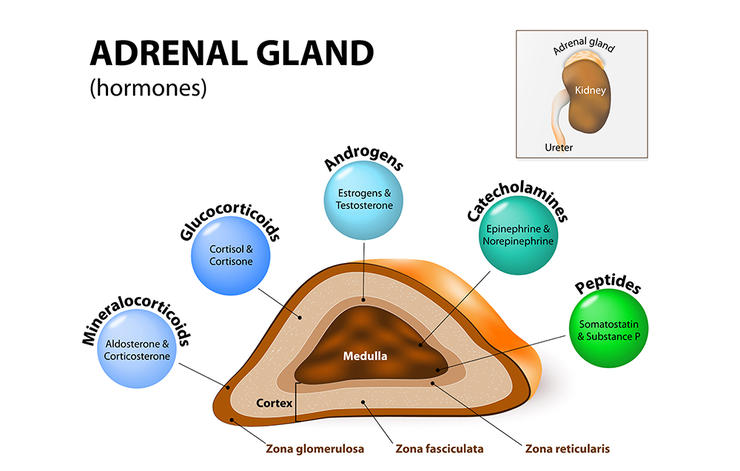
Cortisol gets a bad rap these days. (Guilty!) Yes, this hormone surges when you’re stressed. And yes, chronic stress is bad news for your health. But while too much cortisol can lead to all sorts of stress-related side effects, too little cortisol is equally debilitating.

Just ask someone with Addison’s disease. If you suffer from this condition, your adrenal glands fail to make adequate amounts of cortisol, says Betul Hatipoglu, MD, an endocrinologist at Cleveland Clinic.

Cortisol plays a role in regulating your blood pressure, heart function, digestion, and a lot else, Hatipoglu explains. So if your adrenal glands poop out and your cortisol levels plummet, a lot can go wrong. (In as little as 30 days, you can be a whole lot slimmer, way more energetic, and so much healthier just by following the simple, groundbreaking plan in The Thyroid Cure!)

Here’s what you need to know about this condition—starting with its craziest symptom.

It can make your teeth appear whiter.

Hatipoglu once met with a patient who was suffering from fatigue, belly pain, and mild weight loss. “Her doctors thought she was depressed,” Hatipoglu recalls. Toward the end of their appointment, Hatipoglu noticed the woman’s teeth looked very white. She realized they looked white because the woman’s skin was tan. “I asked her if she’d been on vacation, and she said she hadn’t been in the sun, and that’s when I knew,” Hatipoglu says. Some Addison’s-related hormone shifts can make the skin appear darker, almost like a tan. “Addison’s is the only disease I know of that can cause darkening of the skin,” she says.

Its (other) symptoms are popular ones.

 Along with darker skin, other symptoms of Addison’s include nausea, mild-to-severe abdominal or bone pain, weight loss, a lack of energy, forgetfulness, and low blood pressure, Hatipoglu says. Of course, those same symptoms are linked to many other health issues, from thyroid disease to cancer. “It’s very easy to confuse with other disorders, so many people see a lot of doctors before finally receiving a proper diagnosis,” she says. (One exception: For young women who develop Addison’s disease, loss of body hair is a warning sign, Hatipoglu adds.)
It’s rare.
Doctors also miss or misinterpret the symptoms of Addison’s disease because it’s very uncommon. “I’m not sure if it’s quite one in a million, but it’s very rare,” Hatipoglu says. “It makes sense that many doctors don’t think of it when examining a patient with these symptoms.”
It’s often confused with adrenal insufficiency.

A lot of online resources mention Addison’s disease and adrenal insufficiency as though they were two names for the same condition. They’re not the same, Hatipoglu says. While a thyroid issue or some other hormone-related imbalance could mess with your adrenal function, Addison’s disease refers to an autoimmune disorder in which your body attacks and destroys your adrenal glands.

That destruction can happen quickly.

While it takes months or even years for some Addison’s sufferers to lose all hormone production in their adrenal glands, for others the disease can knock out those organs very rapidly—in a matter of days, Hatipoglu says. “That’s very uncommon,” she adds. But compared to other less-severe adrenal issues, the symptoms of Addison’s tend to present more dramatically, she explains. That means a sufferer is likely to experience several of the symptoms mentioned above, and those symptoms will continue to grow worse as time passes.

Anybody can get it.

Addison’s is not picky. It can strike at any age, regardless of your sex or ethnicity, Hatipoglu says. While there’s some evidence that genetics may play a role—if other people in your family have the disease or some other endocrine disorder, that may increase your risk—there’s really no way to predict who will develop the disease, she adds.

Screening for Addison’s is pretty simple.

If your doctor suspects Addison’s, he or she will conduct a blood test to check for your levels of cortisol and another hormone called ACTH. “Usually the results of that screening are very clear,” Hatipoglu says. If they’re not, some follow-up tests can determine for sure if you have the condition.

There are effective treatments.

Those treatments involve taking oral hormone supplements.  In extreme cases, if the patient’s body does not properly absorb those supplements, injections may be necessary, Hatipoglu explains. “But patients live a normal life,” she adds. “It’s a treatable disease, and the treatments are effective.”

From http://www.prevention.com/health/addisons-disease-symptoms

Endoscopic Surgery on a Pituitary Adenoma

Philip Theodosopoulos, M.D. is Professor and Vice-Chair of Neurological Surgery at the University of California, San Francisco. He is the Director of the Skull Base Tumor Program and has extensive experience performing endoscopic transsphenoidal pituitary surgery for pituitary tumors (over 1000 operations) and other disease processes as well as tumors of the base of the skull.

In this video Dr. Theodosopoulos illustrates portions of an endoscopic resection of a pituitary adenoma.


To learn more about Dr. Theodosopoulos and to schedule an appointment for consultation please copy this link:
neurosurgery.UCSF.edu/index.php/about_us_faculty_theodosopoulos.html

Neurosurgeon and Otolaryngologist Team Up to Remove Tumor in Pituitary Gland

After experiencing bad headaches and double vision, Kris Johnson was diagnosed with a pituitary adenoma, a tumor of the pituitary gland at the base of the brain. Loyola ENT surgeon Chirag Patel, MD, teamed up with neurosurgeon Anand Germanwala, MD, to remove the tumor, and Ms. Johnson now is “100 percent back to normal.”

Article ID: 668877

Released: 3-Feb-2017 2:05 PM EST

Source Newsroom: Loyola University Health System

Pituitary Issues: Irregular Periods

Q: I am 28 years old and I have not yet started my periods naturally. I have to take medicine for periods — Novelon. The doctors say that there is some problem with my hormones in the pituitary gland. Please advise me how to get normal and natural periods, because after taking the medicine I get my period, but without medicines I don’t.

A by Dr Sharmaine Mitchell: The problem you have with your menstrual period being irregular is most likely due to overproduction of the hormone prolactin by the pituitary gland in the brain. The pituitary gland can sometimes enlarge and cause an overproduction of prolactin and this can result in inappropriate milk production in the breasts (white nipple discharge), irregular menstruation or absent menstrual periods, headaches and blurred vision. The blurred vision occurs as a result of compression of the optic nerve which supplies the eyes, by the enlarged brain tumour in the pituitary gland.

You should get a magnetic resonance imaging (MRI) or CT scan of the brain and pituitary gland done. You should also test your prolactin levels to determine the extent of overproduction of the hormone.

Other investigations should include a thyroid function test (TSH), follicle stimulating hormone (FSH) and leutinizing hormone (LH), and baseline testosterone level tests.

Abnormalities in the production of thyroid hormones can also cause menstrual irregularities and this should be ruled out.

Polycystic ovarian disease can also cause irregular menstrual periods and checking the level of FSH, LH and testosterone will help to rule out this diagnosis. This condition is usually associated with excessive weight gain, abnormal male pattern distribution on the face, chest and abdomen and an increased risk for diabetes mellitus. A pelvic ultrasound to look at the structure of the ovaries and to rule out polycystic ovaries is essential.

If the pituitary gland is enlarged, then medication can be prescribed to shrink it. Bromocriptine or Norprolac are commonly used drugs which work well in reducing the prolactin levels and establishing regular menstrual cycles. The use of these drugs will also help to establish ovulation and improve your fertility.

In some cases it may become necessary to have surgery done if the tumour in the pituitary gland is large and does not respond to the usual medications prescribed to shrink the pituitary gland. The MRI of the brain and pituitary gland will give an idea as to the size of the gland and help to determine if there is a need for you to see the neurosurgeon.

In most cases medical management with drugs will work well and there is no need for surgical intervention. This is a problem that can recur, so it may be necessary to take treatment intermittently for a long period of time, especially if fertility is desired.

Consult your doctor who will advise you further. Best wishes.

Dr Sharmaine Mitchell is an obstetrician and gynaecologist. Send questions via e-mail to allwoman@jamaicaobserver.com; write to All Woman, 40-42 1/2 Beechwood Ave, Kingston 5; or fax to 968-2025. All responses are published. Dr Mitchell cannot provide personal responses.

DISCLAIMER:

The contents of this article are for informational purposes only and must not be relied upon as an alternative to medical advice or treatment from your own doctor.

From http://www.jamaicaobserver.com/magazines/allwoman/Still-no-normal-period-at-28_87596