Patient’s Atypical Cushing’s Symptoms Lead to Discovery of Novel Genetic Mutations

New genetic mutations were found in a patient who exhibited atypical symptoms of Cushing’s syndrome, notably an abnormal protrusion of the eye, a case report shows.

The research, “Extensive ARMC5 genetic variance in primary bilateral macronodular adrenal hyperplasia that started with exophthalmos: a case report,” was published in the Journal of Medical Case Reports.

Primary bilateral macronodular adrenal hyperplasia (PBMAH) is a disorder characterized by multiple lumps in the adrenal glands and excessive cortisol production. It is a rare cause of Cushing’s syndrome.

According to recent research, PBMAH is caused by mutations in the ARMC5 gene, which data suggest may act as a tumor suppressor.

Researchers presented the case of a 52-year-old Chinese woman who exhibited a protrusion of both eyes (exophtalmos), which was first thought to be Graves’ ophthalmopathy. An injection of triamcinolone acetonide, a corticosteroid, into the area behind the eye globe did not improve symptoms.

The patient later was diagnosed with diabetes, which was treated with insulin, and hypertension, treated with insulin and amlodipine. She also developed muscle weakness and bruised easily. She had no other relevant chronic illness or infectious disease, and did not smoke tobacco or drink alcohol.

Physical examination showed skin atrophy, moon face, buffalo hump (between the shoulders), and purplish abdominal striae (stretch marks), which researchers defined as a typical Cushingoid appearance. The patient also experienced elevated pressure inside the eye, and had edema, conjunctival congestion, and lid retraction. No liver, spleen, respiration, cardiac, abdominal, blood counts, urinary, sensory, or motor abnormalities were noted.

Biochemical evaluation showed elevated cortisol and reduced adrenocorticotropin (ACTH) levels. Administering  dexamethasone did not lower the level of cortisol. Abnormal responses of the hormone vasopressin also were detected.

A computed tomography (CT) scan of the adrenal glands showed bilateral multiple lobular masses, and an MRI of the eye orbits indicated bilateral exophthalmos with hypertrophy of the retro-orbital fat, which lines the orbit.

After PBMAH was diagnosed, the patient’s adrenal glands were removed. Pathological findings showed multiple, homogenous, golden-yellow-colored nodules on the glands.

The surgery successfully lowered the level of cortisol and increased that of ACTH. The patient began taking hydrocortisone and metformin for diabetes. After six months, her exophtlamos, blood glucose levels, and blood pressure had improved.

Genetic analysis revealed six specific ARMC5 mutations in five of the seven adrenal nodules analyzed. “All the mutations are novel and not found in available online databases,” the researchers wrote. The mutations may lead to resistance to cell death in the tumor cells, and cause an increase in the production of cortisol, they observed.

As a result of the ARMC5 mutations, gene expression (conversion of genetic information) of the messenger RNA (mRNA, which is converted from DNA in the first step of protein synthesis) was lower in the adrenal tumor samples, in comparison with normal adrenal cortex.

Overall, the study “highlights the importance of early recognition of atypical symptoms of Cushing’s syndrome such as exophthalmos, which would save the patient from harmful effects of excessive cortisol exposure,” the researchers said. Screening for ARMC5 mutations also would help improve diagnosis and genetic counseling, they said.

From https://cushingsdiseasenews.com/2018/02/13/odd-cushings-symptoms-linked-genetic-mutations-case-report/

Temozolomide May Partially Improve Aggressive Pituitary Tumors Causing Cushing’s Disease

The chemotherapy temozolomide partially improved a case of an aggressive pituitary tumor that caused symptoms of Cushing’s disease (CD), according to a new study in Poland. However, after tumor mass and cortisol levels were stabilized for a few months, the patient experienced rapid progression, suggesting that new methods for extending the effects of temozolomide are needed.

The study, “Temozolomide therapy for aggressive pituitary Crooke’s cells corticotropinoma causing Cushing’s Disease: A case report with literature review,” appeared in the journal Endokrynologia Polska.

Aggressive pituitary tumors are usually invasive macroadenomas, or benign tumors larger than 10 mm.

A very rare subset of pituitary adenoma — particularly corticotropinoma, or tumors with excessive secretion of corticotropin (ACTH) — exhibit Crooke’s cells. These tumors are highly invasive, have a high recurrence rate, and are often resistant to treatment.

Information is not widely available about the effectiveness of treating aggressive pituitary tumors, particularly those that cause Cushing’s disease. The management of these tumors usually requires neurosurgery, followed by radiotherapy, and pharmacotherapy. However, the chemotherapy medication temozolomide has been increasingly used as a first-line treatment after initial evidence of its effectiveness in treating glioblastoma, the most common form of brain cancer.

In this study, researchers at the Jagiellonian University, in Poland, discussed the case of a 61-year-old man with ACTH-dependent Cushing’s syndrome caused by Crooke’s cell corticotropinoma.

The patient first presented with symptoms of severe hypercorticoidism — the excessive secretion of steroid hormones from the adrenal cortex — in December 2011. He also showed advanced heart failure, severe headaches, and impaired vision, which had started two or three years before diagnosis. Examinations revealed osteoporosis and a fracture in the Th5 vertebra.

His morning ACTH levels were high. The same was observed for mean cortisol levels even after dexamethasone treatment, which was suggestive of a pituitary tumor secreting ACTH. MRIs showed the existence of a tumor mass, later identified as a macroadenoma with high cell polymorphism, the presence of Crooke’s cells, and ACTH secretion.

The patient was referred for transsphenoidal nonradical neurosurgery, performed through the nose and the sphenoid sinus, and bilateral adrenalectomy, or the surgical removal of the adrenal glands, in 2012-2013. However, he developed fast, postoperative recurrence of hypercorticoidism and tumor regrowth. This led to three additional transsphenoidal neurosurgeries and radiotherapy.

The patient’s clinical status worsened as he developed severe cardiac insufficiency. Doctors began temozolomide treatment in April 2015, which did not result in adverse effects throughout treatment.

The initial standard dose (150–200 mg/m2) was given once daily in the morning for five consecutive days, in a 28-day cycle. The patient also received 600 mg of ketoconazole, an antifungal medication. Ondansetron was administered to prevent nausea and vomiting.

Subsequent examinations revealed clinical and biochemical improvements, including a reduction in ACTH and cortisol levels. In addition, the patient also showed reduced cardiac insufficiency, less frequent and less severe headaches, visual field improvements, and better physical fitness and mood.

However, clinical symptoms worsened after the eighth temozolomide cycle. The tumor size also suddenly increased after the ninth cycle, reaching the inner ear. Temozolomide was then discontinued and ACTH levels increased by 28 percent one month later. The patient also demonstrated deteriorated vision, hearing loss, and strong headaches.

Clinicians then decided to start treatment with the Cushing’s disease therapy Signifor (pasireotide), but a worsening of diabetes was observed, and the patient died in February 2016.

“The most probable reason for death was compression of the brainstem, which had been observed in the last MRI of the pituitary,” the researchers wrote, adding that “due to the very short duration of treatment, any conclusions on the treatment with Signifor cannot be drawn.”

Overall, “the results of the presented case suggest that [temozolomide] treatment monotherapy could have only partial response in aggressive corticotroph adenoma causing Cushing’s disease, followed by sudden progression,” the investigators wrote. This contrasts with mostly responsive cases reported in research literature, they noted.

“Therefore, further research on the factors of responsiveness and on novel methods to extend the duration of the effect of [temozolomide] should be carried out,” they wrote.

From https://cushingsdiseasenews.com/2018/02/08/cushings-disease-case-study-poland-shows-temozolomide-temporarily-effective-treating-aggressive-pituitary-tumor/

ACTH-producing Lung Tumors Hard to Detect, But May Be Cured with Surgery

Ectopic Cushing’s syndrome can be challenging to diagnose, especially when it comes identifying the problem source. But appropriate hormone management protocols, used in combination with advanced imaging methods, may help physicians identify ectopic ACTH-producing tumors.

The findings in a case report of a young man with ectopic Cushing’s syndrome were published in the International Journal of Surgery Case Reports, under the title “Case report: Ectopic Cushing’s syndrome in a young male with hidden lung carcinoid tumor.”

Cushing’s syndrome is caused by high amounts of glucocoticosteroids in the blood. The most common cause is a malfunction of the glands that produce these hormones. In some cases, however, the disease may be caused by tumors elsewhere in the body that have the ability to produce adrenocorticotropic hormone (ACTH).

In half of all Cushing’s patients, ectopic ACTH is produced by small lung cell carcinomas or lung carcinoids (a type of slow-growing lung cancer). But some tumors in the thymus and pancreas also have been found to produce ACTH.

Researchers at Damascus University Hospital in Syria presented the case of a 26-year-old man who had ectopic Cushing’s syndrome due to lung carcinoids.

The patient presented with increased appetite and rapid weight gain for more than a year. These were associated with headache, fatigue, proximal muscle weakness, and easy bruising. He had no family history of hormonal disorder.

Based on the initial physical and symptom evaluation, the clinical team suspected Cushing’s syndrome. Blood analysis revealed high levels of cortisol and ACTH hormones, which supported the diagnosis.

Administration of dexamethasone, a treatment used to inhibit the production of glucocoticosteroids by the pituitary gland, reduced cortisol levels within normal range, but not ACTH levels. This led to the diagnosis of ectopic Cushing’s syndrome.

The next step was to identify the tumor causing the syndrome. The team conducted imaging studies of the brain, chest, and abdomen, but found no tumor.

Because ectopic ACTH is commonly produced by lung cancers, the team then analyzed the patient’s lungs. Again, they failed to detect a tumor.

The patient was discharged with prescription of 200 mg of Nizoral (ketoconazole) once-daily, calcium, and vitamin D. After three months of treatment, he remained stable, with no evidence of symptom improvement.

At this point, the team decided to surgically remove both adrenal glands in an attempt to reduce the hormone levels. Treatment with prednisolone 5 mg and fludrocortisone 0.1 mg once daily was initiated, along with calcium and vitamin D.

Eighteen months later, the patient’s condition worsened and he required hospitalization.

Imaging tests targeting the neck, chest, and abdomen were conducted again. This time, physicians detected a 2 cm mass in the middle lobe of the right lung, which was removed surgically. Detailed analysis of the small tumor confirmed that it was the source of the excessive ACTH.

“ACTH secreting tumors can be very hard to detect,” the researchers stated. “Initial failed localization is common in ectopic ACTH syndrome and it is usually due to carcinoid.”

Cases where the ectopic ACTH production is caused by a carcinoid tumor can be challenging to diagnose because tumors are small and relatively slow-growing. Imaging data is often hard to analyze and the tumors can be confused with pulmonary vessels, the researchers explained.

“In such cases we should first aim to lower blood cortisol medically or through bilateral adrenalectomy to avoid Cushing’s complications,” which should then “be followed up through imaging studies (CT, MRI, scintigraphy or PET) to detect the tumor and resect it, which is the definitive treatment of these patients,” the researchers concluded.

From https://cushingsdiseasenews.com/2017/12/12/case-report-ectopic-acth-producing-lung-tumors-can-hard-detect/

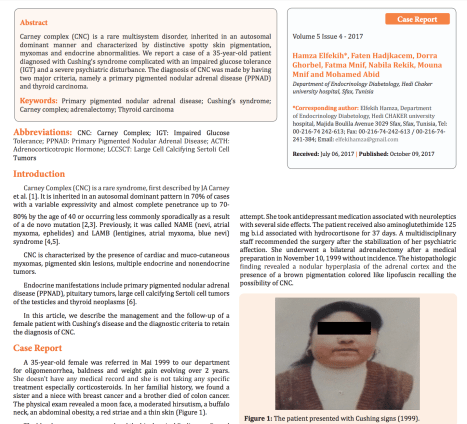
Cushing’s Syndrome Revealing Carney Complex: A Case Report


Carney complex (CNC) is a rare multisystem disorder, inherited in an autosomal dominant manner and characterized by distinctive spotty skin pigmentation, myxomas and endocrine abnormalities.

We report a case of a 35-year-old patient diagnosed with Cushing’s syndrome complicated with an impaired glucose tolerance (IGT) and a severe psychiatric disturbance. The diagnosis of CNC was made by having two major criteria, namely a primary pigmented nodular adrenal disease (PPNAD) and thyroid carcinoma.

Read the entire report here: Cushing’s Syndrome Revealing Carney Complex: A Case
Report

A 12-year-old boy died from Addison’s disease after the chance of lifesaving treatment was ‘missed’

The death of a 12-year-old boy who was suffering from undiagnosed Addison’s disease was preventable, an inquest heard.

Ryan Lee Morse had been unwell from July 2012, with his parents noticing his skin darkening and him becoming lethargic and losing weight.

His condition worsened over the following months and he died during the early hours of December 8, 2012.

During the time he was unwell, Ryan’s mother, Carol Ann Morse, took him to Abernant Surgery in Abertillery several times.

She said: “Ryan was rarely ill as a child. In June 2012, which was towards the end of Ryan’s first comprehensive school year, I noticed his skin colour changing.

“His skin seemed to be getting darker.”

She said his joint areas, including elbows and knees, were getting darker. Under his eyes, it looked as if he had not slept for a month. I don’t suppose it worried me at the time because it was gradual.”

A post mortem was held on December 12 by Dr E. J. Lazda, a consultant pathologist at University Hospital of Wales in Cardiff who concluded that Ryan died as a result of Addison’s disease.

An inquest into Ryan’s death was held at Newport Coroner’s Court on Thursday.

Dr Yvette Cloette, a consultant paediatrician since 2004, was called during the early hours of December 8, 2012, by a registrar where she was told the details of Ryan’s death.

She said: “Ryan’s parents told me he had been unwell since July.

“It was thought Ryan had been particularly unwell since the Thursday before he passed away. He had to be collected from school that day. On (the) Friday morning, she said he hallucinated. His temperature did settle that afternoon but then he had diarrhoea.

“As his mum was cleaning him, she noticed his genitalia were black.

“I then examined Ryan. At this time I formed the opinion that Ryan may have had Addison’s disease. I didn’t share this with the family at the time because I didn’t have enough evidence.

“I believe that Ryan’s death was preventable. Addison’s is a disease which, once recognised, can be treated.”

She said it was easier to put things together retrospectively, as opposed to when treating an acute illness as a GP.

David Bowen, senior coroner for Gwent, paid tribute to Ryan’s family during the hearing.

“Before summing up, I think it’s right that I pay tribute to the dignity that has been shown by Mrs Morse and her family.

“It can’t have been easy for them to rehear events that took place over five years ago.

“Please accept my belated condolences.”

Mr Bowen told the inquest that Ryan had been fit and well up until July 2012.

“However at about that time, his parents began to notice a gradual change in his skin and a fluctuation in his general health.”

He had been diagnosed with a viral infection and prescribed Paracetamol, he said.

Over the next six to eight weeks, he did not improve.

Mr Bowen said: “Consequently, his mother took him back to the doctor. The GP was more concerned about the rash, it seems to me, than any of the other symptoms.

“He prescribed tablets and cream for that condition.”

Mr Bowen said that during October and November 2012, “Ryan’s health became much more of a concern for his parents.”

He suffered from headaches, pains in his legs, and occasional episodes of projectile vomiting.

On November 7, Mrs Morse took Ryan back to the GP surgery, where she described symptoms to Dr Rudling, who took samples of blood.

On November 21, they returned to receive the blood test results.

The results revealed a “slightly lower than normal” white blood cell count. The inquest heard Ryan was told he was still suffering from a viral infection that had been diagnosed some months earlier.

Mr Bowen said: “It appears that about this time, there was an outbreak of Norovirus or vomiting and sickness in the area that may have confused the diagnosis.”

Mrs Morse said: “I’d been told to bring Ryan back in January so I thought I would just get Christmas out of the way and take him back. I’d been a carer for 9-10 years but my job didn’t give me any insight into what Ryan had.”

On November 29, 2012, Ryan returned to school, but around a week later on December 6 he was so ill that his mum had to collect him early.

The following day, on December 7, Mrs Morse rang Abernant Surgery saying she needed to speak to a doctor.

Between 8.50am and 8.55am, she received a call from Dr Lyndsey Elizabeth Thomas.

Mrs Morse said: “She asked if he’d been given Paracetamol and I explained he wouldn’t take it. She asked what his temperature was like.

“I’d said Ryan was awake (that morning) and talking rubbish.”

The inquest heard Mrs Morse was asked to take Ryan to the surgery, but she said she was unable to.

“She then told me to give Ryan some dissolvable Paracetamol and see how it goes until dinner. She said fetch him up if you need to.”

Dr Lyndsey Elizabeth Thomas said her contact with Ryan was limited to a single telephone conversation with his mother on December 7.

She said: “I considered whether Ryan needed to be seen or admitted to hospital.

“I clearly recall explaining that if she had any concerns or if Ryan’s delirium or temperature didn’t improve in two hours, he would need to be seen, I would be able to go and visit him at the end of the morning surgery if necessary.”

Mrs Morse said she later noticed that her son’s genitals were black.

She rang the surgery and was put her through to Dr Rudling.

Mrs Morse said: “She said ‘it’s all to do with his hormones’. Phone Monday and we’ll fit him in. At this point I didn’t know what to think.

“I was thinking I’ll take him in on Monday and see what they say. There was no more temperature, no more sickness and no more diarrhoea.”

The inquest heard Dr Joanne Louise Rudling, who qualified in 1993, joined Abernant in August 2011.

She said her first contact with Ryan was in November 2012.

On December 7, Dr Rudling said the receptionist took a call from Ryan’s mother while she was in reception.

Dr Rudling said: “I decided to speak to Ryan’s mother in reception there and then.

“She also asked if this could be age related, I said it could be but I would have to examine him first.

“The impression I got was Ryan was improving. His mother was concerned about the darkening of his genitalia.”

Ryan’s father said goodnight around 10.15pm and went to bed. At around 11.10pm Mrs Morse could see Ryan had fallen asleep, and went to sleep herself at around 11.30pm.

She said: “I woke up and saw it was 4.10am and then I looked at Ryan and looking at his chest could see he wasn’t breathing.

“I started to do chest compressions, dialled 999, continued chest compressions until the paramedics arrived. They took over. They told me Ryan had died.”

Mr Bowen said: “This is a rare but natural disease, one which apparently GPs will not normally encounter.

“Unfortunately, neither doctor nor parents thought it necessary to refer Ryan to hospital, where the true nature of his illness may have been diagnosed.”

Recording a narrative conclusion, Mr Bowen said Ryan died of natural causes.

He said: “The opportunity to administer life-saving treatment was missed.”

Speaking after the inquest, Ryan’s sister Christina Morse said: “First of all I would like to thank everyone involved with Ryan and Ryan’s case.

“Today, after five long years, the coroner has come to the conclusion that Ryan’s death was due to natural causes and that Ryan’s death was preventable.”

From http://www.walesonline.co.uk/news/wales-news/boy-died-addisons-disease-after-13687355