2 Days! The Countdown begins

Only 2 days until the Cushing’s Awareness Challenge 2016 begins.  At night, when I’m supposed to be sleeping, ideas for posts keep swarming through my head.  Sometimes, they form into fully-written posts.  Then, when I wake up, the posts are gone.

I plan to follow the suggestions to some extent and have a few ideas of my own.  Over the years, I’ve posted lots on several blogs but I don’t know if I can get 30 days of Cushing’s stuff together…again!  This is the fourth year of the Cushing’s Awareness Challenge.

At the moment, there are 2 participants in this challenge and growing.  Please follow their blogs.  The list is on the right side and is constantly updated as new URLs come in.

If you want to join us, its not too late.  Directions and suggestions for posts can be found here: http://cushie-blogger.blogspot.com/2015/03/cushings-awareness-challenge-2015.html

If you have ideas for what you’d like to read about (Cushing’s related, of course), please feel free to put it in the comments area.


Young people with Cushing syndrome may be at higher risk for suicide, depression

Children with Cushing syndrome may be at higher risk for suicide as well as for depression, anxiety and other mental health conditions long after their disease has been successfully treated, according to a study by researchers at the National Institutes of Health.

Cushing syndrome results from high levels of the hormone cortisol. Long-term complications of the syndrome include obesity, diabetes, bone fractures, high blood pressure, kidney stones and serious infections. Cushing’s syndrome may be caused by tumors of the adrenal glands or other parts of the body that produce excess cortisol. It also may be caused by a pituitary tumor that stimulates the adrenal glands to produce high cortisol levels. Treatment usually involves stopping excess cortisol production by removing the tumor.

“Our results indicate that physicians who care for young people with Cushing syndrome should screen their patients for depression-related mental illness after the underlying disease has been successfully treated,” said the study’s senior author, Constantine Stratakis, D(med)Sci, director of the Division of Intramural Research at NIH’s Eunice Kennedy Shriver National Institute of Child Health and Human Development. “Patients may not tell their doctors that they’re feeling depressed, so it’s a good idea for physicians to screen their patients proactively for depression and related conditions.”

Cushing syndrome may affect both adults and children. A recent study estimated that in the United States, there are 8 cases of Cushing syndrome per 1 million people per year.

The researchers published their findings in the journal Pediatrics. They reviewed the case histories of all children and youth treated for Cushing syndrome at NIH from 2003 to 2014, a total of 149 patients. The researchers found that, months after treatment, 9 children (roughly 6 percent) had thoughts of suicide and experienced outbursts of anger and rage, depression, irritability and anxiety. Of these, 7 experienced symptoms within 7 months of their treatment.

Two others began experiencing symptoms at least 48 months after treatment.

The authors noted that children with Cushing syndrome often develop compulsive behaviors and tend to become over-achievers in school. After treatment, however, they then become depressed and anxious. This is in direct contrast to adults with Cushing syndrome, who tend to become depressed and anxious before treatment and gradually overcome these symptoms after treatment.

The authors stated that health care providers might try to prepare children with Cushing syndrome before they undergo treatment, letting them know that their mood may change after surgery and may not improve for months or years. Similarly, providers should consider screening their patients periodically for suicide risk in the years following their treatment.

Source: NIH/Eunice Kennedy Shriver National Institute of Child Health and Human Development

Fifth Annual Cushing’s Awareness Challenge

awareness


The Cushing’s Awareness Challenge is almost upon us again!

Do you blog? Want to get started?

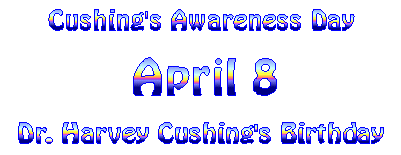
Since April 8 is Cushing’s Awareness Day, several people got their heads together to create the Fifth Annual Cushing’s Awareness Blogging Challenge.

All you have to do is blog about something Cushing’s related for the 30 days of April.

There will also be a logo for your blog to show show you’ve participated.

Please let me know the URL to your blog in the comments area of this post, on the Facebook page, in one of the Facebook Groups, on the message boards or an email  and I will list it on CushieBloggers ( http://cushie-blogger.blogspot.com/)

The more people who participate, the more the word will get out about Cushing’s.

Suggested topics – or add your own!

  • In what ways have Cushing’s made you a better person?
  • What have you learned about the medical community since you have become sick?
  • If you had one chance to speak to an endocrinologist association meeting, what would you tell them about Cushing’s patients?
  • What would you tell the friends and family of another Cushing’s patient in order to garner more emotional support for your friend? challenge with Cushing’s? How have you overcome challenges? Stuff like that.
  • I have Cushing’s Disease….(personal synopsis)
  • How I found out I have Cushing’s
  • What is Cushing’s Disease/Syndrome? (Personal variation, i.e. adrenal or pituitary or ectopic, etc.)
  • My challenges with Cushing’s
  • Overcoming challenges with Cushing’s (could include any challenges)
  • If I could speak to an endocrinologist organization, I would tell them….
  • What would I tell others trying to be diagnosed?
  • What would I tell families of those who are sick with Cushing’s?
  • Treatments I’ve gone through to try to be cured/treatments I may have to go through to be cured.
  • What will happen if I’m not cured?
  • I write about my health because…
  • 10 Things I Couldn’t Live Without.
  • My Dream Day.
  • What I learned the hard way
  • Miracle Cure. (Write a news-style article on a miracle cure. What’s the cure? How do you get the cure? Be sure to include a disclaimer)
  • Give yourself, your condition, or your health focus a mascot. Is it a real person? Fictional? Mythical being? Describe them. Bonus points if you provide a visual!
  • 5 Challenges & 5 Small Victories.
  • The First Time I…
  • Make a word cloud or tree with a list of words that come to mind when you think about your blog, health, or interests. Use a thesaurus to make it branch more.
  • How much money have you spent on Cushing’s, or, How did Cushing’s impact your life financially?
  • Why do you think Cushing’s may not be as rare as doctors believe?
  • What is your theory about what causes Cushing’s?
  • How has Cushing’s altered the trajectory of your life? What would you have done? Who would you have been
  • What three things has Cushing’s stolen from you? What do you miss the most? What can you do in your Cushing’s life to still achieve any of those goals?
  • What new goals did Cushing’s bring to you?
  • How do you cope?
  • What do you do to improve your quality of life as you fight Cushing’s?
  • How Cushing’s affects children and their families
  • Your thoughts…?


maryo colorful zebra

Webinar on Management Options for Pituitary Tumors March 22

Dr. Andaluz will cover the full breadth of treatment options from managing endocrine function, surgical procedures (transsphenoidal, endoscopic, and keyhole approaches), radiotherapy / radiosurgery, and the importance of getting care at a multidisciplinary center.

Dr. Norberto Andaluz is a neurosurgeon with the Mayfield Clinic and University of Cincinnati Brain Tumor Center. He is also Associate Professor of Neurosurgery at the University of Cincinnati, Surgical Director of the Neuroscience Intensive Care Unit, and Director of Neurotrauma at the University of Cincinnati Neuroscience Institute. He specializes in the treatment of all disorders and diseases of the brain and spine, but in particular, traumatic brain injury, aneurysms, arteriovenous malformations (AVMs), intracerebral hemorrhage, stroke, carotid artery disease, moyamoya disease and brain tumors (with special training in skull base tumors like pituitary adenoma). Dr. Andaluz received his medical degree from Unversidad Nacional de Rosario in Argentina. He completed his residency in neurosurgery at Instituto de Neurología y Neurocirugía at Sanatorio Parque in Rosario, Argentina and earned a fellowship in cerebrovascular surgery from the University of Cincinnati. Professional memberships include the American Heart Association, Congress of Neurological Surgeons, National Neurotrauma Society, Neurocritical Care Society and North American Skull Base Society.

Register at http://pituitary.org/events/webinar-management-options-for-pituitary-tumors

Interview with Deborah March 30, 2016

Deborah has many symptoms but is not yet diagnosed.

interview

Deborah will be our guest in an interview on BlogTalk Radio  Wednesday, March 30 at 6:00 PM eastern.  The Call-In number for questions or comments is (845) 241-9850.

The archived interview will be available after 7:00 PM Eastern through iTunes Podcasts (Cushie Chats) or BlogTalkRadio.  While you’re waiting, there are currently 89 other past interviews to listen to!

~~~~~~

Deborah’s Bio:

Hello all,

I do not know where to begin. For many years I have been struggling with these symptoms. I have proximal weakness, intolerance to stress, blood pressure fluctuations, hyperpigmentation, reactive hypoglycemia, sweating, severe dehydration, very bad confusion, vision, memory problems, physical body changes (hump, bruises), carb intolerance, and inability to exercise.

My endocrinologist did a workup for Cushing’s disease and the midnight saliva test was high. She brushed it off as “stress”. I am seeing a doctor now that says I have POTS and Dysautonomia. My doctor says I have inappropriate adrenaline rushes.

My body is falling apart because I haven’t found a doctor who will take my symptoms and test results serious. I would like to talk to others who are having trouble getting diagnosed and also to those who have gotten diagnosed who have a good doctor.

God Bless and Thank You,
Deborah

HOME | Sitemap | Adrenal Crisis! | Abbreviations | Glossary | Forums | Donate | Bios | Add Your Bio | Add Your Doctor | MemberMap | CushieWiki