Common Asthma Steroids Linked to Side Effects in Adrenal Glands

(Reuters Health) – After stopping steroids commonly prescribed for asthma and allergies, a significant number of people may experience signs of malfunctioning in the adrenal glands, a European study finds.

So-called adrenal insufficiency can be dangerous, especially if the person’s body has to cope with a stress like surgery, injury or a serious illness, the study authors say.

“The takeaway message of the study is that in corticosteroid use there is a substantial risk of adrenal insufficiency,” senior author Dr. Olaf Dekkers, an endocrinologist at Aarhus University in Denmark, said by email. “Patients should be aware of this risk and be informed about potential symptoms.”

Those symptoms can include fatigue, dizziness, weight loss and salt cravings, the authors write in the Journal of Clinical Endocrinology and Metabolism.

Corticosteroids are man-made drugs designed to mimic the hormone cortisol, which the adrenal glands produce naturally. The drugs are usually used to counter inflammation in a wide range of conditions, including asthma, psoriasis, rheumatoid arthritis, lupus, blood cancers and organ transplants.

People with adrenal insufficiency do not make enough of two hormones, cortisol and aldosterone. Cortisol helps the body respond to stress, recover from infections and regulate blood pressure and metabolism. Aldosterone helps maintain the right amounts of salt, potassium and water in the body.

While on steroids, the body often produces less of these hormones naturally, and after coming off the drugs it can take a while for natural production to ramp back up. The result is adrenal insufficiency, which can be treated with medication to replace cortisol or aldosterone.

Dekkers and colleagues analyzed 74 research articles published from 1975 to 2014, covering a total of 3753 study participants, to see how different doses and types of corticosteroid treatment might impact the likelihood of developing adrenal insufficiency after treatment.

Researchers found the risk of adrenal insufficiency was highest when corticosteroids were taken orally or injected, and lower with inhaled, nasal or topical treatment.

When they looked just at patients using steroids for asthma, the researchers found that the risk of adrenal insufficiency was about 7 percent with inhaled corticosteroids, but about 44 percent with other formulations including oral medication.

Only about 2 percent of asthma patients on the lowest dose of steroids experienced adrenal insufficiency, compared with about 22 percent on the highest doses.

Similarly, slightly more than 1 percent of asthma patients on short-term steroids developed adrenal insufficiency, compared with about 27 percent on long-term treatment.

There is no way to safely halt treatment with corticosteroids that can rule out the potential for adrenal insufficiency, Dekkers said.

The side effect is more likely when patients take higher doses of steroids or remain on treatment for longer than three weeks, said Dr. Roberto Salvatori, medical director of the pituitary center at Johns Hopkins Hospital in Baltimore.

“It’s likely, and it’s often overlooked because most often the people who prescribe corticosteroids aren’t endocrinologists; they are in other specialities and they don’t recognize the symptoms of adrenal insufficiency,” said Salvatori, who wasn’t involved in the study.

He gives his patients on corticosteroids medical identification bracelets or necklaces to wear so they can be identified as at risk for adrenal insufficiency in an emergency. “This is a very important issue that’s not on the radar screen,” he said.

To be sure, more physicians are aware of the risk now than in the 1970s, and the standard doses and durations of corticosteroid treatment have been reduced in part because of this risk, said Dr. Douglas Coursin, a professor at the University of Wisconsin School of Medicine and Public Health in Madison. He, too, advises medical alert bracelets for patients on long-term or high-dose treatment.

“In the past, patients with asthma, certain immune diseases, those receiving some cancer therapies and those who had a solid organ transplant received higher doses for longer periods of time,” Coursin, who wasn’t involved in the study, said by email. “Overall, I think the risk may be lower than outlined in the study because of practice changes.”

SOURCE: bit.ly/1PjRHYw Journal of Clinical Endocrinology and Metabolism, online April 6, 2015.

Day Eleven, Cushing’s Awareness Challenge 2015

UVA 2004
Cushing’s Conventions have always been special times for me – we learn a lot, get to meet other Cushies, even get referrals to endos!

As early as 2001 (or before) my pituitary function was dropping.  My former endo tested annually but did nothing to help me with the symptoms.

In the fall of 2002 my endo refused to discuss my fatigue or anything at all with me until I lost 10 pounds. He said I wasn’t worth treating in my overweight condition and that I was setting myself up for a heart attack. He gave me 3 months to lose this weight. Those 3 months included Thanksgiving, Christmas and New Years.  Needless to say, I left his office in tears, again.

Fast forward 2 years to 2004.  I had tried for awhile to get my records from this endo. He wouldn’t send them, even at doctors’ or my requests.

I wanted to go see Dr. Vance at UVa but I had no records so she would’t see me until I could get them.

Finally, my husband went to the former endo’s office and threatened him with a court order. The office manager managed to come up with about 13 pages of records. For going to him from 1986 to 2001 including weeks and weeks at NIH and pituitary surgery, that didn’t seem like enough records to me.

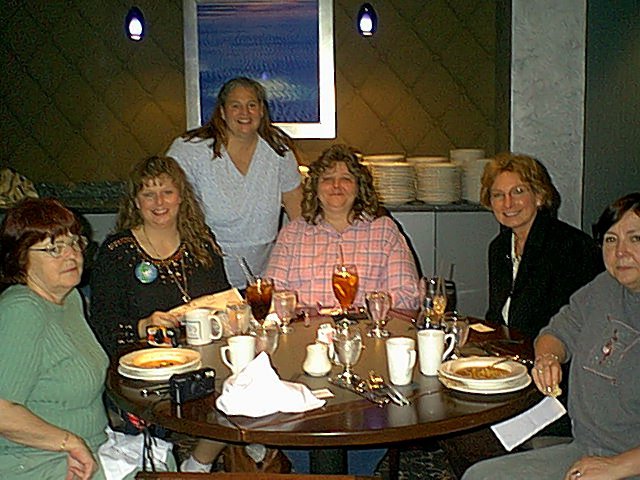
In April of 2004, many of us from the message boards went to the UVa Pituitary Days Convention. That’s where the picture above comes in.  Other pictures from that convention are here.

By chance, we met a wonderful woman named

Read Barbara Craven. She sat at our table for lunch on the last day and, after we learned that she was a dietitian who had had Cushing’s, one of us jokingly asked her if she’d do a guest chat for us. I didn’t follow through on this until she emailed me later. In the email, she asked how I was doing. Usually I say “fine” or “ok” but for some reason, I told her exactly how awful I was feeling.

Barbara emailed me back and said I should see a doctor at Johns Hopkins. I said I didn’t think I could get a recommendation to there, so SHE referred me. The doctor got right back to me, set up an appointment. Between his vacation and mine, that first appointment turned out to be Tuesday, Sept 14, 2004.

Just getting through the maze at Johns Hopkins was amazing. They have the whole system down to a science, moving from one place to another to sign in, then go here, then window 6, then… But it was very efficient.

My new doctor was wonderful. Understanding, knowledgeable. He never once said that I was “too fat” or “depressed” or that all this was my own fault. I feel so validated, finally.

He looked through my records, especially at my 2 previous Insulin Tolerance Tests. From those, he determined that my growth hormone has been low since at least August 2001 and I’ve been adrenal insufficient since at least Fall, 1999 – possibly as much as 10 years! I was amazed to hear all this, and astounded that my former endo not only didn’t tell me any of this, he did nothing. He had known both of these things – they were in the past records that I took with me. Perhaps that was why he had been so reluctant to share copies of those records. He had given me Cortef in the fall of 1999 to take just in case I had “stress” and that was it.

The new endo took a lot of blood (no urine!) for cortisol and thyroid stuff. I went back on Sept. 28, 2004 for arginine, cortrosyn and IGF testing.

He said that I would end up on daily cortisone – a “sprinkling” – and some form of GH, based on the testing the 28th.

For those who are interested, my new endo is Roberto Salvatori, M.D.
Assistant Professor of Medicine at Johns Hopkins

Medical School: Catholic University School of Medicine, Rome, Italy
Residency: Montefiore Medical Center
Fellowship: Cornell University, Johns Hopkins University
Board Certification: Endocrinology and Metabolism, Internal Medicine

Clinical Interests: Neuroendocrinology, pituitary disorders, adrenal disorders

Research Interests: Control of growth hormone secretion, genetic causes of growth hormone deficiency, consequences of growth hormone deficiency.

Although I have this wonderful doctor, a specialist in growth hormone deficiency at Johns Hopkins, in November, 2004, my insurance company saw fit to over-ride his opinions and his test results based on my past pharmaceutical history! Hello??? How could I have a history of taking GH when I’ve never taken it before?

Of course, I found out late on a Friday afternoon. By then it was too late to call my case worker at the drug company, so we had to appeal on Monday. My local insurance person also worked on an appeal, but the whole thing was  just another long ordeal of finding paperwork, calling people, FedExing stuff, too much work when I just wanted to start feeling better by Thanksgiving.

As it turned out the insurance company rejected the brand of hGH that was prescribed for me. They gave me the ok for a growth hormone was just FDA-approved for adults on 11/4/04. The day this medication was approved for adults was the day after my insurance said that’s what is preferred for me. In the past, this form of hGH was only approved for children with height issues. Was I going to be a ginuea pig again?

The new GH company assigned a rep for me, submitted info to pharmacy, and waited for insurance approval, again.

I finally started the Growth Hormone December 7, 2004.

Was the hassle and 3 year wait worth it?

Stay tuned for tomorrow, April 12, 2015 when all will be revealed.

Read

Read Dr. Barbara Craven’s Guest Chat, October 27, 2004

Thanks for reading 🙂

MaryO

Johns Hopkins Pituitary Patient Day 2013

Johns Hopkins Pituitary Patient Day

Join us on Saturday, September 28, 2013, for the 5th Annual Patient Education Day at the Johns Hopkins Pituitary Center.

When: Saturday, September 28, 2013
Time: 9:30 a.m.
Location:
Johns Hopkins Mt. Washington Conference Center
5801 Smith Avenue
Baltimore, MD 21209
map and directions

Location of the pituitary gland in the human brain

Location of the pituitary gland in the human brain (Photo credit: Wikipedia)

Patient Education Day Agenda:
9:30 – 10:00 AM REGISTRATION
10:00 – 10:25 AM What is the pituitary gland, where it is located, what it does, and what can go wrong Gary Wand, MD
10:30 – 10:50 AM How pituitary tumors can affect your vision Prem Subramanian, MD, PhD
Vivek Patel, MD, PhD
10:50 – 11:10 AM Cushing disease journey: a patient’s perspective Stacey Hardy
11:15 – 11:40 AM Surgery for Pituitary tumors: from very tiny to very large Alfredo Quinones-Hinojosa, MD
Gary Gallia, MD, PhD
Alessandro Olivi, MD
11:40 – 12:00 PM Radiation therapy: when, why, and how Lawrence Kleinberg, MD
Kristen Redmond, MD
12:05 – 12:25 PM The medications you may be taking (new and old ones): what you need to know Roberto Salvatori, MD
12:30 – 1:25 PM Lunch
1:30 – 3:00 PM PM Round table sessions:
1) Medical therapy (Wand/Salvatori)
2) Surgical therapy (Quinones/Gallia/Olivi)
3) Radiation therapy (Redmond/Kleinberg/Lim)
4) Vision issues (Subramanian/Patel)

*This schedule is subject to change

Please R.S.V.P. by September 13, 2013, vie email (preferred) to PituitaryDay@jhmi.edu  or to Alison Dimick at 410-955-3921.

Reservations will be taken on a first-come, first-serve basis.

Notes on the Magic Foundation Cushing’s Conference, 2012

Here are links to all the posts in order, although some still need to be edited.  I posted these directly from the meeting hall with no rereads or rewrites.  If anyone has anything to add, edit or delete, please let me know!


  • Magic Conference: Understanding your Pituitary Gland in Health and Disease

Dr. Frohman will present an overview of the pituitary gland. He will cover general aspects of pituitary function and testing and also review the types of pituitary disease that occur, including pituitary tumors and Sheehan’s Syndrome. Many people ask and wonder if Growth Hormone Deficiency can be inherited. Dr. Frohman will also briefly address that concern.


http://cushingshelp.blogspot.com/2012/07/magic-conference-understanding-your.html


  • Magic Conference: Testing and Diagnosis Process for Pituitary Disorders

Pituitary disorders can be difficult to diagnose in many cases. Dr. Salvatori will discuss the different testing and diagnostic procedures to determine the pituitary disorder. MAGIC receives many calls asking about diagnostic procedures. This segment will be helpful in understanding what procedures are used today to provide the best treatment available.

http://cushingshelp.blogspot.com/2012/07/magic-conference-testing-and-diagnosis.html


  • Magic Conference: Managing Medications and Aftercare of Treatments

It is crucial to monitor your treatments and aftercare of treatments when living with a pituitary disorder. Dr. Salvatori will discuss the importance of these issues so you will be aware of how to manage your pituitary disorder. A simple diagnosis does not mean that medications may be altered or changed in the future. This segment will assist you with information on how to manage your future.

http://cushingshelp.blogspot.com/2012/07/magic-conference-managing-medications.html


  • Magic Conference: Cushing’s Disease, Are We Closer to Medical Therapies?

A significant proportion of patients with Cushing’s Disease are not cured by primary surgical treatment, the disease is prone to relapse and significantly damages quality of life. Adjuvant radiotherapy is an increasingly unattractive option for clinicians who wish to spare their patients hypopituitarism and other potential complications. Some pharmacological options are currently available but tend to have dose-limiting side effects. New agents recently approved or under investigation will be discussed and strategies to select the optimal drug or drug combination for individual patients reviewed.

http://cushingshelp.blogspot.com/2012/07/magic-conference-cushings-disease-are.html


  • The Trip So Far…

MaryO’s personal experiences and thoughts

http://cushingshelp.blogspot.com/2012/07/the-trip-so-far.html


  • Cushing’s Help Turned Twelve During the Conference!

Twelve  years ago I was talking with my dear friend Alice, who runs a wonderful menopause site, Power Surge, wondering why there weren’t many support groups online (OR off!) for Cushing’s and I wondered if I could start one myself.  We decided that I could.

This website (http://www.cushings-help.com) first went “live” July 21, 2000 and the message boards September 30, 2000. Hopefully, with this site, I’ve made  some helpful differences in someone else’s life.

http://cushingshelp.blogspot.com/2012/07/today-we-twelve.html


  • Magic Conference: Treating Cushing’s Disease with Surgery: Ways of Achieving a Cure

Dr. McCutcheon will discuss the ways of treating Cushing’s disease from the surgical perspective, including the different ways of getting to the pituitary, the chances of success, and the potential complications. In addition, special nuances and pitfalls ofsurgery in Cushing’s (as opposed to other types of pituitary tumor) will be addressed.

http://cushingshelp.blogspot.com/2012/07/magic-conference-treating-cushings.html


  • Phil and the Zebra Undies

Dr. McCutcheon is a surprise participant in a gift to Phil.

http://cushingshelp.blogspot.com/2012/07/phil-and-zebra-undies.html


  • Real Talk: Psychological Process of Illness, part 1

This Segment will be broken into two sections. Part I will be provide an open opportunity for participants to ask relevant questions around the emotional/mental issues in living with a chronic illness. Participants will be able to openly talk about depression, anxiety, trauma, and other processes that occur when living illness.


Due to confidentiality issues, most of this segment is not shared.

http://cushingshelp.blogspot.com/2012/07/real-talk-psychological-process-of.html


  • Real Talk: Psychological Process of Illness, part 2

Part II will focus on seeing ourselves as survivors of illness and the process of staying empowered through illness that impacts us in such a powerful way. Principles of empowerment and how one can turn adversity into opportunity will be discussed. This segment should create an environment that is non judgmental and motivating.


Due to confidentiality issues, most of this segment is not shared.

http://cushingshelp.blogspot.com/2012/07/real-talk-psychological-process-of_21.html


  • The Rest Of The Trip

Wind-up and heading home

http://cushingshelp.blogspot.com/2012/07/the-rest-of-trip.html

Eventually, all these posts will be edited, cleaned up and typos corrected.;

Day Nine, Cushing’s Awareness Challenge

UVA 2004
Cushing’s Conventions have always been special times for me – we learn a lot, get to meet other Cushies, even get referrals to endos!

As early as 2001 (or before) my pituitary function was dropping.  My former endo tested annually but did nothing to help me with the symptoms.

In the fall of 2002 my endo refused to discuss my fatigue or anything at all with me until I lost 10 pounds. He said I wasn’t worth treating in my overweight condition and that I was setting myself up for a heart attack. He gave me 3 months to lose this weight. Those 3 months included Thanksgiving, Christmas and New Years.  Needless to say, I left his office in tears, again.

Fast forward 2 years to 2004.  I had tried for awhile to get my records from this endo. He wouldn’t send them, even at doctors’ or my requests.

I wanted to go see Dr. Vance at UVa but I had no records so she would’t see me until I could get them.

Finally, my husband went to the former endo’s office and threatened him with a court order, The office manager managed to come up with about 13 pages of records. For going to him from 1986 to 2001 including weeks and weeks at NIH and pituitary surgery, that didn’t seem like enough records to me.

In April of 2004, many of us from the message boards went to the UVa Pituitary Days Convention. That’s where the picture above comes in.  Other pictures from that convention are here.

By chance, we met a wonderful woman named Barbara Craven. She sat at our table for lunch on the last day and, after we learned that she was a dietitian who had had Cushing’s, one of us jokingly asked her if she’d do a guest chat for us. I didn’t follow through on this until she emailed me later. In the email, she asked how I was doing. Usually I say “fine” or “ok” but for some reason, I told her exactly how awful I was feeling.

Barbara emailed me back and said I should see a doctor at Johns Hopkins. I said I didn’t think I could get a recommendation to there, so SHE referred me. The doctor got right back to me, set up an appointment. Between his vacation and mine, that first appointment turned out to be Tuesday, Sept 14, 2004.

Just getting through the maze at Johns Hopkins was amazing. They have the whole system down to a science, moving from one place to another to sign in, then go here, then window 6, then… But it was very efficient.

My new doctor was wonderful. Understanding, knowledgeable. He never once said that I was “too fat” or “depressed” or that all this was my own fault. I feel so validated, finally.

He looked through my records, especially at my 2 previous Insulin Tolerance Tests. From those, he determined that my growth hormone has been low since at least August 2001 and I’ve been adrenal insufficient since at least Fall, 1999 – possibly as much as 10 years! I was amazed to hear all this, and astounded that my former endo not only didn’t tell me any of this, he did nothing. He had known both of these things – they were in the past records that I took with me. Perhaps that was why he had been so reluctant to share copies of those records. He had given me Cortef in the fall of 1999 to take just in case I had “stress” and that was it.

The new endo took a lot of blood (no urine!) for cortisol and thyroid stuff. I went back on Sept. 28, 2004 for arginine, cortrosyn and IGF testing.

He said that I would end up on daily cortisone – a “sprinkling” – and some form of GH, based on the testing the 28th.

For those who are interested, my new endo is Roberto Salvatori, M.D.
Assistant Professor of Medicine at Johns Hopkins

Medical School: Catholic University School of Medicine, Rome, Italy
Residency: Montefiore Medical Center
Fellowship: Cornell University, Johns Hopkins University
Board Certification: Endocrinology and Metabolism, Internal Medicine

Clinical Interests: Neuroendocrinology, pituitary disorders, adrenal disorders

Research Interests: Control of growth hormone secretion, genetic causes of growth hormone deficiency, consequences of growth hormone deficiency.

Although I have this wonderful doctor, a specialist in growth hormone deficiency at Johns Hopkins, in November, 2004, my insurance company saw fit to over-ride his opinions and his test results based on my past pharmaceutical history! Hello??? How could I have a history of taking GH when I’ve never taken it before?

Of course, I found out late on a Friday afternoon. By then it was too late to call my case worker at the drug company, so we had to appeal on Monday. My local insurance person also worked on an appeal, but the whole thing was  just another long ordeal of finding paperwork, calling people, FedExing stuff, too much work when I just wanted to start feeling better by Thanksgiving.

As it turned out the insurance company rejected the brand of hGH that was prescribed for me. They gave me the ok for a growth hormone was just FDA-approved for adults on 11/4/04. The day this medication was approved for adults was the day after my insurance said that’s what is preferred for me. In the past, this form of hGH was only approved for children with height issues. Was I going to be a ginuea pig again?

The new GH company assigned a rep for me, submitted info to pharmacy, and waited for insurance approval, again.

I finally started the Growth Hormone December 7, 2004.

Was the hassle and 3 year wait worth it?

Stay tuned for Day 12, April 12, 2012 when all will be revealed.


Read Dr. Barbara Craven’s Guest Chat, October 27, 2004

Thanks for reading 🙂


MaryO