Interview May 7 with Kathy C, Pituitary Patient

My name is Kathy Casey. I am a 63 year old retired school nurse. I am married with two wonderful sons and a grandson. My husband and I live in the mountain town of Mt. Shasta in northern California. I have always been athletic.

In 1995, I was diagnosed with a pituitary tumor. At the time the only symptom I was aware of was a severe headache. I had a transphenoidal resection by Dr. Wilson at UCSF Medical Center followed by radiation therapy for 23 days. At the time they said they could not remove all of the tumor.

In 2008/2009. I exhibited symptoms of Cushing’s and my cortisol level was outrageous, and I had to be hospitalized initially for a potassium level of 2. I returned to UCSF and Dr. Anwar Sandeep operated . By removing part of the tumor. My Cushing symptoms resolved. However, he said that the tumor was not encapsulated and was invading the cavernous sinus and stella turcica so it was still not possible to remove it all.

I was OK until December 2013 when I began exhibiting the symptoms of Cushings. One of my 24 hr. urines was 14,000. I had to be hospitalized for a potassium level of 1.9. Dr. Heaney said he has never seen a cortisol level that high. This time I decided to go to the UCLA Pituitary Tumor and Endocrinology Program where they were more oriented to follow-up and treating this disorder. Dr. Bergsneider decided that surgery was not an option. He and Dr. Heaney decided radiation was not an option. So now I am being followed by Dr. Heaney to see if medication can help.

I am now on Cabergoline 0.5 mg three tabs twice a week and Signifor 0.9 mg subcutaneosly twice a day. I think they are alleviating some of the symptoms. However, the Signifor caused my blood sugar to rise, and I had to go on Metformin which is causing nausea to a point where I have a hard time eating.

Anyway, this whole situation is depressing and overwhelming. I am tryng to stay positive, but I wonder how it will turn out. I am fortunate to have a supportive and helpful husband.

I am interested in communicating with people who may be going through a similar experience and learning more about this rare condition.

Kathy will be interviewed May 7, 2014 in BlogTalkRadio

HOME | Contents | Adrenal Crisis! | Abbreviations | Glossary | Forums | Donate | Bios | Add Your Bio

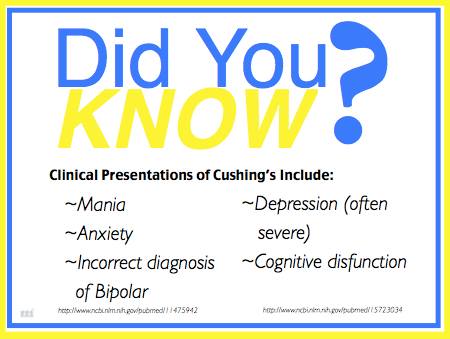
Cushing’s Awareness Challenge, Day 3: Symptoms

robin-symptoms


Robin has made another excellent graphic of some of the symptoms of Cushing’s.  There are far too many to be listed in any image, as shown by the list at http://www.cushings-help.com/toc.htm#symptoms


Just to be silly, a few years ago, I did my own version of Cushing’s symptoms:


The Seven Dwarves of Cushing's

Headache and pituitary disease A systematic review

Clinical Endocrinology, 08/15/2013  Evidence Based Medicine  Review Article

Kreitschmann–Andermahr I et al. –

English: Cavernous sinus

English: Cavernous sinus (Photo credit: Wikipedia)

Headache is very common in pituitary disease and is reported to be present in more than a third of all patients with pituitary adenomas.

Tumour size, cavernous sinus invasion, traction or displacement of intracranial pain–sensitive structures such as blood vessels, cranial nerves and dura mater, and hormonal hypersecretion are implicated causes.

Some studies suggest that oversecretion of GH and prolactin may be important for the development of headaches and treatment, particularly with somatostatin analogues, has been shown to improve symptoms in these patients.

Otherwise, treatment rests on general treatment options for headaches based an accurate clinical history and a precise classification which includes assessment of the patient’s psychosocial risk factors.

From PubMed

From Bangladesh ~ Pituitary Adenoma: When headache is a headache

Location of the pituitary gland in the human brain

Location of the pituitary gland in the human brain (Photo credit: Wikipedia)

“Got headache? Take a paracetamol and get relieved in a short while.”

This is common practice in our country. Almost everyone has had a headache, but rarely headache becomes a headache in our lives. Not all headaches require doctor’s attention but sometimes it represent the tip of a huge iceberg.

Mr Shafiul Islam, 38 years of age, an active male developed a gradual onset of headache, which worsened at the morning, followed by vomiting. He visited a general practitioner and took prescribed medicines, but that failed to cure the symptoms. Rather he was gradually experiencing loss of outer side vision of both eyes.

When he revisited a doctor and was advised for MRI of brain he was diagnosed with a core of “Pituitary Macrodenoma,” a tumor of a hormone producing gland of brain. Then Shafiul was referred to Neurosurgeon of Comfort Nursing home Assistant Professor Dr Moshiur Rahman, who decided to perform operation for removal of the tumor after the initial evaluation.

The pituitary gland is an endocrine gland about the size of a pea and weighing 5 grams (0.18 oz) in humans. It is a protrusion off the bottom of the hypothalamus at the base of the brain, and rests in a small, bony cavity (sella turcica). The pituitary gland secretes nine hormones. A pituitary adenoma is a slow growing and less harmful tumor arising from cells in the pituitary gland. Because they originate from cells in the pituitary gland, which is the master hormone gland, they often cause problems related to hormonal dysfunction.

Some pituitary tumors result in excessive production and over-secretion of hormones, which can result in a variety of syndromes. A large proportion of these tumors, however, do not produce any functional hormones, but instead grow to a size where they cause symptoms because they compress surrounding structures. For these reasons, larger pituitary tumors (called macroadenomas) often present with headache, visual loss and pituitary gland dysfunction.

The specific cause of pituitary adenoma development is unknown, although they are likely to be caused in part by random mutations in cells of the pituitary gland. Surgery is the first line of treatment for many symptomatic pituitary tumors in patients that are good surgical candidates, especially in patients with nonfunctioning macroadenomas.

Dr Moshiur approached the tumor by entering through nasal opening with the help of ENT specialist Associate Professor Dr Sajol Ashfaq, under general aenesthesia (fully unconscious) done by Aenesthesiologist Associate Professor Dr Shamsul Alam. After elevation of a thin membrane over the nasal partition and breaking a bone in the base of the skull they got a vision of the tumor through endoscope. After that, the tumor was removed through the nose. After three days of post-operative care, the patient was discharged. All his symptoms, headache, vomiting and poor vision improved dramatically and he got back to his normal life.

Dr Moshiur Rahman said: “The surgical approach for removing pituitary tumours is usually an endonasal (through the nostril) transsphenoidal (through the sphenoid sinus) approach. This procedure is Endoscopic Transnasal Transphenoidal Pituitary Adenomectomy, which is a safe, minimally invasive but effective, modern treatment option for Pituitary Adenoma, with few side effects and short post-operative hospital stay. This latest technology is being practiced in some centres of the capital for last few years.”

He also said, he performed three operations before successfully with no long term adverse effect. He also paid gratefulness to Associate Professor Dr Sajol Ashfaq and Associate Professor Dr Shamsul Alam for their sincere and great effort.

Once, people had to go outside of the country for this operation. Nowadays, this operation is often performed by many neurosurgeons of the capital. A few centres have also developed to provide these facilities of operation. People can take this oppurtunity confidently by choosing a competent surgical team.

Day Eighteen, Cushing’s Awareness Challenge

Over the years, we went on several Windjammer Barefoot Cruises.  We liked them because they were small, casual and were fairly easy on the wallet.

They sailed around the Caribbean to a variety of islands, although they sometimes changed itineraries depending on weather, crew, whatever.  One trip we were supposed to go to Saba but couldn’t make port.  A lot of people got off at the next port and flew home.

The captains were prone to “Bedtime Stories” which were often more fiction than true but they added to the appeal of the trip.  We didn’t care if we missed islands or not – we were just there to sail over the waves and enjoy the ride.

The last trip we took with them was about two years before I started having Cushing’s problems.  (You wondered how I was going to tie this together, right?)

The cuise was uneventful, other than the usual mishaps like hitting docks, missing islands and so on.  Until it was a particularly rough sea one day.  I was walking somewhere on deck and suddenly a wave came up over the deck making it very slippery.  I fell and cracked the back of my head on the curved edge of a table in the dining area.  I had the next-to-the-worse headache I have ever had, the worst being after my pituitary surgery. At least after the surgery I got some morphine.

We asked several doctors later if that hit could have contributed to my Cushing’s but doctors didn’t want to get involved in that at all.

The Windjammer folks didn’t fare much better, either. In October 1998, Hurricane Mitch was responsible for the loss of the s/v Fantome (the last one we were on).

All 31 crew members aboard perished; passengers and other crew members had earlier been offloaded in Belize.

The story was recorded in the book The Ship and the Storm: Hurricane Mitch and the Loss of the Fantome by Jim Carrier.  The ship, which was sailing in the center of the hurricane, experienced up to 50-foot (15 m) waves and over 100 mph (160 km/h) winds, causing the Fantome to founder off the coast of Honduras.


This event was similar to the Perfect Storm in that the weather people were more interested in watching the hurricane change directions than they were in people who were dealing with its effects.

I read this book and I was really moved by the plight of those crew members.


I’ll never know if that hit on my head contributed to my Cushing’s but I have seem several people mention on the message boards that they had a traumatic head injury of some type in their earlier lives.