What would Harvey Cushing say about Cushing’s disease today?

harvey-book

(BPT) – More than 80 years ago renowned neurosurgeon, Dr. Harvey Cushing, discovered a tumor on the pituitary gland as the cause of a serious, hormone disorder that leads to dramatic physical changes in the body in addition to life-threatening health concerns. The discovery was so profound it came to be known as Cushing’s disease. While much has been learned about Cushing’s disease since the 1930s, awareness of this rare pituitary condition is still low and people often struggle for years before finding the right diagnosis.

Read on to meet the man behind the discovery and get his perspective on the present state of Cushing’s disease.

* What would Harvey Cushing say about the time it takes for people with Cushing’s disease to receive an accurate diagnosis?

Cushing’s disease still takes too long to diagnose!

Despite advances in modern technology, the time to diagnosis for a person with Cushing’s disease is on average six years. This is partly due to the fact that symptoms, which may include facial rounding, thin skin and easy bruising, excess body and facial hair and central obesity, can be easily mistaken for other conditions. Further awareness of the disease is needed as early diagnosis has the potential to lead to a more favorable outcome for people with the condition.

* What would Harvey Cushing say about the advances made in how the disease is diagnosed?

Significant progress has been made as several options are now available for physicians to use in diagnosing Cushing’s disease.

In addition to routine blood work and urine testing, health care professionals are now also able to test for biochemical markers – molecules that are found in certain parts of the body including blood and urine and can help to identify the presence of a disease or condition.

* What would Harvey Cushing say about disease management for those with Cushing’s disease today?

Patients now have choices but more research is still needed.

There are a variety of disease management options for those living with Cushing’s disease today. The first line and most common management approach for Cushing’s disease is the surgical removal of the tumor. However, there are other management options, such as medication and radiation that may be considered for patients when surgery is not appropriate or effective.

* What would Harvey Cushing say about the importance of ongoing monitoring in patients with Cushing’s disease?

Routine check-ups and ongoing monitoring are key to successfully managing Cushing’s disease.

The same tests used in diagnosing Cushing’s disease, along with imaging tests and clinical suspicion, are used to assess patients’ hormone levels and monitor for signs and symptoms of a relapse. Unfortunately, more than a third of patients experience a relapse in the condition so even patients who have been surgically treated require careful long-term follow up.

* What would Harvey Cushing say about Cushing’s disease patient care?

Cushing’s disease is complex and the best approach for patients is a multidisciplinary team of health care professionals working together guiding patient care.

Whereas years ago patients may have only worked with a neurosurgeon, today patients are typically treated by a variety of health care professionals including endocrinologists, neurologists, radiologists, mental health professionals and nurses. We are much more aware of the psychosocial impact of Cushing’s disease and patients now have access to mental health professionals, literature, patient advocacy groups and support groups to help them manage the emotional aspects of the disease.

Learn More

Novartis is committed to helping transform the care of rare pituitary conditions and bringing meaningful solutions to people living with Cushing’s disease. Recognizing the need for increased awareness, Novartis developed the “What Would Harvey Cushing Say?” educational initiative that provides hypothetical responses from Dr. Cushing about various aspects of Cushing’s disease management based on the Endocrine Society’s Clinical Guidelines.

For more information about Cushing’s disease, visit www.CushingsDisease.com or watch educational Cushing’s disease videos on the Novartis YouTube channel at www.youtube.com/Novartis.


From http://www.jsonline.com/sponsoredarticles/health-wellness/what-would-harvey-cushing-say-about-cushings-disease-today8087390508-253383751.html

Suspected case of Cushing’s Syndrome with history of taking medicines prescribed by registered Chinese medicine practitioner

The Department of Health (DH) today (February 18) alerted clients who have consulted a registered Chinese medicine practitioner (CMP) Mr Chan Kong-kin (CMP Chan), practising at G/F, No.25, Leung Tin Village in Tuen Mun, should consult health-care professionals for advice if they have been supplied with medicines suspected to be Western medicines.

The appeal followed the DH’s investigation into two public complaints. The first complaint involved a 23-year-old woman who consulted CMP Chan for management of eczema. She was given a type of green pills, two types of yellow pills and a type of red-yellow capsules for treatment of her disease for about one year.

She developed round face and increased facial hair which are features compatible with Cushing’s syndrome and steroid overdose can cause the syndrome. The patient was admitted to a public hospital on February 5 for investigation and was discharged on February 7.

The second complaint involved a 24-year-old woman who was recommended by the first complainant to consult CMP Chan for management of allergic rhinitis and eczema. She was given similar medicines as those for the first complainant for three days.

Her condition was stable.

Today, chemical analysis by the Government Laboratory on the patients’ drug samples showed that Western medicine Dexamethasone was detected in the red-yellow capsule.

Dexamethasone is a potent steroid. Taking dexamethasone for a long time, especially when in substantial dosage, can cause side effects such as moon face, high blood pressure, high blood sugar, muscle atrophy, peptic ulcer and even osteoporosis.

DH has set up a hotline 2125 1133 for public enquiries related to the medicines prescribed by the CMP.

It will operate from 9am to 9pm, Monday to Friday.

“Preliminary investigation by the DH revealed that pills and capsules were found in the CMP’s premises and all have been seized for further investigation,” the spokesman said.

“In December 31, 2012, the DH announced that CMP Chan was found in possession of Part I poisons and unregistered pharmaceutical products in the same clinic which also involved medicines with steroid. The DH subsequently took enforcement action and the relevant legal proceeding is in progress.

The case has also been referred to the Chinese Medicine Council of Hong Kong for follow-up action,” the spokesman added

“On completion of our investigation, the DH will seek advice from the Department of Justice regarding possible contravention of the Pharmacy and Poisons Ordinance (Cap 138) for the illegal sale or possession of Part I poisons. According to the Ordinance, the maximum penalty for each offence is a fine of $100,000 and two years’ imprisonment. Besides, the DH will also refer this case to the Chinese Medicine Council of Hong Kong for possible disciplinary action”, the spokesman remarked.

People who have been supplied with medicines by the concerned CMP and are in doubt should consult health-care professionals as soon as possible.

They should submit the medicines to the Chinese Medicine Division of DH at 16/F, AIA Kowloon Tower, Landmark East, 100 How Ming Street, Kwun Tong, during office hours for disposal.

Source: HKSAR Government

From http://7thspace.com/headlines/453015/suspected_case_of_cushings_syndrome_with_history_of_taking_medicines_prescribed_by_registered_chinese_medicine_practitioner.html

Polycystic ovarian syndrome and Cushing’s syndrome: A persistent diagnostic quandary

European Journal of Obstetrics & Gynecology and Reproductive Biology, 02/10/2014  Clinical Article

Brzana J, et al. – This study aims to retrospectively review institutional records of female patients of reproductive age with Cushing’s disease (CD) and determine if and how many had been previously diagnosed as having solely PCOS. To determine whether clinical patterns might be useful in identifying appropriate candidates for hypercortisolism screening in women suspected of PCOS. Prolonged exposure to hypercortisolism has been linked with increased mortality and morbidity. Tests for hypercortisolism in all the PCOS cases authors report led to an appropriate CD diagnosis. Future research should focus on when and which (if not all) women with suspected PCOS should be tested for hypercortisolism.

Methods

  • The study included 50 patients with pathologically proven CD at Oregon Health & Science University, Northwest Pituitary Center between 2006 and 2011.
  • Physical, clinical, and biochemical features for hypercortisolism were compared.

Results

  • Of 50 patients with pathologically proven CD, 26 were women of reproductive age.
  • Of these, half had previously been diagnosed with and treated initially solely for PCOS.
  • Hirsutism and menstrual abnormalities were more common in the group with an initial PCOS diagnosis than in the group with an initial CD diagnosis.

From http://www.mdlinx.com/endocrinology/newsl-article.cfm/5055779/ZZ4747461521296427210947/?news_id=2364&newsdt=021014&subspec_id=1509&utm_source=Focus-On&utm_medium=newsletter&utm_content=Top-New-Article&utm_campaign=article-section

When to think Cushing’s syndrome in type 2 diabetes

ESTES PARK, COLO. – Diabetes mellitus, osteoporosis, and hypertension are conditions that should boost the index of suspicion that a patient with some cushingoid features may in fact have endogenous Cushing’s syndrome, Dr. Michael T. McDermott said at a conference on internal medicine sponsored by the University of Colorado.

An estimated 1 in 20 patients with type 2 diabetes has endogenous Cushing’s syndrome. The prevalence of this form of hypercortisolism is even greater – estimated at up to 11% – among individuals with osteoporosis. In hypertensive patients, the figure is 1%. And among patients with an incidentally detected adrenal mass, it’s 6%-9%, according to Dr. McDermott, professor of medicine and director of endocrinology and diabetes at the University of Colorado.

“Endogenous Cushing’s syndrome is not rare. I suspect I’ve seen more cases than I’ve diagnosed,” he observed. “I’ve probably missed a lot because I failed to screen people, not recognizing that they had cushingoid features. Not everyone looks classic.”

There are three screening tests for endogenous Cushing’s syndrome that all primary care physicians ought to be familiar with: the 24-hour urine cortisol test, the bedtime salivary cortisol test, and the overnight 1-mg dexamethasone suppression test.

“I think if you have moderate or mild suspicion, you should use one of these tests. If you have more than moderate suspicion – if a patient really looks like he or she has Cushing’s syndrome – then I would use at least two screening tests to rule out endogenous Cushing’s syndrome,” the endocrinologist continued.

The patient performs the bedtime salivary cortisol test at home, obtaining samples two nights in a row and mailing them to an outside laboratory. The overnight dexamethasone suppression test entails taking 1 mg of dexamethasone at bedtime, then measuring serum cortisol the next morning. A value greater than 1.8 mcg/dL is a positive result.

Pregnant women constitute a special population for whom the screening method recommended in Endocrine Society clinical practice guidelines (J. Clin. Endocrinol. Metab. 2008;93:1526-40) is the 24-hour urine cortisol test. That’s because pregnancy is a state featuring high levels of cortisol-binding globulins, which invalidates the other tests. In patients with renal failure, the recommended screening test is the 1-mg dexamethasone suppression test. In patients on antiepileptic drugs, the 24-hour urine cortisol or bedtime salivary cortisol test is advised, because antiseizure medications enhance the metabolism of dexamethasone.

Dr. McDermott said that “by far” the most discriminatory clinical features of endogenous Cushing’s syndrome are easy bruising, violaceous striae on the trunk, facial plethora, and proximal muscle weakness.

“They’re by no means specific. You’ll see these features in people who don’t have Cushing’s syndrome. But those are the four things that should make you really consider Cushing’s syndrome in your differential diagnosis,” he stressed.

More widely recognized yet actually less discriminatory clinical features include facial fullness and the “buffalo hump,” supraclavicular fullness, central obesity, hirsutism, reduced libido, edema, and thin or poorly healing skin.

Endogenous Cushing’s syndrome can have three causes. An adrenocorticotropic hormone (ACTH)-secreting pituitary adenoma accounts for 80% of cases. A cortisol-secreting adrenal tumor is the cause of 10%. And another 10% are due to an ectopic ACTH-secreting tumor, most commonly a bronchial carcinoid tumor.

Once the primary care physician has a positive screening test in hand, it’s typical to refer the affected patient to an endocrinologist in order to differentiate which of the three causes is present. This is accomplished based upon the results of a large, 8-mg dexamethasone suppression test coupled with measurement of plasma ACTH levels.

Dr. McDermott recommended as a good read on the topic of evaluating a patient with endogenous Cushing’s syndrome a recent review article that included a useful algorithm (N. Engl. J. Med. 2013;368:2126-36).

He reported having no financial conflicts.

bjancin@frontlinemedcom.com

From http://www.clinicalendocrinologynews.com

Cushing’s Disease – Rare Disease Quick Facts

cushings-diagnosis


Cushing’s disease is a rare condition due to excess cortisol levels that result from a pituitary tumor secreting adrenocorticotropic hormone (ACTH), which stimulates cortisol secretion.  Cushing’s disease should not be confused with Cushing’s syndrome which is increased cortisol levels but that increase can be due to any number of factors. However, Cushing’s disease is the most common form of Cushing’s syndrome.

Symptoms

The symptoms related to Cushing’s disease and Cushing’s syndrome are the same, since both are related to an excess of cortisol. Also, symptoms vary extensively among patients and that, with the inherent fluctuation in hormone levels make it difficult to diagnosis both conditions.

Changes in physical characteristics of the body

  • Fullness and rounding of the face
  • Added fat on back of neck (so-called “buffalo hump”)
  • Easy bruising
  • Purplish stretch marks on the abdomen (abdominal striae)
  • Excessive weight gain, especially in abdominal region
  • Red cheeks
  • Excess hair growth on the face, neck, chest, abdomen and thighs

Changes in physiology/psychology

  • Generalized weakness and fatigue
  • Menstrual disorder
  • Decreased fertility and/or sex drive
  • High blood pressure that is often difficult to treat
  • Diabetes mellitus
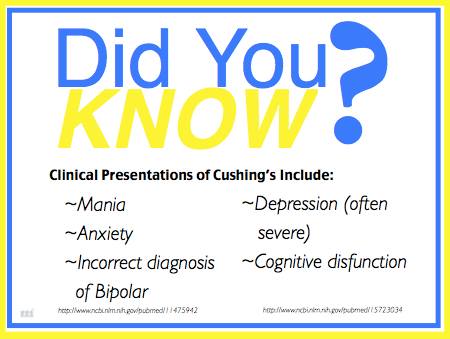
  • Mood and behavior disorders

Diagnosis

The early stages of Cushing’s disease may be difficult to recognize. However, if it is suspected, diagnosis is generally a 2 stage process. First to determine if cortisol levels are high, and if so, why they are high.

Tests to confirm high cortisol levels:

  • 24-hour urine cortisol
  • Dexamethasone suppression test (low dose)

Tests to determine cause:

  • Blood ACTH level
  • Brain MRI
  • Corticotropin-releasing hormone test
  • Dexamethasone suppression test (high dose)
  • Petrosal sinus sampling

Treatment

Surgery

  • Most patients with Cushing’s disease undergo surgery to remove the pituitary adenoma offers.
  • If the tumor is isolated to the pituitary, cure rates of 80-85% are common.
  • If the tumor has spread to nearby organs, cure rates of 50-55% are common.

Medicine (approved orphan drugs)

Signifor (pasireotide)

  • Approved for patients with Cushing’s disease for whom pituitary is not an option or surgery has been ineffective.
  • Signifor is a somatostatin receptor agonist that leads to inhibition of ACTY secretion (and subsequently decreased cortisol levels).

Korlym (mifepristone)

  • Approved for patients with Cushing’s syndrome who have type 2 diabetes or glucose intolerance and have failed surgery (or not candidates for surgery).
  • Korlym is a glucocorticoid receptor antagonist which in turn blocks the effects of the high levels of cortisol in the body. Korlym is used to treat high glucose levels due to elevated cortisol.

Medicines used but not indicated for Cushing’s disease include

Mitoden

ketoconazole

Metyrapone

Etomidate

Radiation

  • Radiation therapy may be used in some patients and can be very effective in controlling the growth of these tumors.

Prognosis

In most cases, treatment can cure Cushing’s disease. If not treated properly, the chronic hypercortisolism can lead to excess morbidity and mortality due to increased cardiovascular and other risk factors.

For more information

National Library of Medicine, National Institute of Health

Cushing’s Disease Information (provided by Novartis Pharmaceuticals)


Images courtesy of the open access journal Orhanet Journal for Rare Diseases.  Castinetti et al. Orphanet J Rare Dis. 2012 7:41   doi:10.1186/1750-1172-7-41

– See more at: http://www.raredr.com/front-page-medicine/articles/cushings-disease-rare-disease-quick-facts-0