Delayed diagnosis, barriers to care increase morbidity in children with Cushing’s syndrome

Hispanic and black children diagnosed with Cushing’s syndrome are more likely to present with higher cortisol measurements and larger tumor size vs. white children, according to study findings presented at the annual Pediatric Academic Societies Meeting in Baltimore.

“Racial and socioeconomic disparities may contribute to the severity of disease presentation for children with Cushing’s [syndrome],” Alexandra Gkourogianni, MD, of the section on endocrinology and genetics at the Eunice Kennedy Shriver National Institute of Child Health and Human Development, and colleagues wrote. “Minority children from disadvantaged backgrounds present more frequently with comorbidities associated with longstanding [Cushing’s syndrome].”

Gkourogianni and colleagues analyzed data from 135 children treated for Cushing’s syndrome (transsphenoidal surgery) at the NIH between 1997 and 2015 (mean age, 13 years; 51% girls; 33% Hispanic or black). Researchers used a 10-point index for rating severity in pediatric Cushing’s syndrome based on predefined cutoffs; degree of hypercortisolemia, impaired glucose tolerance, and hypertension were graded on a 3-point scale (0-2); height, BMI z scores, duration of disease, and tumor invasion were graded on a 2-point scale (0-1).

Researchers found that midnight cortisol measurements were higher among Hispanic and black children vs. white children (23.3 µg/dL vs. 16 µg/dL; P = .019), as were tumor sizes (mean 6.3 mm vs. 3.3 mm; P = .016). Height standard deviation score was more severely affected in black and Hispanic children (–1.6 vs. –1.1; P = .038), and mean Cushing’s syndrome score for Hispanic and black children was higher vs. white children (4.5 vs. 3.8; P = .033).

Researchers found that median income had an independent correlation with Cushing’s syndrome score in univariate regression analysis for covariates of socioeconomic status and demographics (P = .025). Multivariable regression analysis using race, prevalence of obesity, estimated income, access to pediatric endocrinologist, age and sex confirmed that race, along with lower socioeconomic status and older age, were predictors of a higher Cushing’s syndrome score (P = .002).

“We speculate that delayed diagnosis, barriers to access to care and poorer quality health care for these underserved patients may contribute to presentation at a later age and increased morbidity,” the researchers wrote. “Additional research is needed to identify potential modifiable factors that may improve care for these patients.” – by Regina Schaffer

Reference:

Gkourogianni A, et al. Poster #445. Presented at: Pediatric Academic Societies Meeting; April 30- May 3, 2016; Baltimore.

Disclosure: Endocrine Today was unable to determine relevant financial disclosures.

From http://www.healio.com/endocrinology/adrenal/news/online/%7Be79d7c84-d539-4a04-a548-882b9f4caadd%7D/delayed-diagnosis-barriers-to-care-increase-morbidity-in-children-with-cushings-syndrome

Day 17, Cushing’s Awareness Challenge 2016


Because it’s a Sunday again, this is a semi-religious post…

After I was finished with the Cushing’s long diagnostic process, surgery and several post-op visits to NIH, I was asked to give the scripture reading at my church. The man who preached the sermon that week was the survivor of a horrific accident where he and his family were hit by a van while waiting at an airport.

I thought I had written down the scripture reading carefully. I practiced and practiced. I don’t like speaking in front of a crowd but I said I would. When I got to church, the reading was different from what I had practiced. Maybe I wrote it down wrong, maybe someone changed it. Whatever.

The real scripture turned out to be Psalm 116. I got very emotional while reading this and started crying when I got to verse 8 “For you, O LORD, have delivered my soul from death“.  Others in the congregation who knew part of my story were very moved, too.

psalm-116-1-4

Psalm 116 (New International Version)

1 I love the LORD, for he heard my voice;
he heard my cry for mercy.

2 Because he turned his ear to me,
I will call on him as long as I live.

3 The cords of death entangled me,
the anguish of the grave came upon me;
I was overcome by trouble and sorrow.

4 Then I called on the name of the LORD:
“O LORD, save me!”

5 The LORD is gracious and righteous;
our God is full of compassion.

6 The LORD protects the simplehearted;
when I was in great need, he saved me.

7 Be at rest once more, O my soul,
for the LORD has been good to you.

8 For you, O LORD, have delivered my soul from death,
my eyes from tears,
my feet from stumbling,

9 that I may walk before the LORD
in the land of the living.

10 I believed; therefore I said,
“I am greatly afflicted.”

11 And in my dismay I said,
“All men are liars.”

12 How can I repay the LORD
for all his goodness to me?

13 I will lift up the cup of salvation
and call on the name of the LORD.

14 I will fulfill my vows to the LORD
in the presence of all his people.

15 Precious in the sight of the LORD
is the death of his saints.

16 O LORD, truly I am your servant;
I am your servant, the son of your maidservant;
you have freed me from my chains.

17 I will sacrifice a thank offering to you
and call on the name of the LORD.

18 I will fulfill my vows to the LORD
in the presence of all his people,

19 in the courts of the house of the LORD—
in your midst, O Jerusalem.
Praise the LORD.

This Psalm has come to have so much meaning in my life. When I saw at a book called A Musician’s Book of Psalms each day had a different psalm. “My” psalm  was listed as the reading for my birthday, so I had to buy this book!  For a while, it was the license plate on my car.

I used to carry a print out of this everywhere I go because I find it very soothing. “when I was in great need, he saved me.” This print out is in a plastic page saver but now I have this info on my phone and iPad.

On the other side there is an article I found after my kidney cancer.  You can read that article in yesterday’s post.

Day 14, Cushing’s Awareness Challenge 2016

Way back when we first got married, my husband thought we might have a big family with a lot of kids.  He was from a family of 6 siblings, so that’s what he was accustomed to.  I am an only child so I wasn’t sure about having so many.

I needn’t have worried.

In January, 1974 I had a miscarriage.  I was devastated. My father revealed that my mother had also had a miscarriage.  I had no idea.

At some point after this I tried fertility drugs.  Clomid and another drug.  One or both drugs made me very angry/depressed/bitchy (one dwarf I left off the image)  Little did I know that these meds were a waste of time.

Eventually,  I did get pregnant and our wonderful son, Michael was born.  It wasn’t until he was seven that I was finally, actually diagnosed with Cushing’s.

When I had my early Cushing’s symptoms, I thought I was pregnant again but it was not to be.

I’ll never forget the fall when he was in second grade.  He was leaving for school and I said goodbye to him.  I knew I was going into NIH that day for at least 6 weeks and my future was very iffy.  The night before, I had signed my will – just in case.  He just turned and headed off with his friends…and I felt a little betrayed.

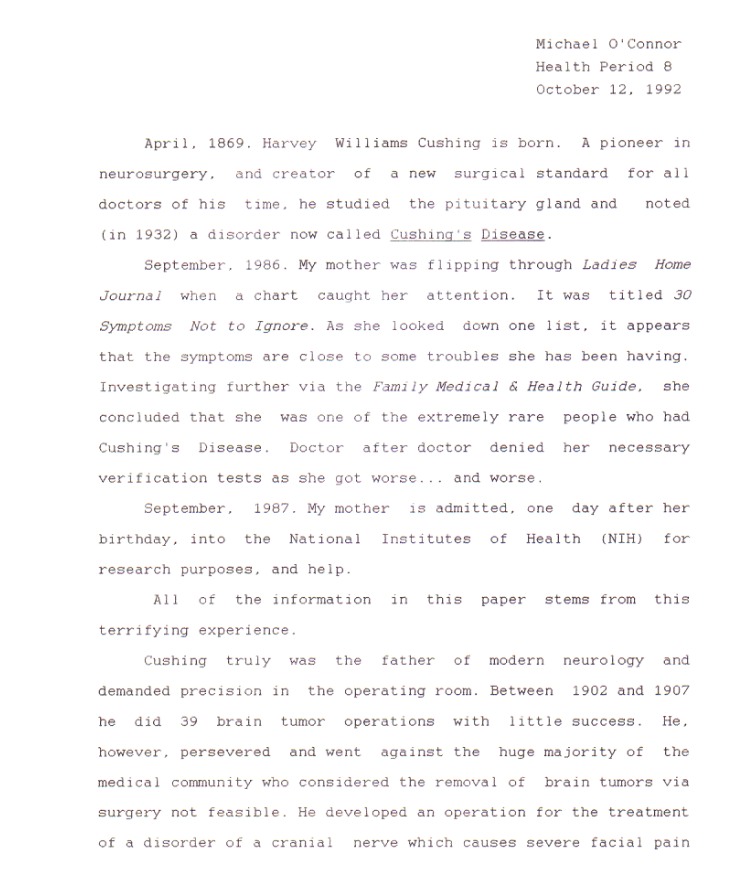
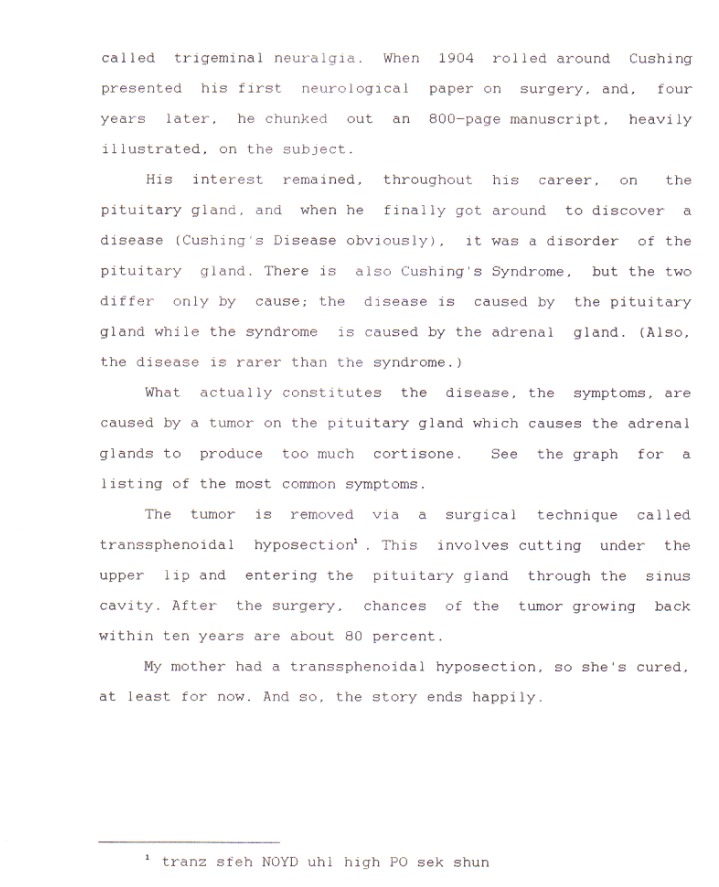
Michael wrote this paper on Cushing’s when he was in the 7th grade. From the quality of the pages, he typed this on typing paper – no computers yet!

Click on each page to enlarge.

When Michael started having headache issues in middle school, I had him tested for Cushing’s.  I had no idea yet if it could be familial but I wasn’t taking any chances.  It turned out that my father had also had some unnamed endocrine issues.  Hmmm…

I survived my time and surgery at NIH and Michael grew up to be a wonderful young man, if an only child.  🙂

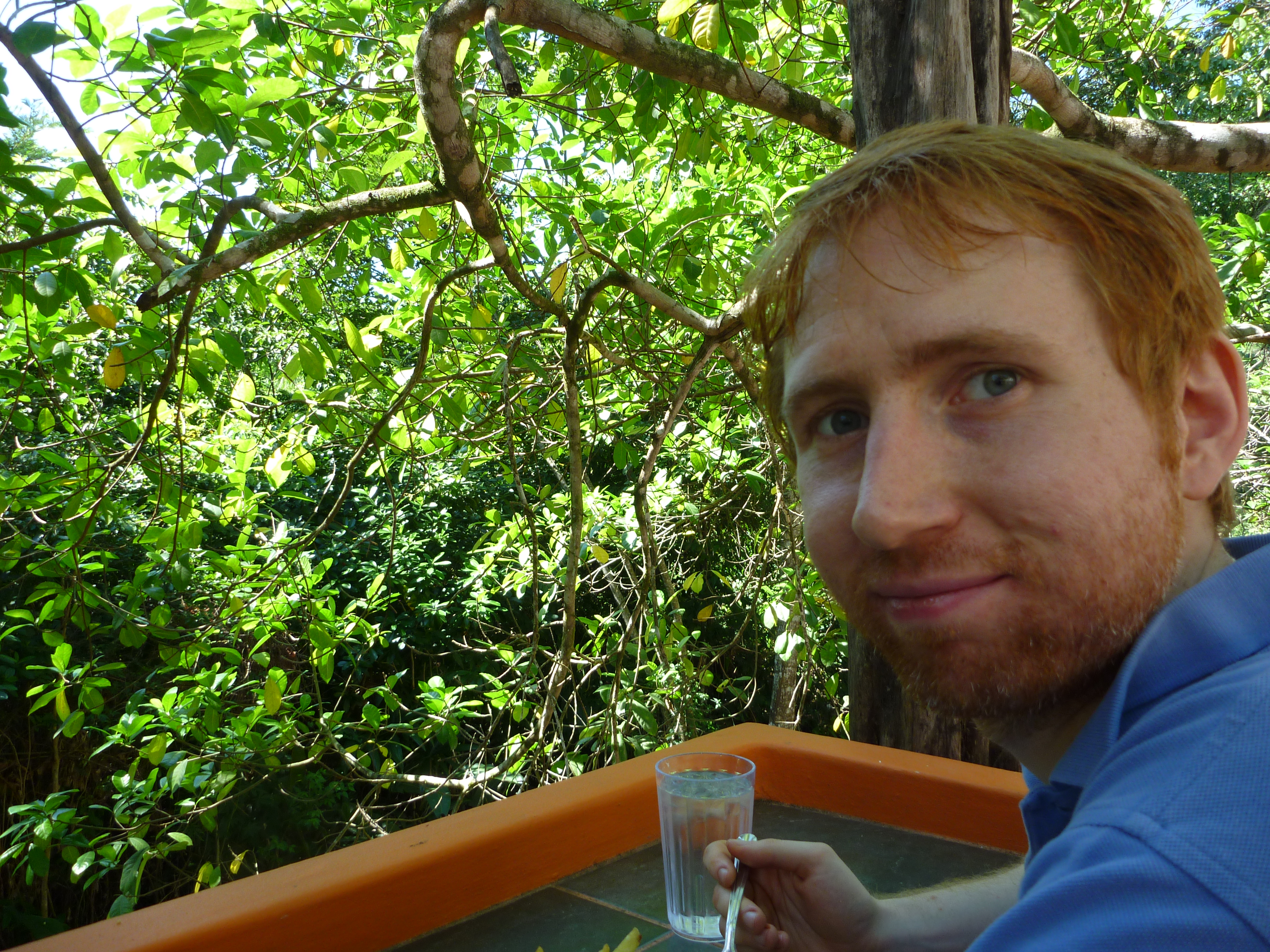
After I survived kidney cancer (Day Twelve, Cushing’s Awareness Challenge 2015) Michael and I went zip-lining – a goal of mine after surviving that surgery.  This photo was taken in a treetop restaurant in Belize.

For the mathematically inclined, this is his blog.  Xor’s Hammer.  I understand none of it.  He also has a page of Math and Music, which I also don’t understand.

I know it doesn’t fit into a Cushing’s awareness post but just because I’m a very proud mama – Michael got a PhD in math from Cornell and his thesis was Using Tree Automata to Investigate Intuitionistic Propositional Logic


proud-mom


Young people with Cushing syndrome may be at higher risk for suicide, depression

Children with Cushing syndrome may be at higher risk for suicide as well as for depression, anxiety and other mental health conditions long after their disease has been successfully treated, according to a study by researchers at the National Institutes of Health.

Cushing syndrome results from high levels of the hormone cortisol. Long-term complications of the syndrome include obesity, diabetes, bone fractures, high blood pressure, kidney stones and serious infections. Cushing’s syndrome may be caused by tumors of the adrenal glands or other parts of the body that produce excess cortisol. It also may be caused by a pituitary tumor that stimulates the adrenal glands to produce high cortisol levels. Treatment usually involves stopping excess cortisol production by removing the tumor.

“Our results indicate that physicians who care for young people with Cushing syndrome should screen their patients for depression-related mental illness after the underlying disease has been successfully treated,” said the study’s senior author, Constantine Stratakis, D(med)Sci, director of the Division of Intramural Research at NIH’s Eunice Kennedy Shriver National Institute of Child Health and Human Development. “Patients may not tell their doctors that they’re feeling depressed, so it’s a good idea for physicians to screen their patients proactively for depression and related conditions.”

Cushing syndrome may affect both adults and children. A recent study estimated that in the United States, there are 8 cases of Cushing syndrome per 1 million people per year.

The researchers published their findings in the journal Pediatrics. They reviewed the case histories of all children and youth treated for Cushing syndrome at NIH from 2003 to 2014, a total of 149 patients. The researchers found that, months after treatment, 9 children (roughly 6 percent) had thoughts of suicide and experienced outbursts of anger and rage, depression, irritability and anxiety. Of these, 7 experienced symptoms within 7 months of their treatment.

Two others began experiencing symptoms at least 48 months after treatment.

The authors noted that children with Cushing syndrome often develop compulsive behaviors and tend to become over-achievers in school. After treatment, however, they then become depressed and anxious. This is in direct contrast to adults with Cushing syndrome, who tend to become depressed and anxious before treatment and gradually overcome these symptoms after treatment.

The authors stated that health care providers might try to prepare children with Cushing syndrome before they undergo treatment, letting them know that their mood may change after surgery and may not improve for months or years. Similarly, providers should consider screening their patients periodically for suicide risk in the years following their treatment.

Source: NIH/Eunice Kennedy Shriver National Institute of Child Health and Human Development

Cushing’s: Update on signs, symptoms and biochemical screening

10.1530/EJE-15-0464

  1. Lynnette Nieman

+Author Affiliations


  1. L Nieman, RBMB, NIH, Bethesda, 20817-1109, United States
  1. Correspondence: Lynnette Nieman, Email: niemanl@mail.nih.gov

Abstract

Endogenous pathologic hypercortisolism, or Cushing’s syndrome, is associated with poor quality of life, morbidity and increased mortality. Early diagnosis may mitigate against this natural history of the disorder.

The clinical presentation of Cushing’s syndrome varies, in part related to the extent and duration of cortisol excess. When hypercortisolism is severe, its signs and symptoms are unmistakable. However, most of the signs and symptoms of Cushing’s syndrome are common in the general population (e.g. hypertension and weight gain) and not all are present in every patient.

In addition to classical features of glucocorticoid excess, such as proximal muscle weakness and wide purple striae, patients may present with the associated co-morbidities that are caused by hypercortisolism. These include cardiovascular disease, thromboembolic disease, psychiatric and cognitive deficits, and infections. As a result, internists and generalists must consider Cushing’s syndrome as a cause, and endocrinologists should search for and treat these co-morbidities.

Recommended tests to screen for Cushing’s syndrome include 1 mg dexamethasone suppression, urine free cortisol and late night salivary cortisol. These may be slightly elevated in patients with physiologic hypercortisolism, which should be excluded, along with exogenous glucocorticoid use. Each screening test has caveats and the choice of tests should be individualized based on each patient’s characteristics and lifestyle.

The objective of this review was to update the readership on the clinical and biochemical features of Cushing’s syndrome that are useful when evaluating patients for this diagnosis.

Read the entire manuscript at http://www.eje-online.org/content/early/2015/07/08/EJE-15-0464.full.pdf+html