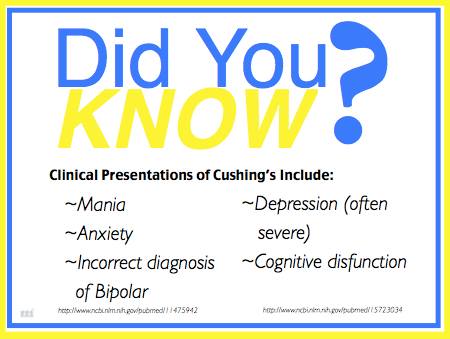
Cushing’s Awareness Challenge, Day 3: Symptoms

robin-symptoms


Robin has made another excellent graphic of some of the symptoms of Cushing’s.  There are far too many to be listed in any image, as shown by the list at http://www.cushings-help.com/toc.htm#symptoms


Just to be silly, a few years ago, I did my own version of Cushing’s symptoms:


The Seven Dwarves of Cushing's

Suspected case of Cushing’s Syndrome with history of taking medicines prescribed by registered Chinese medicine practitioner

The Department of Health (DH) today (February 18) alerted clients who have consulted a registered Chinese medicine practitioner (CMP) Mr Chan Kong-kin (CMP Chan), practising at G/F, No.25, Leung Tin Village in Tuen Mun, should consult health-care professionals for advice if they have been supplied with medicines suspected to be Western medicines.

The appeal followed the DH’s investigation into two public complaints. The first complaint involved a 23-year-old woman who consulted CMP Chan for management of eczema. She was given a type of green pills, two types of yellow pills and a type of red-yellow capsules for treatment of her disease for about one year.

She developed round face and increased facial hair which are features compatible with Cushing’s syndrome and steroid overdose can cause the syndrome. The patient was admitted to a public hospital on February 5 for investigation and was discharged on February 7.

The second complaint involved a 24-year-old woman who was recommended by the first complainant to consult CMP Chan for management of allergic rhinitis and eczema. She was given similar medicines as those for the first complainant for three days.

Her condition was stable.

Today, chemical analysis by the Government Laboratory on the patients’ drug samples showed that Western medicine Dexamethasone was detected in the red-yellow capsule.

Dexamethasone is a potent steroid. Taking dexamethasone for a long time, especially when in substantial dosage, can cause side effects such as moon face, high blood pressure, high blood sugar, muscle atrophy, peptic ulcer and even osteoporosis.

DH has set up a hotline 2125 1133 for public enquiries related to the medicines prescribed by the CMP.

It will operate from 9am to 9pm, Monday to Friday.

“Preliminary investigation by the DH revealed that pills and capsules were found in the CMP’s premises and all have been seized for further investigation,” the spokesman said.

“In December 31, 2012, the DH announced that CMP Chan was found in possession of Part I poisons and unregistered pharmaceutical products in the same clinic which also involved medicines with steroid. The DH subsequently took enforcement action and the relevant legal proceeding is in progress.

The case has also been referred to the Chinese Medicine Council of Hong Kong for follow-up action,” the spokesman added

“On completion of our investigation, the DH will seek advice from the Department of Justice regarding possible contravention of the Pharmacy and Poisons Ordinance (Cap 138) for the illegal sale or possession of Part I poisons. According to the Ordinance, the maximum penalty for each offence is a fine of $100,000 and two years’ imprisonment. Besides, the DH will also refer this case to the Chinese Medicine Council of Hong Kong for possible disciplinary action”, the spokesman remarked.

People who have been supplied with medicines by the concerned CMP and are in doubt should consult health-care professionals as soon as possible.

They should submit the medicines to the Chinese Medicine Division of DH at 16/F, AIA Kowloon Tower, Landmark East, 100 How Ming Street, Kwun Tong, during office hours for disposal.

Source: HKSAR Government

From http://7thspace.com/headlines/453015/suspected_case_of_cushings_syndrome_with_history_of_taking_medicines_prescribed_by_registered_chinese_medicine_practitioner.html

Are you carrying adrenal Cushing’s syndrome without knowing it?

Genetic research that will be published tomorrow in the New England Journal of Medicine suggests to Dr. André Lacroix, professor at the University of Montreal, that clinicians’ understanding and treatment of a form of Cushing’s syndrome affecting both adrenal glands will be fundamentally changed, and that moreover, it might be appropriate to begin screening for the genetic mutations that cause this form of the disease.

“Screening family members of bilateral adrenal Cushing’s syndrome patients with  may identify affected silent carriers,” Lacroix said in an editorial in the Journal. “The development of drugs that interrupt the defective genetic chemical link that causes the syndrome could, if confirmed to be effective in people, provide individualized specific therapies for hypercortisolism, eliminate the current practice of removing both , and possibly prevent disease progression in genetically affected .”

Adrenal glands sit above the kidneys are mainly responsible for releasing cortisol, a stress hormone. Hypercortiolism means a high level of the adrenal hormone cortisol, which causes many symptoms including weight gain, , diabetes, osteoporosis, concentration deficit and increased cardiovascular deaths.

Cushing’s syndrome can be caused by corticosteroid use (such as for asthma or arthritis), a tumor on the adrenal glands, or a  that releases too much ACTH. The pituitary gland sits under the brain and releases various hormones that regulate our bodies’ mechanisms.

Jérôme Bertherat is a researcher at Cochin Hospital in Paris. In the study he published today, he showed that 55% of Cushing’s Syndrome patients with bilaterally very enlarged adrenal glands have mutations in a gene that predisposes to the development of adrenal tumours. This means that bilateral adrenal Cushing’s is much more hereditary than previously thought. The new knowledge will also enable clinicians to undertake genetic screening. Hervé Lefebvre is a researcher at the University Hospital in Rouen, France. His research shows that the adrenal glands from the same type of patients with two large adrenal glands can produce ACTH, which is normally produced by the pituitary gland. Hormone receptors are the chemical link that cause a cell to behave differently when a hormone is present. Several misplaced hormone receptors cause the ACTH to be produced in the enlarged benign adrenal tissue. Knowing this means that researchers might be able to develop drugs that interrupt the receptors for these hormones and possibly even prevent the benign tissue from developing in the first place.

 Explore further: Scientists discover a curable cause for some cases of high blood pressure

More information: André Lacroix, M.D., Heredity and Cortisol Regulation in Bilateral Macronodular Adrenal Hyperplasia, New England Journal of Medicine 369;22, November 28, 2013

Estelle Louiset, Ph.D., Céline Duparc, Ph.D., Jacques Young, M.D., Ph.D., Sylvie Renouf, Ph.D., Milène Tetsi Nomigni, M.Sc., Isabelle Boutelet, Ph.D., Rossella Libé, M.D., Zakariae Bram, M.Sc., Lionel Groussin, M.D., Ph.D., Philippe Caron, M.D., Antoine Tabarin, M.D., Ph.D., Fabienne Grunenberger, M.D., Sophie Christin-Maitre, M.D., Ph.D., Xavier Bertagna, M.D., Ph.D., Jean-Marc Kuhn, M.D., Youssef Anouar, Ph.D., Jérôme Bertherat, M.D., Ph.D., and Hervé Lefebvre, M.D., Ph.D., Intraadrenal Corticotropin in Bilateral Macronodular Adrenal Hyperplasia, New England Journal of Medicine 369;22, November 28, 2013

Guillaume Assié, M.D., Ph.D., Rossella Libé, M.D., Stéphanie Espiard, M.D., Marthe Rizk-Rabin, Ph.D., Anne Guimier, M.D., Windy Luscap, M.Sc., Olivia Barreau, M.D., Lucile Lefèvre, M.Sc., Mathilde Sibony, M.D., Laurence Guignat, M.D., Stéphanie Rodriguez, M.Sc., Karine Perlemoine, B.S., Fernande René-Corail, B.S., Franck Letourneur, Ph.D., Bilal Trabulsi, M.D., Alix Poussier, M.D., Nathalie Chabbert-Buffet, M.D., Ph.D., Françoise Borson-Chazot, M.D., Ph.D., Lionel Groussin, M.D., Ph.D., Xavier Bertagna, M.D., Constantine A. Stratakis, M.D., Ph.D., Bruno Ragazzon, Ph.D., and Jérôme Bertherat, M.D., Ph.D., ARMC5 Mutations in Macronodular Adrenal Hyperplasia with Cushing’s Syndrome, New England Journal of Medicine 369;22, November 28, 2013

Bone Complications in Patients with Cushing’s Syndrome: Looking for clinical, biochemical, and genetic determinants

Osteoporosis International, 11/14/2013  Clinical Article

Trementino L, et al. – Bone loss and fractures are a common complication of CS.

The authors investigate the role of gender, disease etiology, duration, and degree of hypercortisolism as well as the impact of glucocorticoid receptor (GR) polymorphisms on the development of bone complications in CS.

While GR gene variants as well as gender and disease etiology seem not to play a role, the degree and duration of hypercortisolism seem to be the major determinants of bone loss and fractures in this group of patients.

More investigations are needed to understand the real impact of these determinants on the development of bone complications in patients with hypercortisolism.

Read more

No High-Quality Studies for Cushing’s Drugs

By Salynn Boyles, Contributing Writer, MedPage Today

Reviewed by Zalman S. Agus, MD; Emeritus Professor, Perelman School of Medicine at the University of Pennsylvania and Dorothy Caputo, MA, BSN, RN, Nurse Planner

There is a paucity of clinical trial data supporting the efficacy of most drugs used to treat Cushing’s disease, researchers reported.

Just one drug — pasireotide — has been evaluated in a randomized, double-blind trial, but even it was judged by the researchers to have only a ‘moderate’ level of evidence supporting its effectiveness and safety.

The review of the literature evaluating drug treatments for Cushing’s disease, a rare pituitary disorder, is the first to employ a rigorous systematic approach with strict, predefined inclusion criteria and formal analysis of the quality of evidence using an established standard, researcher Monica Gadelha, MD, PhD, of Brazil’s Federal University of Rio de Janeiro, and colleagues wrote in the journal Clinical Endocrinology.

“This systematic review indicates that the majority of medical therapies currently used in the treatment of Cushing’s disease are supported by a low level of evidence,” the researchers wrote. “Further well-designed prospective studies of medications in Cushing’s disease would help to inform clinical practice further.”

Cushing’s disease is the most common form of endogenous Cushing’s syndrome, a hormonal disorder resulting from persistent exposure to abnormally high levels of the hormone cortisol. In the case of Cushing’s disease, the cortisol is secreted by a pituitary adenoma.

Prolonged exposure to high levels of cortisol raises the risk for diabetes mellitus, cardiovascular disease, osteoporosis and nephrolithiasis. Patients with persistent Cushing’s disease have a 3- to 5-fold higher mortality than the general population.

Surgery to remove the pituitary adenoma is the first-line treatment for Cushing’s disease in the U.S., and when the procedure is performed by an experienced surgeon, remission rates in patients with smaller tumors range from 65% to 90%. The long-term remission rate is lower, however, because many patients develop recurrent disease.

Several medical therapies are widely used to treat patients who are not candidates for surgery or who experience relapse following surgery.

Novartis Oncology’s somatostatin analog drug pasireotide (Signifor) became the only drug approved for this indication in December of last year. And the progesterone-blocking drug mifepristone, best known as the abortion pill once called RU-486, was approved in February of 2012 for the treatment of Cushing’s disease-associated hyperglycemia.

Other drugs — including metyrapone, mitotane, cabergoline, and ketoconazole — are also used off-label in the treatment of Cushing’s, and several have shown better response rates than pasireotide in small studies.

In their systematic review, Gadelha and colleagues identified 15 studies that included at least 10 adults with Cushing’s disease and reported treatment responses as the proportion of patients reaching a specified definition of response. Studies examining combinations of medications were excluded from the analysis, as were studies with indefinite diagnoses of Cushing’s disease.

For medications other than mifepristone, studies had to report the proportion of patients with normalized urinary free cortisol (UFC), midnight salivary cortisol or midnight serum cortisol.

The studies were scored according to the Grading of Recommendations, Assessment, Development and Evaluation (GRADE) system for rating quality of evidence.

Ten of the 15 included studies reported outcomes specifically for patients with Cushing’s disease and the remaining five included patients with other forms of Cushing’s syndrome.

The researchers reported that:

  • Pasireotide was the only treatment assessed in a randomized trial, and it was judged to have a ‘moderate’ level of evidence supporting its use. Response rates from three prospective studies of the drug ranged from 17% to 29%.
  • The remaining medications were supported by a ‘low’ or ‘very low’ level of evidence.
  • The highest response rates were reported in a small retrospective studies of metyrapone (75%, one study) and mitotane (72%, one study).
  • Response rates were 25% to 50% for cabergoline (four studies) and 45% for ketoconazole (one study).
  • Among studies that included patients with other forms of Cushing’s syndrome, response rates were 53% to 88% for ketoconazole (three studies), 70% for mitotane (one study), 57% for metyrapone (one study), and 38% to 60% for mifepristone (one study).


But the researchers urged caution in comparing the drugs, citing the variability in the study designs and patient selection endpoints, among other limitations in the research literature.

“The wide variation in the time-frames over which response to treatment was measured makes comparison a challenge,” they wrote. “Comparison of response rates reported in the included studies is also complicated by the variation in methodology used to assess response.”

They noted that well-designed clinical trials are needed to determine which drugs or drug combinations are most effective in the treatment of Cushing’s disease patients.

“Combinations of medical therapies with different modes of action might aid in optimizing the balance of efficacy and safety,” they wrote. “Investigational medications, such as bexarotene, LC1699 and retinoic acid, may help to expand the range of future therapeutic options.”

Maria Fleseriu, MD, who was not involved in the review, agreed that more drug treatments are needed. But she added that Cushing’s patients today have many more drug options than they did just a few years ago.

Fleseriu directs the Pituitary Center at Oregon Health & Science University, where she is an associate professor of medicine and endocrinology.

In a recently published analysis, Fleseriu wrote that pituitary-targeted medical therapies should soon play a more prominent role in treating Cushing’s disease, and may become first-line treatments when surgery fails or is contraindicated.

“We now have one drug approved for Cushing’s and another approved for diabetes symptoms associated with the disease,” she told MedPage Today. “We are moving forward, but we are not where we would like to be. Combination therapy is probably where we are heading, but further studies are needed.”

Financial support for this research was provided by Novartis Pharmaceuticals.

Researcher Monica Gadelha reports receiving speaker fees and participating on advisory boards for Novartis. Gadelha and co-author Leonardo Vieira Neto were investigators in Novartis’ clinical trials of pasireotide.


From http://www.medpagetoday.com/Endocrinology/GeneralEndocrinology/42043