Long-term remission and recurrence rate in a cohort of Cushing’s disease: the need for long-term follow-up

Pituitary. 2014 Apr 19. [Epub ahead of print]

Author information

 Abstract

OBJECTIVE:

Transsphenoidal surgery is the procedure of choice in Cushing disease (CD), with immediate post-operative remission rates ranging between 59 and 94 % and recurrence rates between 3 and 46 %, both depending upon the definition criteria and the duration of the follow-up. Our aim was to assess the rate of remission, recurrence and persistence of the disease after the first treatment and to identify predictors of remission in the CD population of our center.

METHODS:

Retrospective cohort study of the patients diagnosed of CD and with follow-up in our center between 1974 and 2011. We analyzed 41 patients (35 women and 6 men) with a mean age at diagnosis of 34 ± 13 years. The mean follow-up was 14 ± 10 years (range 1-37 years) and the median of follow-up period was 6.68 years.

RESULTS:

Thirty-five (85.4 %) patients underwent transsphenoidal surgery as first treatment option. Histopathological evidence of a pituitary adenoma was registered in 17 (48.5 %) patients. Thirty-two (78 %) patients achieved disease remission after the first treatment, 21 (65.6 %) of them presented disease recurrence. Persistent disease was observed in 9 (22 %) patients. Twelve (29.3 %) subjects developed post-surgical adrenal insufficiency, 7 of which (70 %) achieved stable remission. Two parameters were found to be significant predictors of remission after the first treatment: age at disease diagnosis and the development of adrenal insufficiency (cortisol ❤ μg/dl) in the immediate post-operative state.

CONCLUSIONS:

We report a high recurrence rate, at least partially attributable to the long follow-up time. Early post-surgery adrenal insufficiency predicts remission. Hypopituitarism was also very prevalent, and strongly associated with radiotherapy. These results lead us to the conclusion that CD needs a life-long strict follow-up.

PMID:


24748528


[PubMed – as supplied by publisher]

Global Pituitary ACTH Hypersecretion (Cushing’s Disease) Therapeutics Pipeline Review 2014

DUBLIN–(BUSINESS WIRE)–Research and Markets (http://www.researchandmarkets.com/research/zp4qhh/pituitary_acth) has announced the addition of the “Pituitary ACTH Hypersecretion (Cushing’s Disease) – Pipeline Review, H1 2014” report to their offering.

“Pituitary ACTH Hypersecretion (Cushing’s Disease) – Pipeline Review, H1 2014”

This report provides comprehensive information on the therapeutic development for Pituitary ACTH Hypersecretion (Cushing’s Disease), complete with comparative analysis at various stages, therapeutics assessment by drug target, mechanism of action (MoA), route of administration (RoA) and molecule type, along with latest updates, and featured news and press releases. It also reviews key players involved in the therapeutic development for Pituitary ACTH Hypersecretion (Cushing’s Disease) and special features on late-stage and discontinued projects.

The report enhances decision making capabilities and help to create effective counter-strategies to gain competitive advantage. It strengthens R&D pipelines by identifying new targets and MOAs to produce first-in-class and best-in-class products.

Scope

  • The report provides a snapshot of the global therapeutic landscape of Pituitary ACTH Hypersecretion (Cushing’s Disease)
  • The report reviews key pipeline products under drug profile section which includes product description, MoA and R&D brief, licensing and collaboration details & other developmental activities
  • The report reviews key players involved in the therapeutics development for Pituitary ACTH Hypersecretion (Cushing’s Disease) and enlists all their major and minor projects
  • The report summarizes all the dormant and discontinued pipeline projects
  • A review of the Pituitary ACTH Hypersecretion (Cushing’s Disease) products under development by companies and universities/research institutes based on information derived from company and industry-specific sources
  • Pipeline products coverage based on various stages of development ranging from pre-registration till discovery and undisclosed stages
  • A detailed assessment of monotherapy and combination therapy pipeline projects
  • Coverage of the Pituitary ACTH Hypersecretion (Cushing’s Disease) pipeline on the basis of target, MoA, route of administration and molecule type
  • Latest news and deals relating related to pipeline products

Companies Involved in Therapeutics Development

  • Isis Pharmaceuticals, Inc.
  • Ipsen S.A.
  • Novartis AG
  • Corcept Therapeutics Incorporated
  • HRA Pharma, SA
  • Cortendo Invest AB
  • Orphagen Pharmaceuticals, Inc.
  • ElexoPharm GmbH

Drug Profiles

  • mifepristone
  • ketoconazole
  • pasireotide LAR
  • LCI-699
  • DG-3173
  • ISIS-GCCRRx
  • Next Generation Cortisol Inhibitor
  • Small Molecule to Inhibit CYP11B1 for Cushing Disease
  • Peptides to Antagonize ACTH Receptor for Cushing Syndrome
  • Steroidogenic Factor-1 Antagonists
  • Drug to Inhibit Melanocortin Receptor 2 for Cushing Disease

For more information visit http://www.researchandmarkets.com/research/zp4qhh/pituitary_acth

Contacts

Research and Markets
Laura Wood, Senior Manager.
press@researchandmarkets.com
U.S. Fax: 646-607-1907
Fax (outside U.S.): +353-1-481-1716
Sector: Pharmaceuticals

Interview May 7 with Kathy C, Pituitary Patient

My name is Kathy Casey. I am a 63 year old retired school nurse. I am married with two wonderful sons and a grandson. My husband and I live in the mountain town of Mt. Shasta in northern California. I have always been athletic.

In 1995, I was diagnosed with a pituitary tumor. At the time the only symptom I was aware of was a severe headache. I had a transphenoidal resection by Dr. Wilson at UCSF Medical Center followed by radiation therapy for 23 days. At the time they said they could not remove all of the tumor.

In 2008/2009. I exhibited symptoms of Cushing’s and my cortisol level was outrageous, and I had to be hospitalized initially for a potassium level of 2. I returned to UCSF and Dr. Anwar Sandeep operated . By removing part of the tumor. My Cushing symptoms resolved. However, he said that the tumor was not encapsulated and was invading the cavernous sinus and stella turcica so it was still not possible to remove it all.

I was OK until December 2013 when I began exhibiting the symptoms of Cushings. One of my 24 hr. urines was 14,000. I had to be hospitalized for a potassium level of 1.9. Dr. Heaney said he has never seen a cortisol level that high. This time I decided to go to the UCLA Pituitary Tumor and Endocrinology Program where they were more oriented to follow-up and treating this disorder. Dr. Bergsneider decided that surgery was not an option. He and Dr. Heaney decided radiation was not an option. So now I am being followed by Dr. Heaney to see if medication can help.

I am now on Cabergoline 0.5 mg three tabs twice a week and Signifor 0.9 mg subcutaneosly twice a day. I think they are alleviating some of the symptoms. However, the Signifor caused my blood sugar to rise, and I had to go on Metformin which is causing nausea to a point where I have a hard time eating.

Anyway, this whole situation is depressing and overwhelming. I am tryng to stay positive, but I wonder how it will turn out. I am fortunate to have a supportive and helpful husband.

I am interested in communicating with people who may be going through a similar experience and learning more about this rare condition.

Kathy will be interviewed May 7, 2014 in BlogTalkRadio

HOME | Contents | Adrenal Crisis! | Abbreviations | Glossary | Forums | Donate | Bios | Add Your Bio

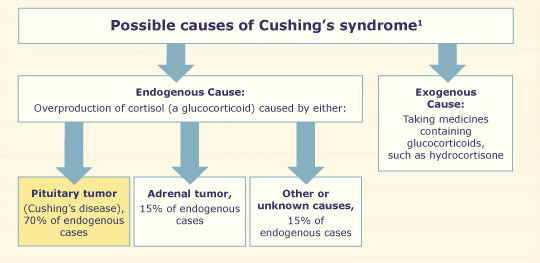
Cushing’s Awareness Challenge 17

robin-causes

Another of Robin’s wonderful images.

A similar image from the CushieWiki

cushings-causes

No wonder Cushing’s is so hard to diagnose!

maryo colorful zebra

Could you Shed Some Light on Cushing’s Disease?

Dear Dr. Roach: Could you shed some light on Cushing’s disease? Four people in the same family have it. The doctors say it has something to do with the thyroid gland.

— Anon.

A: Cushing’s syndrome, which is different from Cushing’s disease, is an excess of cortisone or similar corticosteroids. It can be caused by taking too much steroid for too long, usually as treatment for a serious medical condition. Cushing’s disease is a special case of Cushing’s syndrome, when the excess cortisone is caused by a tumor in the pituitary gland, which spurs the adrenal gland to make excess amounts of hormone. Weight gain, almost exclusively in the abdomen, a striking round “moon” face, a fat pad on the back of the neck and upper back (“buffalo hump”), diabetes, pigmented stretch marks and high blood pressure are common findings in any form of Cushing’s syndrome.

It is very unusual for Cushing’s disease to run in families. Also, it does not affect the thyroid, although thyroid conditions can sometimes mimic Cushing’s (and vice versa). I suspect that what this might be is a rare condition called multiple endocrine neoplasia type I (MEN-1). This does run in families, and combines risk for pituitary, parathyroid and pancreatic islet cell tumors. (The parathyroid glands sit on top of the thyroid gland and secrete parathyroid hormone, responsible for calcium metabolism. The pancreatic islet cells are where insulin is made.) Not everybody with MEN-1 will have tumors in all of these glands. Parathyroid tumors are the most common.

An endocrinologist is the expert in Cushing’s and the MEN syndromes.

​Dr. Keith Roach writes for North America Syndicate. Send letters to Box 536475, Orlando, FL 32853-6475 or email ToYourGoodHealth@med.cornell.edu.

From http://herald-review.com/news/opinion/editorial/columnists/roach/dr-keith-roach-teeth-grinding-is-common-in-the-elderly/article_bef63ba4-9b5e-5bff-b66a-3530be158857.html