Johns Hopkins Pituitary Patient Day 2013

Johns Hopkins Pituitary Patient Day

Join us on Saturday, September 28, 2013, for the 5th Annual Patient Education Day at the Johns Hopkins Pituitary Center.

When: Saturday, September 28, 2013
Time: 9:30 a.m.
Location:
Johns Hopkins Mt. Washington Conference Center
5801 Smith Avenue
Baltimore, MD 21209
map and directions

Location of the pituitary gland in the human brain

Location of the pituitary gland in the human brain (Photo credit: Wikipedia)

Patient Education Day Agenda:
9:30 – 10:00 AM REGISTRATION
10:00 – 10:25 AM What is the pituitary gland, where it is located, what it does, and what can go wrong Gary Wand, MD
10:30 – 10:50 AM How pituitary tumors can affect your vision Prem Subramanian, MD, PhD
Vivek Patel, MD, PhD
10:50 – 11:10 AM Cushing disease journey: a patient’s perspective Stacey Hardy
11:15 – 11:40 AM Surgery for Pituitary tumors: from very tiny to very large Alfredo Quinones-Hinojosa, MD
Gary Gallia, MD, PhD
Alessandro Olivi, MD
11:40 – 12:00 PM Radiation therapy: when, why, and how Lawrence Kleinberg, MD
Kristen Redmond, MD
12:05 – 12:25 PM The medications you may be taking (new and old ones): what you need to know Roberto Salvatori, MD
12:30 – 1:25 PM Lunch
1:30 – 3:00 PM PM Round table sessions:
1) Medical therapy (Wand/Salvatori)
2) Surgical therapy (Quinones/Gallia/Olivi)
3) Radiation therapy (Redmond/Kleinberg/Lim)
4) Vision issues (Subramanian/Patel)

*This schedule is subject to change

Please R.S.V.P. by September 13, 2013, vie email (preferred) to PituitaryDay@jhmi.edu  or to Alison Dimick at 410-955-3921.

Reservations will be taken on a first-come, first-serve basis.

Doctor’s Notes: Part 2, Adrenal

The adrenal glands sit atop the kidneys.

The adrenal glands sit atop the kidneys. (Photo credit: Wikipedia)

Acronyms or abbreviations for “Adrenal”

AD: adrenal vein
AG: adrenal gland
AdNA: adrenal gland
AC: adrenal cortex
adc: adrenal cortex
ADM: adrenal medulla
AA: adrenal adenoma
AF: adrenal failure
AM: adrenal medulla
AA: adrenal androgen
PA: pituitary-adrenal
AA: adrenal androgens
AAs: adrenal androgens
AM: adrenal medullary
LAV: left adrenal vein
AH: adrenal hypoplasia
AH: adrenal hemorrhage
AE: adrenal enucleation
AG: adrenal glomerulosa
AH: adrenal hyperplasia
HFA: human fetal adrenal
BAC: bovine adrenal cells
ADM: adrenal demedullation
AI: adrenal incidentaloma
AI: adrenal insufficiency
AVS: adrenal vein sampling
AI: adrenal incidentalomas
BAM: Bovine Adrenal Medulla
PAA: pituitary-adrenal axis
AMQD: Adrenal Move Quick Draw
AVS: Adrenal venous sampling
ach: adrenal cortical hormone
ACCs: adrenal chromaffin cells
AZF: adrenal zona fasciculata
BAM: Bovine adrenal medullary
PAL: Primary adrenal lymphoma
Ad4BP: Adrenal 4-binding protein
BAC: bovine adrenal chromaffin
ACC: adrenal cortical carcinoma
acca: adrenal cortical carcinoma
BAG: bovine adrenal glomerulosa
SAM: sympatho-adrenal-medullary
NAH: neonatal adrenal hemorrhage
PAH: primary adrenal hyperplasia
AHC: adrenal hypoplasia congenita
ACA: adrenal cortex autoantibodies
ACTH: adrenal corticotropic hormone
BAH: bilateral adrenal hyperplasia
CAH: congenital adrenal hypoplasia
HPA: hypothalamo-pituitary-adrenal
PAI: primary adrenal insufficiency
SAM: sympathetic-adrenal medullary
cah: congenital adrenal hyperplasia
HPA: hypothalamic-pituitary-adrenal
IAH: idiopathic adrenal hyperplasia
ACTH: adrenal corticotrophic hormone
ahc: adrenal hypoplasia, congenital
BAMC: bovine adrenal medullary cells
H-P-A: hypothalamic-pituitary-adrenal
HPA: hypothalamic-adrenal-pituitary
HPA: hypothalamus-pituitary-adrenal
HPAA: hypothalamic-pituitary-adrenal
IHA: idiopathic adrenal hyperplasia
LOAH: late-onset adrenal hyperplasia
NCAH: nonclassic adrenal hyperplasia
UAH: unilateral adrenal hyperplasia
BACC: bovine adrenal chromaffin cells
BACCs: bovine adrenal chromaffin cells
BCC: Bovine adrenal chromaffin cells
CAH: congenital adrenal hyperplasias
HHA: hypothalamo-hypophyseal-adrenal
BAC: bovine adrenal fasciculata cells
ARH: adrenal regeneration hypertension
HPAA: hypothalamo-pituitary-adrenal axis
ASNA: adrenal sympathetic nerve activity
HPA: hypothalamo-pituitary-adrenal axis
BAMC: bovine adrenal medullary chromaffin
FAH: Functional adrenal hyperandrogenism
HPA: hypothalamic-pituitary-adrenal axis
HPA-axis: hypothalamic-pituitary-adrenal axis
HPAA: hypothalamic-pituitary-adrenal axis
HPAA: hypothalamus-pituitary-adrenal axis
AASH: adrenal androgen stimulating hormone
BAME: bovine adrenal medullary endothelial
HPA: hypothalamus-pituitary-adrenal gland
NADF: National Adrenal Diseases Foundation
PAMC: porcine adrenal medullary chromaffin
CLAH: congenital lipoid adrenal hyperplasia
APA: aldosterone-producing adrenal adenoma
HPA: hypothalamic-pituitary-adrenal system
HPAT: hypothalamus-pituitary-adrenal-thymus
LHPA: limbic-hypothalamic-pituitary-adrenal
PCAI: primary chronic adrenal insufficiency
HHAS: hypothalamo-hypophyseal-adrenal system
HPA: hypothalamo-pituitary-adrenal cortical
HPA: hypothalamic-pituitary-adrenal cortical
RAMEC: rat adrenal medullary endothelial cells
CVAH: congenital virilizing adrenal hyperplasia
CAH: congenital virilizing adrenal hyperplasia
LOCAH: late-onset congenital adrenal hyperplasia
LHPA: limbic-hypothalamic-pituitary-adrenal axis
NC-CAH: non-classical congenital adrenal hyperplasia
AIMAH: ACTH-independent bilateral macronodular adrenal
pre-ASNA: preganglionic adrenal sympathetic nerve activity
AIMAH: ACTH-independent macronodular adrenal hyperplasia
CAHSA: Congenital Adrenal Hyperplasia Support Association
AIMAH: ACTH-independent bilateral macronodular adrenal hyperplasia

Looking at your Doctor’s Notes?

The anterior pituitary is the anterior, glandu...

The anterior pituitary is the anterior, glandular lobe of the pituitary gland. (Photo credit: Wikipedia)

Acronyms or abbreviations for “Pituitary”

PIT: pituitary
P: Pituitary
PI: pituitary
PT: pituitary
PG: pituitary gland
PIT: pituitary gland
PS: pituitary stalk
NP: normal pituitary
PT: pituitary tumors
PV: pituitary venous
SP: sellar pituitary
PA: pituitary-adrenal
PA: pituitary adenoma
PEX: Pituitary Extract
ap: anterior pituitary
PA: pituitary adenomas
PA: pituitary apoplexy
PAs: pituitary adenomas
PP: posterior pituitary
oPRL: ovine pituitary PRL
phTSH: pituitary human TSH
Pitx1: pituitary homeobox 1
Ptx1: pituitary homeobox 1
BPG: brain-pituitary-gonad
HP: hypothalamo-pituitary
H-P: hypothalamic-pituitary
HP: hypothalamic-pituitary
HP: hypothalamus/pituitary
PAA: pituitary-adrenal axis
A.P.L.: anterior pituitary like
AP: anterior pituitary lobe
pgh: pituitary growth hormone
AP: anterior pituitary gland
APG: anterior pituitary gland
BPE: bovine pituitary extract
EPE: equine pituitary extract
PA: pituitary-adrenocortical
PP: posterior pituitary lobe
AP: Anterior pituitary glands

Approach to testing growth hormone (GH) secretion in obese subjects.

Source

Faculty of Medicine, University of Belgrade, Department of Neuroendocrinology, Clinical Center Serbia, Dr Subotic 13, 11000 Belgrade, Serbia. popver@eunet.rs

Abstract

Identification of adults with GH deficiency (GHD) is challenging because clinical features of adult GHD are not distinctive and because clinical suspicion must be confirmed by biochemical tests.

Adults are selected for testing for adult GHD if they have a high pretest probability of GHD, ie, if they have hypothalamic-pituitary disease, if they have received cranial irradiation or central nervous system tumor treatment, or if they survived traumatic brain injury or subarachnoid hemorrhage.

Testing should only be carried out if a decision has already been made that if deficiency is found it will be treated. There are many pharmacological GH stimulation tests for the diagnosis of GHD; however, none fulfill the requirements for an ideal test having high discriminatory power; being reproducible, safe, convenient, and economical; and not being dependent on confounding factors such as age, gender, nutritional status, and in particular obesity.

In obesity, GH secretion is reduced, GH clearance is enhanced, and stimulated GH secretion is reduced, causing a false-positive result. This functional hyposomatotropism in obesity is fully reversed by weight loss. In conclusion, GH stimulation tests should be avoided in obese subjects with very low pretest probability.

PMID:
23650336
[PubMed – in process]

J Clin Endocrinol Metab. 2013 May;98(5):1789-96. doi: 10.1210/jc.2013-1099.

From http://www.ncbi.nlm.nih.gov/pubmed/23650336

Cushing’s Syndrome is Hazardous to Your Health

morbidity

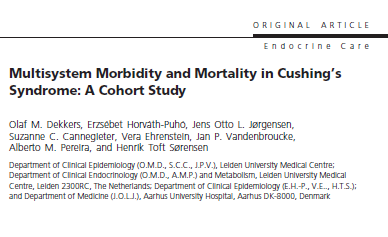
People with Cushing’s syndrome, even when treated, have higher morbidity and mortality rates that comparable controls. That is the conclusion of a new study published in the June issue of the Journal of Clinical Endocrinology Metabolism. The study by Olaf Dekkers et al, examined data records from the Danish National Registry of Patients and the Danish Civil Registration System of 343 patients with benign Cushing’s syndrome of adrenal or pituitary origin (i.e., Cushing’s disease) and a matched population comparison cohort (n=34,300).  Due to the lengthy delay of many patients being diagnosed with Cushing’s syndrome, morbidity was investigated in the 3 years before diagnosis while  morbidity and mortality were assessed during complete follow-up after diagnosis and treatment.

The study found that mortality was twice as high in Cushing’s syndrome patients (HR 2.3, 95% CI 1.8-2.9) compared with controls over a mean follow-up period of 12.1 years. Furthermore, patients with Cushing’s syndrome were at increased risk for:

  • venous thromboembolism (HR 2.6, 95% CI 1.5-4.7)
  • myocardial infarction (HR 3.7, 95% CI 2.4-5.5)
  • stroke (HR 2.0, 95% CI 1.3-3.2)
  • peptic ulcers (HR 2.0, 95% CI 1.1-3.6)
  • fractures (HR 1.4, 95% CI 1.0-1.9)
  • infections (HR 4.9, 95% CI 3.7-6.4).

The study also found that this increased multimorbidity risk was present before diagnosis indicating that it was due to cortisol overproduction rather than treatment.

Many of the Cushing’s syndrome patients underwent surgery to remove the benign tumor. For this group, the investigators performed a sensitivity analysis of the  long-term mortality and cardiovascular risk in this  subgroup (n=186)  considered to be cured after operation (adrenal surgery and patients with pituitary surgery in combination with a diagnosis of hypopituitarism in the first 6 months after operation).  The risk estimates for mortality (HR 2.31, 95% CI 1.62-3.28), venous thromboembolism (HR 2.03, 95% CI 0.75-5.48), stroke (HR 1.91, 95% CI 0.90-4.05), and acute myocardial infarction (HR 4.38, 95% CI 2.31-8.28) were also increased in this subgroup one year after the operation.

The standard treatment for endogenous Cushing’s syndrome is surgery. This past year, Signifor (pasireotide) was approved for treatment of adults patients with Cushing’s disease for whom pituitary surgery is not an option or has not been curative.  Cushing’s disease, which accounts for the majority of Cushing’s syndrome patients, is defined as the presence of an ACTH producing tumor on the pituitary grand. In the study by Dekker’s et al, the percentage of patients with Cushing’s disease is not known. We look forward to reexamination of this dataset in a few years following the introduction of more treatment options for Cushing’s disease as well as an analysis that explores the differences in mortality/morbidity rates in the different subsets of patients that make of Cushing’s syndrome (Cushing’s disease, ectopic Cushing’s syndrome, Exogenous Cyshing’s syndrome).

References

Dekkers OM, Horvath-Pujo, Jorgensen JOL, et al, Multisystem morbidity and mortality in Cushing’s syndrome: a cohort study. J Clin Endocrinol Metab 2013 98(6): 2277–2284. doi: 10.1210/jc.2012-3582

– See more at: http://www.raredr.com/medicine/articles/cushing%E2%80%99s-syndrome-hazardous-your-health-0