Interview May 7 with Kathy C, Pituitary Patient

My name is Kathy Casey. I am a 63 year old retired school nurse. I am married with two wonderful sons and a grandson. My husband and I live in the mountain town of Mt. Shasta in northern California. I have always been athletic.

In 1995, I was diagnosed with a pituitary tumor. At the time the only symptom I was aware of was a severe headache. I had a transphenoidal resection by Dr. Wilson at UCSF Medical Center followed by radiation therapy for 23 days. At the time they said they could not remove all of the tumor.

In 2008/2009. I exhibited symptoms of Cushing’s and my cortisol level was outrageous, and I had to be hospitalized initially for a potassium level of 2. I returned to UCSF and Dr. Anwar Sandeep operated . By removing part of the tumor. My Cushing symptoms resolved. However, he said that the tumor was not encapsulated and was invading the cavernous sinus and stella turcica so it was still not possible to remove it all.

I was OK until December 2013 when I began exhibiting the symptoms of Cushings. One of my 24 hr. urines was 14,000. I had to be hospitalized for a potassium level of 1.9. Dr. Heaney said he has never seen a cortisol level that high. This time I decided to go to the UCLA Pituitary Tumor and Endocrinology Program where they were more oriented to follow-up and treating this disorder. Dr. Bergsneider decided that surgery was not an option. He and Dr. Heaney decided radiation was not an option. So now I am being followed by Dr. Heaney to see if medication can help.

I am now on Cabergoline 0.5 mg three tabs twice a week and Signifor 0.9 mg subcutaneosly twice a day. I think they are alleviating some of the symptoms. However, the Signifor caused my blood sugar to rise, and I had to go on Metformin which is causing nausea to a point where I have a hard time eating.

Anyway, this whole situation is depressing and overwhelming. I am tryng to stay positive, but I wonder how it will turn out. I am fortunate to have a supportive and helpful husband.

I am interested in communicating with people who may be going through a similar experience and learning more about this rare condition.

Kathy will be interviewed May 7, 2014 in BlogTalkRadio

HOME | Contents | Adrenal Crisis! | Abbreviations | Glossary | Forums | Donate | Bios | Add Your Bio

Cushing’s Awareness Challenge, Day 3: Symptoms

robin-symptoms


Robin has made another excellent graphic of some of the symptoms of Cushing’s.  There are far too many to be listed in any image, as shown by the list at http://www.cushings-help.com/toc.htm#symptoms


Just to be silly, a few years ago, I did my own version of Cushing’s symptoms:


The Seven Dwarves of Cushing's

Outcome of Bilateral Adrenalectomy in Cushing’s Syndrome: A Systematic Review

  1. Katrin Ritzel,
  2. Felix Beuschlein,
  3. Anne Mickisch,
  4. Andrea Osswald,
  5. Harald J. Schneider,
  6. Jochen Schopohl and
  7. Martin Reincke

Author Affiliations


  1. Medizinische Klinik und Poliklinik IV, Klinikum der Universität München, D-80336 München, Germany
  1. Address all correspondence and requests for reprints to: Martin Reincke, M.D., Medizinische Klinik und Poliklinik IV, Klinikum der Universität München, Ziemssenstrasse 1, D-80336 München, Germany. E-mail:Martin.Reincke@med.uni-muenchen.de.

Abstract

Background: The outcome of bilateral adrenalectomy (BADx) in patients with Cushing’s syndrome (CS) is not well characterized.

Methods: A literature search was performed with the search terms “bilateral adrenalectomy” or “total adrenalectomy” and “Cushing’s” or “Cushing.” Immediate and long-term outcomes after BADx in CS were analyzed using descriptive statistics (median [range]).

Results: From 549 screened publications, 37 studies met inclusion criteria (1320 patients, 82% having Cushing’s disease [CD], 13% having ectopic CS, and 5% having primary adrenal hyperplasia).

Surgical morbidity and mortality of BADx (23 studies, 739 patients) were 18% (6–31) and 3% (0–15), respectively. In patients with CD, surgical mortality was below 1%. Although residual cortisol secretion due to accessory adrenal tissue or adrenal remnants was found in 3–34% (5 studies, 236 patients), less than 2% had a relapse of CS.

Symptoms of hypercortisolism (eg, hypertension, obesity, or depression) improved in the majority of the patients after BADx (7 studies, 195 patients). The number of adrenal crises per 100 patient-years was 9.3 (6 studies, 203 patients).

Nelson’s syndrome occurred in 21% (0–47) of the patients (24 studies, 768 patients). Mortality (23 studies, 690 patients) was 17% (0–88) at a follow-up of 41 months (14–294). Remarkably, 46% of the patients died in the first year after surgery. The median ages at death were 62 years (CD) and 53 years (ectopic CS).

Conclusion: BADx is relatively safe and provides adequate success. Excess mortality within the first year after surgery suggests that intensive clinical care for patients after BADx is warranted.

Footnotes

  • For editorial see page 3974

  • Abbreviations:

    BADx
    bilateral adrenalectomy
    BAH
    bilateral adrenal hypercortisolism
    CD
    Cushing’s disease
    CS
    Cushing’s syndrome
    ECS
    ectopic CS
    NS
    Nelson’s syndrome
    QOL
    quality of life
    TSS
    transsphenoidal surgery.


From http://jcem.endojournals.org/content/98/10/3939.abstract

Prince George’s woman works to raise awareness about rare disease

Lanham resident to speak at Patient Education Day event about Cushing’s disease

By Sophie Petit Staff Writer
stacy

Greg Dohler/The Gazette

Lanham resident Stacey L. Hardy, a survivor of Cushing’s disease, will speak about her experience with the pituitary disorder at an upcoming event at Johns Hopkins Hospital.

Stacy L. Hardy of Lanham described herself as athletic, which is why she became concerned when in 1996 she mysteriously gained 240 pounds that took five doctors 14 years to determine she had a potentially fatal disease.

Now Hardy said she wants to raise awareness among others who may unknowingly have Cushing’s disease, but are unaware of the symptoms and treatment.

It wasn’t until 2010 that Hardy, now 43, was diagnosed with the disease, a rare disorder that causes the body to release too much cortisol, the body’s stress or “fight or flight” hormone, said Gary Wand, a pituitary gland specialist at The Johns Hopkins Hospital in Baltimore.

Excess cortisol causes weight gain, especially in the stomach, extreme fatigue, muscle aches, anxiety and depression, he said.

“I didn’t even know what Cushing’s was. I was ready to just live with [the symptoms],” Hardy said, adding that by the time she was diagnosed she felt so tired she could barely move.

At 5 feet, 4 inches tall, Hardy said she reached 365 pounds during her struggle with the disease.

“We knew something for a while wasn’t right, but I never thought it would be something like that,” said Hardy’s daughter, Paij Hardy, 21, a student at Baltimore City Community College.

Just three out of every one million people are diagnosed with Cushing’s each year, said Wand, who estimates he sees 30 patients per year worldwide.

In 2011, Hardy underwent 16 hours of surgery at Sinai Hospital in Baltimore to remove four tumors from her pituitary gland, located at the base of the brain that controls the release of cortisol.

Today, she is 100 pounds lighter, with the weight still rapidly coming off, and said she is determined to serve as a lifelong support and education source for her fellow “cushies” — others with Cushing’s disease.

Hardy will speak Saturday at the Johns Hopkins Pituitary Gland Center’s fifth annual Patient Education Day, an event to raise awareness about the disease, Wand said.

Since the pituitary gland is the size of a kidney bean, Hardy underwent several brain scans before doctors, who previously suggested she might have leukemia or needed to diet and exercise more, could tell there were tumors on her gland, she said.

Hardy’s experience with delayed diagnosis and misdiagnosis is not unique, Wand said.

Cushing’s is a “subtle” disease, which is difficult to diagnose, and not everyone exhibits the same symptoms, he said.

If left untreated for more than a decade, the disease is fatal, but removing the pituitary gland tumors has proved extremely successful, Wand said.

“I’m evidence that there’s help out there,” Hardy said. “I can move. I can almost run. I can bend over and pick up a box. Oh my goodness, I can dance.”

From http://www.gazette.net/article/20130926/NEWS/130929354/1077/prince-george-x2019-s-woman-works-to-raise-awareness-about-rare&template=gazette

One Of A Kind: Despite use of only one lung, right guard Dillon Reagan helps solidify Jacks’ offensive line

The Big Uglies. The Big Nasties. The Hogs.

All terms used to describe a football team’s offensive line.

More often than not, it takes a special breed of player to be willing to do battle in the trenches.

Humboldt State right guard Dillon Reagan can without a doubt be bestowed with the title of special.

From overcoming Cushing’s Syndrome — a rare disease which left him with the use of only one lung — to the depression that was associated with the disorder, the Issaquah, Wash. native has definitely taken the road less traveled.

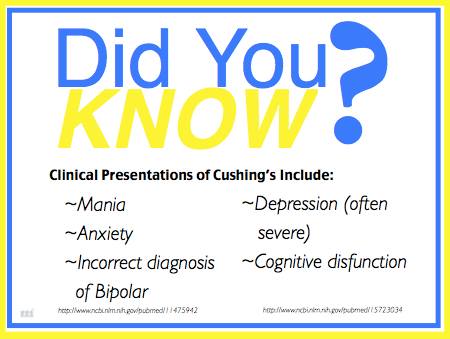
”The hardest part,” Reagan began, “was the first four months. (Doctors) didn’t know what was necessarily wrong with me. I was misdiagnosed as bipolar.”

Reagan displayed the initial symptoms of Cushing’s in 2009 after earning second-team All-State honors as a freshman at College of the Redwoods. A disorder caused by a tumor on one of the endocrine glands, Cushing’s causes a massive secretion of hormones which can affect behavior and physical appearance.

It did that and more to Reagan.

”I had full-ride scholarships taken away,” he said.

A full-body scan revealed a softball-sized tumor wrapped around his heart and left lung. Open heart surgery remedied the situation but his left lung useless.

In the midst of all this, Reagan also developed diabetes.

It would have been quite easy for the 6-foot-3 kid from Washington to call it quits. No one would have blamed him.

But an offensive lineman never quits.

”I never changed my approach,” Reagan said. “It’s a position of dominance and perseverance. Being an offensive lineman helped me get through all that. It helped me not feel sorry for myself.

”It was a long road back to full speed, but, your body reacts to how you push it.”

And push he did.

Reagan hit the weight room and transformed his body — which ballooned to 380 pounds due to Cushing’s — back to the muscular 300-pound frame he showcased his freshman year. He returned to Redwoods for his sophomore campaign and again displayed the skills that made him a Division I commodity.

”I ended up getting All-California,” Reagan said. “And with the use of only one lung.”

Looking to further his football career at the university level, there was really only one option.

”I wanted to go to a good program,” Reagan said. “That clear answer was Humboldt State.”

Reagan noted the close ties Redwoods and Humboldt shared as a deciding factor. His coach at CR was Duke Manyweather, a former HSU player himself. Reagan also sought the guidance of Humboldt State strength and conditioning coach Drew Petersen during his road to physical recovery.

Reagan asked to join Humboldt State as a non-scholarship athlete during the 2012 Spring semester and head coach Rob Smith and his coaching staff were more than happy to have him.

The following season, Reagan showed why.

As a junior, Reagan started 11 games for the Jacks providing a stabilizing force for a unit which paved the way for running backs to gain 2,152 total yards. He also earned second-team all conference honors.

It is amazing how high Reagan has risen after seeing how far he had fallen. An inspiration and uplifting athlete, it is easy to label him special.

Just don’t tell Reagan that.

”It takes me a little longer to warm up and get to game speed. But I don’t want to be treated differently than my teammates,” he said.

Entering his senior season, Reagan is being counted upon to be a stalwart right guard as he is only one of two returning starters (center and good friend David Kulp the other) from last season’s road graders.

Reagan is more than ready.

”As an offensive lineman, you show up every day, no matter what happens outside of practice, no matter what’s going on at home, no matter how beat up you are. You do it again and do it every day,” he said. “We set the tempo for the rest of the practice, rest of the game. If we don’t know up, it’s hard for everyone else to show up.”

Three positions are up for grabs on the Jacks’ front line. Reagan likes what he is seeing from the player stepping up to the plate.

”Start with tackle,” Reagan began, “(Jonathon) Rowe has made tremendous contributions at camp. He’s really growing up for his in a short time. Jonathan Bajet, he’s moving over from the defensive line, and he’s been really neck-and-neck for a starting guard position. David (Kulp), he’s a great guy to play next too, a great guy to have in your corner. It just works. We don’t have to say anything, we know what we’re doing. And (Jarrett) Adams has stepped up a bit. In the last few weeks he’s learned how to play right tackle.”

Humboldt is still knee-deep in competition in preparation for the Sept. 7 season-opening home contest against Simon Fraser. Reagan notes practicing daily against a defensive line which features returners Alex Markarian, Silas Sarvinski and Tommy Stuart, to name a few, helps both the O and D.

”They are adapting to our fast offense,” Reagan said. “You’re only as good as you practice. No one shows up game day and plays good. We challenge each other every day. It gets intense. But it’s all out of competition. Competition is a thing that drives a football team.”

If everything falls into place, all the Jacks’ hard work will result in one thing: Great Northwest Athletic Conference supremacy.

There’s simply no better lasting impression for Reagan.

”A GNAC Championship,” he said. “That puts you down in the books forever, that GNAC Championship.”

Title or not, it’s a pretty safe bet Reagan has already left a lasting impression.


Ray Aspuria can be reached evenings at 707-441-0527 or raspuria@times-standard.com. Follow him at twitter.com/AirUpsa707


From The Times-Standard