Day 6: Cushing’s Awareness Challenge

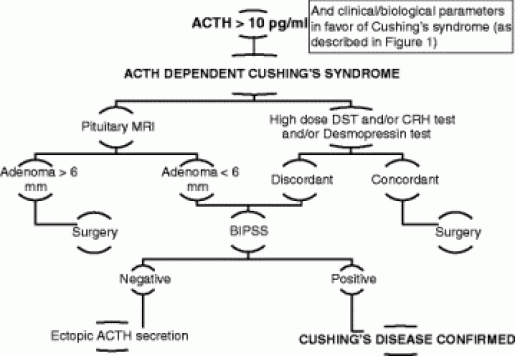
cushings-diagnosis.gif?resize=515%2C356

The above is the official Cushing’s path to a diagnosis but here’s how it seems to be in real life:

Egads!  I remember the naive, simple days when I thought I’d give them a tube or two of blood and they’d tell me I had Cushing’s for sure.

Who knew that diagnosing Cushing’s would be years of testing, weeks of collecting every drop of urine, countless blood tests, many CT and MRI scans…

Then going to NIH, repeating all the above over 6 weeks inpatient plus an IPSS test, an apheresis (this was experimental at NIH) and specialty blood tests…

The path to a Cushing’s diagnosis is a long and arduous one but you have to stick with it if you believe you have this Syndrome.

stick-with-it.jpeg?resize=575%2C87&ssl=1

maryo-blue.gif?resize=228%2C70&ssl=1

Day 1: Cushing’s Awareness Challenge

April is always Cushing’s Awareness Challenge month because Dr. Harvey Cushing was born on April 8th, 1869.

30-posts

Thanks to Robin for this wonderful past logo!  I’ve participated in these 30 days for Cushing’s Awareness several times so I’m not quite sure what is left to say this year but I always want to get the word out when I can.

As I see it, there have been some strides the diagnosis or treatment of Cushing’s since last year.  More drug companies are getting involved, more doctors seem to be willing to test, a bit more awareness, maybe.


April Fool's Day

How fitting that this challenge should begin on April Fool’s Day.  So much of Cushing’s  Syndrome/Disease makes us Cushies seem like we’re the April Fool.  Maybe, just maybe, it’s the doctors who are the April Fools…

Doctors tell us Cushing’s is too rare – you couldn’t possibly have it.  April Fools!

All you have to do is exercise and diet.  You’ll feel better.  April Fools!

Those bruises on your legs?  You’re just clumsy. April Fools!

Sorry you’re growing all that hair on your chin.  That happens as you age, you know.  April Fools!

Did you say you sleep all day?  You’re just lazy.  If you exercised more, you’d have more energy. April Fools!

You don’t have stretch marks.  April Fools!

You have stretch marks but they are the wrong [color/length/direction] April Fools!

The hump on the back of your neck is from your poor posture. April Fools!

Your MRI didn’t show a tumor.  You couldn’t have Cushing’s. April Fools!

This is all in your mind.  Take this prescription for antidepressants and go home.  April Fools!

If you have this one surgery, your life will get back to normal within a few months. April Fools!

What?  You had transsphenoidal surgery for Cushing’s?  You wasted your time and money. April Fools!

I am the doctor.  I know everything.  Do not try to find out any information online. You could not have Cushing’s.  It’s too rare…  April FOOL!

All this reminds me of a wonderful video a message board member posted a while ago:

So now – who is the April Fool?  It wasn’t me.  Don’t let it be you, either!

COVID-19 May Be Severe in Cushing’s Patients

A young healthcare worker who contracted COVID-19 shortly after being diagnosed with Cushing’s disease was detailed in a case report from Japan.

While the woman was successfully treated for both conditions, Cushing’s may worsen a COVID-19 infection. Prompt treatment and multidisciplinary care is required for Cushing’s patients who get COVID-19, its researchers said.

The report, “Successful management of a patient with active Cushing’s disease complicated with coronavirus disease 2019 (COVID-19) pneumonia,” was published in Endocrine Journal.

Cushing’s disease is caused by a tumor on the pituitary gland, which results in abnormally high levels of the stress hormone cortisol (hypercortisolism). Since COVID-19 is still a fairly new disease, and Cushing’s is rare, there is scant data on how COVID-19 tends to affect Cushing’s patients.

In the report, researchers described the case of a 27-year-old Japanese female healthcare worker with active Cushing’s disease who contracted COVID-19.

The patient had a six-year-long history of amenorrhea (missed periods) and dyslipidemia (abnormal fat levels in the body). She had also experienced weight gain, a rounding face, and acne.

After transferring to a new workplace, the woman visited a new gynecologist, who checked her hormonal status. Abnormal findings prompted a visit to the endocrinology department.

Clinical examination revealed features indicative of Cushing’s syndrome, such as a round face with acne, central obesity, and buffalo hump. Laboratory testing confirmed hypercortisolism, and MRI revealed a tumor in the patient’s pituitary gland.

She was scheduled for surgery to remove the tumor, and treated with metyrapone, a medication that can decrease cortisol production in the body. Shortly thereafter, she had close contact with a patient she was helping to care for, who was infected with COVID-19 but not yet diagnosed.

A few days later, the woman experienced a fever, nausea, and headache. These persisted for a few days, and then she started having difficulty breathing. Imaging of her lungs revealed a fluid buildup (pneumonia), and a test for SARS-CoV-2 — the virus that causes COVID-19 — came back positive.

A week after symptoms developed, the patient required supplemental oxygen. Her condition worsened 10 days later, and laboratory tests were indicative of increased inflammation.

To control the patient’s Cushing’s disease, she was treated with increasing doses of metyrapone and similar medications to decrease cortisol production; she was also administered cortisol — this “block and replace” approach aims to maintain cortisol levels within the normal range.

The patient experienced metyrapone side effects that included stomach upset, nausea, dizziness, swelling, increased acne, and hypokalemia (low potassium levels).

She was given antiviral therapies (e.g., favipiravir) to help manage the COVID-19. Additional medications to prevent opportunistic fungal infections were also administered.

From the next day onward, her symptoms eased, and the woman was eventually discharged from the hospital. A month after being discharged, she tested negative for SARS-CoV-2.

Surgery for the pituitary tumor was then again possible. Appropriate safeguards were put in place to protect the medical team caring for her from infection, during and after the surgery.

The patient didn’t have any noteworthy complications from the surgery, and her cortisol levels soon dropped to within normal limits. She was considered to be in remission.

Although broad conclusions cannot be reliably drawn from a single case, the researchers suggested that the patient’s underlying Cushing’s disease may have made her more susceptible to severe pneumonia due to COVID-19.

“Since hypercortisolism due to active Cushing’s disease may enhance the severity of COVID-19 infection, it is necessary to provide appropriate, multidisciplinary and prompt treatment,” the researchers wrote.

From https://cushingsdiseasenews.com/2021/01/15/covid-19-may-be-severe-cushings-patients-case-report-suggests/?cn-reloaded=1

Think Like a Doctor: Red Herrings Solved!

By LISA SANDERS, M.D.

On Thursday we challenged Well readers to take the case of a 29-year-old woman with an injured groin, a swollen foot and other abnormalities. Many of you found it as challenging as the doctors who saw her. I asked for the right test as well as the right diagnosis. More than 200 answers were posted.

The right test was…

The dexamethasone suppression test,though I counted those of you who suggested measuring the cortisol in the urine.

The right diagnosis was…

Cushing’s disease

More than a dozen of you got the right answer or the right test, but Dr. Davin Quinn, a consultant psychiatrist at the University of New Mexico Hospital, was the first to be right on both counts. As soon as he saw that the patient’s cortisol level was increased, he thought of Cushing’s. And he had treated a young patient like this one some years ago as a second year resident.

The Diagnosis:

Cushing’s disease is caused by having too much of the stress hormone cortisol in the body. Cortisol is made in the adrenal glands, little pyramid shaped organs that sit atop the kidneys. It is normally a very tightly regulated hormone that helps the body respond to physical stress.

Sometimes the excess comes from a tumor in the adrenal gland itself that causes the little organ to go into overdrive, making too much cortisol. More often the excess occurs when a tumor in the pituitary gland in the brain results in too much ACTH, the hormone that controls the adrenal gland.

In the body, cortisol’s most fundamental job is to make sure we have enough glucose around to get the body’s work done. To that end, the hormone drives appetite, so that enough fuel is taken in through the food we eat. When needed, it can break muscle down into glucose. This essential function accounts for the most common symptoms of cortisol excess: hyperglycemia, weight gain and muscle wasting. However, cortisol has many functions in the body, and so an excess of the hormone can manifest itself in many different ways.

Cushing’s was first described by Dr. Harvey Cushing, a surgeon often considered the father of modern neurosurgery. In a case report in 1912, he described a 23-year-old woman with sudden weight gain, mostly in the abdomen; stretch marks from skin too thin and delicate to accommodate the excess girth; easy bruising; high blood pressure and diabetes.

Dr. Cushing’s case was, it turns out, a classic presentation of the illness. It wasn’t until 20 years later that he recognized that the disease had two forms. When it is a primary problem of an adrenal gland gone wild and producing too much cortisol on its own, the disease is known as Cushing’s syndrome. When the problem results from an overgrown part of the pituitary making too much ACTH and causing the completely normal adrenal glands to overproduce the hormone, the illness is called Cushing’s disease.

It was an important distinction, since the treatment often requires a surgical resection of the body part where the problem originates. Cushing’s syndrome can also be caused by steroid-containing medications, which are frequently used to treat certain pulmonary and autoimmune diseases.

How the Diagnosis Was Made:

After the young woman got her lab results from Dr. Becky Miller, the hematologist she had been referred to after seeing several other specialists, the patient started reading up on the abnormalities that had been found. And based on what she found on the Internet, she had an idea of what was going on with her body.

“I think I have Cushing’s disease,” the patient told her endocrinologist when she saw him again a few weeks later.

The patient laid out her argument. In Cushing’s, the body puts out too much cortisol, one of the fight-or-flight stress hormones. That would explain her high blood pressure. Just about everyone with Cushing’s disease has high blood pressure.

She had other symptoms of Cushing’s, too. She bruised easily. And she’d been waking up crazy early in the morning for the past year or so – around 4:30 – and couldn’t get back to sleep. She’d heard that too much cortisol could cause that as well. She was losing muscle mass – she used to have well-defined muscles in her thighs and calves. Not any more. Her belly – it wasn’t huge, but it was a lot bigger than it had been. Cushing’s seemed the obvious diagnosis.

The doctor was skeptical. He had seen Cushing’s before, and this patient didn’t match the typical pattern. She was the right age for Cushing’s and she had high blood pressure, but nothing else seemed to fit. She wasn’t obese. Indeed, she was tall (5- foot-10) and slim (150 pounds) and athletic looking. She didn’t have stretch marks; she didn’t have diabetes. She said she bruised easily, but the endocrinologist saw no bruises on exam. Her ankle was still swollen, and Cushing’s can do that, but so can lots of other diseases.

The blood tests that Dr. Miller ordered measuring the patient’s ACTH and cortisol levels were suggestive of the disease, but many common problems — depression, alcohol use, eating disorders — can cause the same result. Still, it was worth taking the next step: a dexamethasone suppression test.

Testing, Then Treatment:

The dexamethasone suppression test depends on a natural negative feedback loop whereby high levels of cortisol suppress further secretion of the hormone. Dexamethasone is an artificial form of cortisol. Given in high doses, it will cause the level of naturally-occurring cortisol to drop dramatically.

The patient was told to take the dexamethasone pills the night before having her blood tested. The doctor called her the next day.

“Are you sure you took the pills I gave you last night?” the endocrinologist asked her over the phone. The doctor’s voice sounded a little sharp to the young woman, tinged with a hint of accusation.

“Of course I took them,” she responded, trying to keep her voice clear of any irritation.

“Well, the results are crazy,” he told her and proposed she take another test: a 24-hour urine test.

Because cortisol is eliminated through the kidneys, collecting a full day’s urine would show how much cortisol her body was making. So the patient carefully collected a day’s worth of urine.

A few days later, the endocrinologist called again: her cortisol level was shockingly high. She was right, the doctor conceded, she really did have Cushing’s.

An M.R.I. scan revealed a tiny tumor on her pituitary. A couple of months later, she had surgery to remove the affected part of the gland.

After recovering from the surgery, the patient’s blood pressure returned to normal, as did her red blood cell count and her persistently swollen ankle. And she was able to once again sleep through the night.

Red Herrings Everywhere:

As many readers noted, there were lots of findings that didn’t really add up in this case. Was this woman’s groin sprain part of the Cushing’s? What about the lower extremity swelling, and the excess red blood cell count?

In the medical literature, there is a single case report of high red blood cell counts as the presenting symptom in a patient with Cushing’s. And with this patient, the problem resolved after her surgery – so maybe they were linked.

And what about the weird bone marrow biopsy? The gastritis? The enlarged spleen? It’s hard to say for certain if any of these problems was a result of the excess cortisol or if she just happened to have other medical problems.

Why the patient didn’t have the typical symptoms of Cushing’s is easier to explain. She was very early in the course of the disease when she got her diagnosis. Most patients are diagnosed once symptoms have become more prominent

By the time this patient had her surgery, a couple of months later, the round face and belly characteristic of cortisol excess were present. Now, two years after her surgery, none of the symptoms remain.

From http://well.blogs.nytimes.com/2014/01/17/think-like-a-doctor-red-herrings-solved/?_php=true&_type=blogs&_r=0

Pituitary adenoma growth rate influenced by multiple factors

Monsalves E. J. Clin Endocrinol Metab. 2013; doi: 10. 1210/jc.2013-3054.

The etiology of pituitary adenoma growth rate is multifactorial and may be influenced by patient age and gender, as well as adenoma subtype, hormonal activity, immunohistological profile and the direction of growth relative to the pituitary fossa, according to results of a retrospective study.

Researchers evaluated pre- and postoperative pituitary adenoma (PA) traits in relation to patient demographics, MRI specifications and histopathological factors. They examined 153 patients who underwent surgery for removal of a histologically-proven PA at Toronto Western Hospital between 1999 and 2011.

All patients had at least two preoperative and two postoperative MRIs to measure tumor volume doubling time. Both scans were completed a minimum of 3 months apart.

Patients all underwent a sella/pituitary imaging protocol, and volume was determined using partitioning and target volume software. Each patient was also reviewed by two endocrine pathologists, and standardized diagnostic synoptic pathology reports provided information on MIB-1 labeling index, p27 and N-terminally truncated fibroblast growth factor receptor 4 (FGFR4). Growth direction patterns were classified as superior, anterior, posterior and lateral in relation to the sellar fossa.

The researchers found a relationship between preoperative growth rate and age (P=.0001), as well as suprasellar growth (P=.003), existence of a cyst or hemorrhage (P= .004), the MIB-1 (P=.005), FGFR4 positivity (P=.047) and p27 negativity (P=.007).

Postoperatively, 34.6% of patients demonstrated residual volumes, while the remaining 100 patients did not. Residual volume was found to be associated with older patient age (57 vs. 51, P=.038), as well as growth patterns, including anterior, posterior, suprasellar and cavernous sinus extension (P=.001). There was a correlation between pre-and postoperative growth rates (r=0.497, P=.026). The rates of postoperative growth were linked with age (P=.015) and gender (P= .017).

“Due to the heterogeneity of PA, no single predictor of PA growth behavior can be taken in isolation as a means to predict its outcome,” the researchers wrote.  “These predictors must be combined in order to formulate the most accurate estimation of PA growth, which in turn will inform sound clinical management.”

Disclosures: The researchers report no relevant financial disclosures.

From http://www.healio.com/endocrinology/neuroendocrinology/news/online/%7B7cb2ec5d-eaa6-42a3-b279-2c2436d0fbd0%7D/pituitary-adenoma-growth-rate-influenced-by-multiple-factors