Rare neuroendocrine tumours may be misdiagnosed as Cushing’s disease

By Eleanor McDermid, Senior medwireNews Reporter

Ectopic tumours secreting corticotropin-releasing hormone (CRH) and adrenocorticotropic hormone (ACTH) are very rare in children and can result in a misdiagnosis of Cushing’s disease (CD), say researchers.

Three of the patients in the reported case series had pituitary hyperplasia and underwent transsphenoidal surgery for apparent CD before the tumour that was actually causing their symptoms was located. The hyperplasia was probably caused by release of CRH from the ectopic tumour, which stimulated the pituitary gland, giving the impression of an ACTH-secreting pituitary adenoma, explain Maya Lodish (National Institutes of Health, Bethesda, Maryland, USA) and study co-authors.

These three patients were part of a series of seven, which Lodish et al describe as “a relatively large number of patients, considering the infrequency of this disease.”

The patients were aged between 1.8 and 21.3 years. Three had neuroendocrine tumours located in the pancreas ranging in size from 1.4 to 7.0 cm, two had thymic carcinoids ranging from 6.0 mm to 11.5 cm, one patient had a 12.0 cm tumour in the liver and one had a 1.3 cm bronchogenic carcinoid tumour of the right pulmonary lobe.

Four of the patients had metastatic disease and, during up to 57 months of follow-up, three died of metastatic disease or associated complications and two patients had recurrent disease.

“Our series demonstrates that these are aggressive tumors with a high mortality rate,” write the researchers in the Journal of Clinical Endocrinology & Metabolism. “It is important to follow the appropriate work up, regarding both biochemical and imaging tests, which can lead to the correct diagnosis and to the most beneficial therapeutic approach.”

The team found the CRH stimulation test to be helpful, noting, for example, that none of the patients had a rise in cortisol that was consistent with CD, with all patients showing smaller responses ranging from 2% to 15%. Likewise, just one patient had an ACTH rise higher than 35% on CRH administration, and four patients had a “flat” response, which has previously been associated with ectopic neuroendocrine tumours.

Of note, six patients had normal or high plasma CRH levels, despite all having high cortisol levels, which would be expected to result in undetectable plasma CRH due to negative feedback, implying another source of CRH production. Five patients had blunted diurnal variation of both cortisol and ACTH levels consistent with Cushing’s syndrome.

The patients also underwent a variety of imaging procedures to identify the source of ACTH/CRH production, some of which, such as octreotide scans, are specialist and not available in most hospitals, the researchers note, potentially contributing to inappropriate diagnosis and management.

From http://www.news-medical.net/news/20141030/Rare-neuroendocrine-tumours-may-be-misdiagnosed-as-Cushinge28099s-disease.aspx

Cushing’s Awareness Challenge: Day 11

robin-uncontrolled

Robin has shared this quote from Dr. Prevedallo.  You can read more at the link at http://brainsurgery.upmc.com/_pdf/Review-of-Endocrin-Cushings.pdf

Over the years, I have seen that this is true, sometimes even for controlled Cushing’s.  Far too many Cushies have died.

Here are some of those that I know of:

Cushing’s is a terrible disease.

There is another Cushie I should add to this list. During the time I was home from NIH just before pituitary surgery, a college classmate of mine (I didn’t know her) did die at NIH of a Cushing’s-related problem. I’m so glad I didn’t find out until a couple months later!  I still have the college alumni magazine that mentioned this.  I’ll have to find that and add it to the In Memory list.

My husband shared a bit about her in my bio:

During the same time Mary was at NIH, another woman had the same operation. She came from Mary’s home town. They were class mates at college. They had the same major. They were the same age. They had the same surgical and medical team. Mary recovered. The other woman died during surgery.


I know we’re always fighting with doctors to get diagnosed, to get treated but reading the stories of these people will hopefully inspire people to fight even harder to be heard.

Stay safe – don’t get added to this list!

8e1d2-maryo_colorful_zebra


Cushing’s Awareness Challenge: Day 10

robin-tests

Gee, I’m an underachiever. LOL I only had one IPSS and one pituitary surgery.

While I was at NIH, my MRIs still showed nothing, so they did an Inferior Petrosal Sinus Sampling Test. That scared me more than the prospect of surgery. (This test carries the risk of stroke and uncontrollable bleeding from the incision points.) Catheters were fed from my groin area to my pituitary gland and dye was injected. I could watch the whole procedure on monitors.

I could not move during this test or for several hours afterwards to prevent uncontrollable bleeding from a major artery. The test did show where the tumor probably was located.

Also done were more sophisticated dexamethasone suppression tests where drugs were administered by IV and blood was drawn every hour (they put a heplock in my arm so they didn’t have to keep sticking me). I got to go home for a weekend and then went back for the surgery – the Transsphenoidal Resection. I fully expected to die during surgery (and didn’t care if I did) so I signed my will and wrote last letters to those I wanted to say goodbye to.

During the time I was home just before surgery, a college classmate of mine (I didn’t know her) did die at NIH of a Cushing’s-related problem. I’m so glad I didn’t find out until a couple months later!

maryo colorful zebra

Cushing’s Awareness Challenge, Day 7

A Cushing’s diagnosis can be a long and frustrating event with testing, repeat testing, redoing testing.

Sometimes, I think that this was the path that some of my UFCs took on the way to my diagnosis:


cushie-diagnosis


It took three years from 1983 to 1986 before doctors would consider testing me for Cushing’s, even though I was sure that this was what my problem was.

My first 24-hour urine free cortisol was run by a Hematologist/Oncologist.  After that, things seemed to move a little better, if not faster.  That UFC got me to my first endo.

The Endocrinologist, of course, didn’t trust the other test so I was back to square one. He ran his own multitude of tests. He had to draw blood at certain times like 9 AM. and 5 PM. There was a dexamethasone suppression test where I took a pill at 10 p.m. and gave blood at 9 am the next day.

ufcI collected gallons of urine in BIG boxes (Fun in the fridge!). Those were from 6 a.m. to 6 a.m. to be delivered to his office by 9 a.m. same day. I was always worried that I’d be stopped in rush hour and the police would ask about what was in that big container. I did those daily for a week.

When the endo confirmed that I had Cushing’s in 1987 he sent me to a local hospital where they repeated all those same tests for another week and decided that it was not my adrenal gland (Cushing’s Syndrome) creating the problem. The doctors and nurses had no idea what to do with me, so they put me on the brain cancer ward.

When I left this hospital after a week, we didn’t know any more than we had before.

As luck would have it, NIH (National Institutes of Health, Bethesda, Maryland) was doing a clinical trial of Cushing’s. I live in the same area as NIH so it was not too inconvenient but very scary at first to think of being tested there. At that time I only had a choice of NIH, Mayo Clinic and a place in Quebec to do this then-rare pituitary surgery called a Transsphenoidal Resection. I chose NIH – closest and free. After I was interviewed by the Doctors there, I got a letter that I had been accepted into the clinical trial. The first time I was there was for 6 weeks as an inpatient. More of the same tests.

Six weeks of daily UFC testing.  To this day, I still remember nurses waking me just after 6 am to “close out your urine”.  Sounded like a bank account!

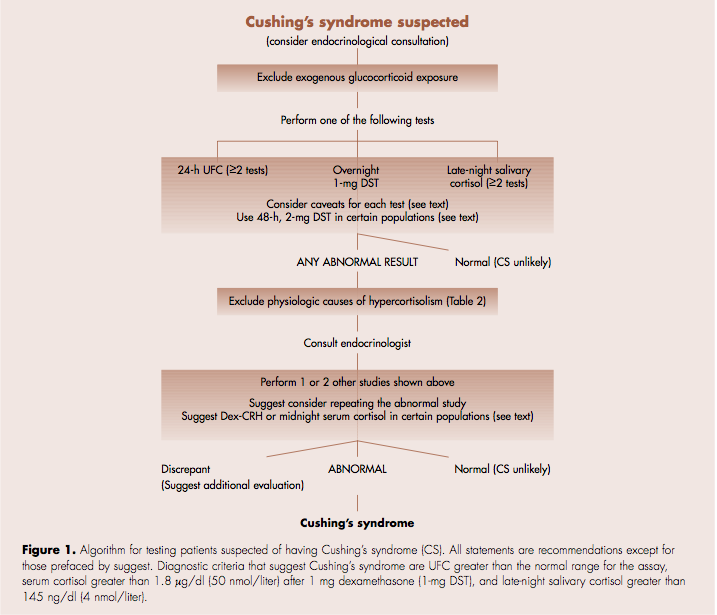
The testing pathway today looks a little more organized but it still takes far too long:

testing-cushings


Cushing’s Awareness Challenge, Day 3: Symptoms

robin-symptoms


Robin has made another excellent graphic of some of the symptoms of Cushing’s.  There are far too many to be listed in any image, as shown by the list at http://www.cushings-help.com/toc.htm#symptoms


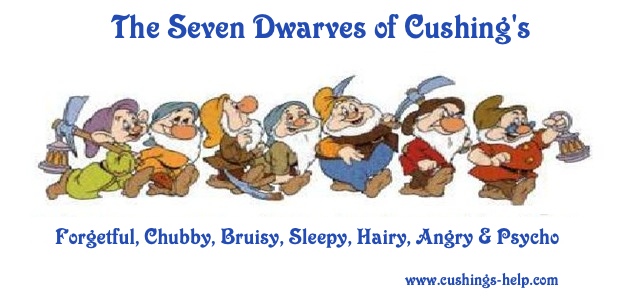
Just to be silly, a few years ago, I did my own version of Cushing’s symptoms:


The Seven Dwarves of Cushing's