Salivary cortisol performs better than urinary free cortisol to diagnose Cushing’s syndrome

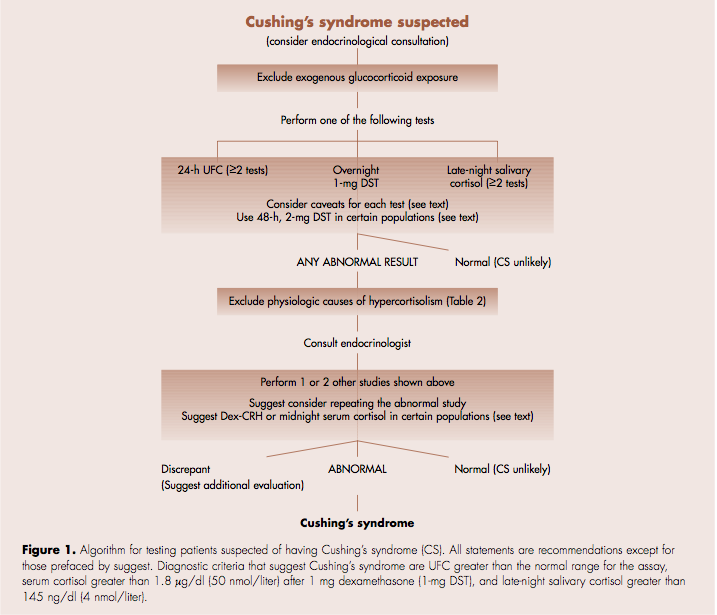
Late-night salivary cortisol has a better performance than urinary free cortisol in the diagnosis of Cushing’s syndrome.

Salimetrics highlights a recent study:  Abstract

Context: The comparison of variability, reproducibility, and diagnostic performance of late-night salivary cortisol (LNSF) and urinary free cortisol (UFC) using concurrent and consecutive samples in Cushing’s syndrome (CS) is lacking.

Objectives, Patients and Methods: In a prospective study, we evaluate three simultaneous and consecutive samples of LNSF by RIA and UFC by LC-MS/MS in Cushing’s disease (CD; n=43), adrenal CS patients (n=9) and obese subjects (n=18) in order to compare their diagnostic performances. In CS patients we also performed a modified Cushing’s syndrome severity index (CSI).

Results: There was no difference in the coefficient of variation (%) between LNSF and UFC among the three samples obtained for each patient with CD (35±26vs31±24), adrenal CS (28±14vs22±14) and obesity (39±37vs48±20). LNSF confirmed the diagnosis of hypercortisolism even in the presence of normal UFC in 17.3% of CS, whereas the inverse situation was not observed for UFC. The area under the ROC curves for LNSF was 0.999 (95%CI 0.990-1.00) and for UFC was 0.928 (95%CI 0.809- 0.987). The ratio between AUCs was 0.928 (95%CI 0.810-0.988) indicating better performance of LNSF than UFC in diagnosing CS. There was no association between the severity of CSI and the degree of biochemical hypercortisolism.

Conclusion: Our data show that despite similar variability between both methods, LNSF has a superior diagnostic performance than UFC and should be used as the primary biochemical diagnostic test for Cushing’s syndrome diagnosis.

Authors Elias P, Martinez E, Barone B, Mermejo L, Castro M, Moreira A
Division of Endocrinology-Department of Medicine and Division of Statistics- Department of Social Medicine, Ribeirao Preto Medical School – University of Sao Paulo, Ribeirao Preto, SP- Brazil
LINK to Paper
Salimetrics guide to Cortisol
LINK to Salimetrics Diagnostic Salivary Cortisol Assay

Skeletal Maturation in Children With Cushing’s Syndrome is Not Consistently Delayed

Skeletal maturation in children with cushing syndrome is not consistently delayed: The role of corticotropin, obesity, and steroid hormones, and the effect of surgical cure.

J Pediatr. 2014 Jan 9. pii: S0022-3476(13)01500-X. doi: 10.1016/j.jpeds.2013.11.065. [Epub ahead of print]

The Journal of Pediatrics, 01/22/2014 Clinical Article

Lodish MB, et al. – The aim of this study is to assess skeletal maturity by measuring bone age (BA) in children with Cushing syndrome (CS) before and 1–year after transsphenoidal surgery or adrenalectomy, and to correlate BA with hormone levels and other measurements. Contrary to common belief, endogenous CS in children appears to be associated with normal or even advanced skeletal maturation. When present, BA advancement in CS is related to obesity, insulin resistance, and elevated adrenal androgen levels and aromatization. This finding may have significant implications for treatment decisions and final height predictions in these children.

Methods

  • This case series conducted at the National Institutes of Health Clinical Center included 93 children with Cushing disease (CD) (43 females; mean age, 12.3 ± 2.9 years) and 31 children with adrenocorticotropic hormone–independent CS (AICS) (22 females, mean age 10.3 ± 4.5 years).
  • BA was obtained before surgery and at follow-up.
  • Outcome measures were comparison of BA in CD vs AICS and analysis of the effects of hypercortisolism, insulin excess, body mass index, and androgen excess on BA.

Results

  • Twenty-six of the 124 children (21.0%) had advanced BA, compared with the expected general population prevalence of 2.5% (P < .0001). Only 4 of 124 (3.2%) had delayed BA.
  • The majority of children (76%) had normal BA.
  • The average BA z-score was similar in the children with CD and those with AICS (0.6 ± 1.4 vs 0.5 ± 1.8; P = .8865).
  • Body mass index SDS and normalized values of dehydroepiandrosterone, dehydroepiandrosterone sulfate, androsteonedione, estradiol, and testosterone were all significantly higher in the children with advanced BA vs those with normal or delayed BA.
  • Fifty-nine children who remained in remission from CD had follow-up BA 1.2 ± 0.3 years after transsphenoidal surgery, demonstrating decreased BA z-score (1.0 ± 1.6 vs 0.3 ± 1.4; P < .0001).

From http://www.ncbi.nlm.nih.gov/pubmed/24412141

Think Like a Doctor: Red Herrings Solved!

By LISA SANDERS, M.D.

On Thursday we challenged Well readers to take the case of a 29-year-old woman with an injured groin, a swollen foot and other abnormalities. Many of you found it as challenging as the doctors who saw her. I asked for the right test as well as the right diagnosis. More than 200 answers were posted.

The right test was…

The dexamethasone suppression test,though I counted those of you who suggested measuring the cortisol in the urine.

The right diagnosis was…

Cushing’s disease

More than a dozen of you got the right answer or the right test, but Dr. Davin Quinn, a consultant psychiatrist at the University of New Mexico Hospital, was the first to be right on both counts. As soon as he saw that the patient’s cortisol level was increased, he thought of Cushing’s. And he had treated a young patient like this one some years ago as a second year resident.

The Diagnosis:

Cushing’s disease is caused by having too much of the stress hormone cortisol in the body. Cortisol is made in the adrenal glands, little pyramid shaped organs that sit atop the kidneys. It is normally a very tightly regulated hormone that helps the body respond to physical stress.

Sometimes the excess comes from a tumor in the adrenal gland itself that causes the little organ to go into overdrive, making too much cortisol. More often the excess occurs when a tumor in the pituitary gland in the brain results in too much ACTH, the hormone that controls the adrenal gland.

In the body, cortisol’s most fundamental job is to make sure we have enough glucose around to get the body’s work done. To that end, the hormone drives appetite, so that enough fuel is taken in through the food we eat. When needed, it can break muscle down into glucose. This essential function accounts for the most common symptoms of cortisol excess: hyperglycemia, weight gain and muscle wasting. However, cortisol has many functions in the body, and so an excess of the hormone can manifest itself in many different ways.

Cushing’s was first described by Dr. Harvey Cushing, a surgeon often considered the father of modern neurosurgery. In a case report in 1912, he described a 23-year-old woman with sudden weight gain, mostly in the abdomen; stretch marks from skin too thin and delicate to accommodate the excess girth; easy bruising; high blood pressure and diabetes.

Dr. Cushing’s case was, it turns out, a classic presentation of the illness. It wasn’t until 20 years later that he recognized that the disease had two forms. When it is a primary problem of an adrenal gland gone wild and producing too much cortisol on its own, the disease is known as Cushing’s syndrome. When the problem results from an overgrown part of the pituitary making too much ACTH and causing the completely normal adrenal glands to overproduce the hormone, the illness is called Cushing’s disease.

It was an important distinction, since the treatment often requires a surgical resection of the body part where the problem originates. Cushing’s syndrome can also be caused by steroid-containing medications, which are frequently used to treat certain pulmonary and autoimmune diseases.

How the Diagnosis Was Made:

After the young woman got her lab results from Dr. Becky Miller, the hematologist she had been referred to after seeing several other specialists, the patient started reading up on the abnormalities that had been found. And based on what she found on the Internet, she had an idea of what was going on with her body.

“I think I have Cushing’s disease,” the patient told her endocrinologist when she saw him again a few weeks later.

The patient laid out her argument. In Cushing’s, the body puts out too much cortisol, one of the fight-or-flight stress hormones. That would explain her high blood pressure. Just about everyone with Cushing’s disease has high blood pressure.

She had other symptoms of Cushing’s, too. She bruised easily. And she’d been waking up crazy early in the morning for the past year or so – around 4:30 – and couldn’t get back to sleep. She’d heard that too much cortisol could cause that as well. She was losing muscle mass – she used to have well-defined muscles in her thighs and calves. Not any more. Her belly – it wasn’t huge, but it was a lot bigger than it had been. Cushing’s seemed the obvious diagnosis.

The doctor was skeptical. He had seen Cushing’s before, and this patient didn’t match the typical pattern. She was the right age for Cushing’s and she had high blood pressure, but nothing else seemed to fit. She wasn’t obese. Indeed, she was tall (5- foot-10) and slim (150 pounds) and athletic looking. She didn’t have stretch marks; she didn’t have diabetes. She said she bruised easily, but the endocrinologist saw no bruises on exam. Her ankle was still swollen, and Cushing’s can do that, but so can lots of other diseases.

The blood tests that Dr. Miller ordered measuring the patient’s ACTH and cortisol levels were suggestive of the disease, but many common problems — depression, alcohol use, eating disorders — can cause the same result. Still, it was worth taking the next step: a dexamethasone suppression test.

Testing, Then Treatment:

The dexamethasone suppression test depends on a natural negative feedback loop whereby high levels of cortisol suppress further secretion of the hormone. Dexamethasone is an artificial form of cortisol. Given in high doses, it will cause the level of naturally-occurring cortisol to drop dramatically.

The patient was told to take the dexamethasone pills the night before having her blood tested. The doctor called her the next day.

“Are you sure you took the pills I gave you last night?” the endocrinologist asked her over the phone. The doctor’s voice sounded a little sharp to the young woman, tinged with a hint of accusation.

“Of course I took them,” she responded, trying to keep her voice clear of any irritation.

“Well, the results are crazy,” he told her and proposed she take another test: a 24-hour urine test.

Because cortisol is eliminated through the kidneys, collecting a full day’s urine would show how much cortisol her body was making. So the patient carefully collected a day’s worth of urine.

A few days later, the endocrinologist called again: her cortisol level was shockingly high. She was right, the doctor conceded, she really did have Cushing’s.

An M.R.I. scan revealed a tiny tumor on her pituitary. A couple of months later, she had surgery to remove the affected part of the gland.

After recovering from the surgery, the patient’s blood pressure returned to normal, as did her red blood cell count and her persistently swollen ankle. And she was able to once again sleep through the night.

Red Herrings Everywhere:

As many readers noted, there were lots of findings that didn’t really add up in this case. Was this woman’s groin sprain part of the Cushing’s? What about the lower extremity swelling, and the excess red blood cell count?

In the medical literature, there is a single case report of high red blood cell counts as the presenting symptom in a patient with Cushing’s. And with this patient, the problem resolved after her surgery – so maybe they were linked.

And what about the weird bone marrow biopsy? The gastritis? The enlarged spleen? It’s hard to say for certain if any of these problems was a result of the excess cortisol or if she just happened to have other medical problems.

Why the patient didn’t have the typical symptoms of Cushing’s is easier to explain. She was very early in the course of the disease when she got her diagnosis. Most patients are diagnosed once symptoms have become more prominent

By the time this patient had her surgery, a couple of months later, the round face and belly characteristic of cortisol excess were present. Now, two years after her surgery, none of the symptoms remain.

From http://well.blogs.nytimes.com/2014/01/17/think-like-a-doctor-red-herrings-solved/?_php=true&_type=blogs&_r=0

Genetic mutation lowers obesity in Cushing’s syndrome

London E. J Clin Endocrinol Metab. 2013; doi:10.1210/jc.2013-1956.

Among adult patients with Cushing’s syndrome, those with mutations in PRKAR1A, the gene that controls cAMP-dependent protein kinase, are less obese than their counterparts without these mutations, according to a recent study.

The retrospective study evaluated adrenalectomy samples from 51 patients with Cushing’s syndrome, 13 with PRKAR1A mutations and 32 without. Of the 51 patients, 40 were female and 11 were male, and patients ranged in age from 4 to 74 years.

A non-Cushing’s syndrome comparison group consisting of 6 adrenalectomy patients with aldosterone producing adenomas (APAs) was included. Additional comparison groups comprising clinical data from 89 patients with Cushing’s disease and 26 with hyperaldosteronism were also studied.

Researchers recorded the weight, height and BMI of all patients, and measured abdominal subcutaneous adipose tissue (ScAT) and periadrenal adipose tissue (PAT) using computed tomography. PAT was collected and frozen for evaluation; the extracts were assessed for levels of cAMP and protein kinase (PKA) activity, as well as for protein and mRNA expression of subunits of PKA. Diurnal cortisol levels and urine-free cortisol were also measured preoperatively.

The study found that in adults with Cushing’s syndrome, the mean BMI of those with PRKAR1A mutations was lower than that of patients with noPRKAR1A mutations (P<.05), and was not inconsistent with the hyperaldosteronism comparison group.

In pediatric patients with adrenal Cushing’s syndrome, the presence of PRKAR1A mutation did not have an impact on mean BMI z-scores. However, in comparison with pediatric patients with pituitary Cushing’s disease, the BMI z-scores were significantly lower in pediatric Cushing’s disease patients with PRKAR1Amutations (P<.05). Patients with Cushing’s syndrome without PRKAR1A mutations had significantly more PAT and ScAT than non-Cushing’s syndrome patients. Additionally, the ratio of basal-to-total (cAMP-triggered) PKA activity was significantly lower in patients with PRKAR1A mutations, suggesting greater proportions of active PKA (P<.005).

“These findings have obvious implications in the establishment of the diagnosis of CS in patients with PRKAR1A mutations: These patients may be leaner than other patients with [Cushing’s syndrome],” the study authors wrote. “Perhaps more importantly, our findings point to the importance of cAMP and or PKA signaling in the regulation of adiposity.”

Disclosures: The researchers report no relevant financial disclosures.

From http://www.healio.com/endocrinology/adrenal/news/online/%7B693f94cd-359d-4c52-8e0d-bfd0e4a51d03%7D/genetic-mutation-lowers-obesity-in-cushings-syndrome

No High-Quality Studies for Cushing’s Drugs

By Salynn Boyles, Contributing Writer, MedPage Today

Reviewed by Zalman S. Agus, MD; Emeritus Professor, Perelman School of Medicine at the University of Pennsylvania and Dorothy Caputo, MA, BSN, RN, Nurse Planner

There is a paucity of clinical trial data supporting the efficacy of most drugs used to treat Cushing’s disease, researchers reported.

Just one drug — pasireotide — has been evaluated in a randomized, double-blind trial, but even it was judged by the researchers to have only a ‘moderate’ level of evidence supporting its effectiveness and safety.

The review of the literature evaluating drug treatments for Cushing’s disease, a rare pituitary disorder, is the first to employ a rigorous systematic approach with strict, predefined inclusion criteria and formal analysis of the quality of evidence using an established standard, researcher Monica Gadelha, MD, PhD, of Brazil’s Federal University of Rio de Janeiro, and colleagues wrote in the journal Clinical Endocrinology.

“This systematic review indicates that the majority of medical therapies currently used in the treatment of Cushing’s disease are supported by a low level of evidence,” the researchers wrote. “Further well-designed prospective studies of medications in Cushing’s disease would help to inform clinical practice further.”

Cushing’s disease is the most common form of endogenous Cushing’s syndrome, a hormonal disorder resulting from persistent exposure to abnormally high levels of the hormone cortisol. In the case of Cushing’s disease, the cortisol is secreted by a pituitary adenoma.

Prolonged exposure to high levels of cortisol raises the risk for diabetes mellitus, cardiovascular disease, osteoporosis and nephrolithiasis. Patients with persistent Cushing’s disease have a 3- to 5-fold higher mortality than the general population.

Surgery to remove the pituitary adenoma is the first-line treatment for Cushing’s disease in the U.S., and when the procedure is performed by an experienced surgeon, remission rates in patients with smaller tumors range from 65% to 90%. The long-term remission rate is lower, however, because many patients develop recurrent disease.

Several medical therapies are widely used to treat patients who are not candidates for surgery or who experience relapse following surgery.

Novartis Oncology’s somatostatin analog drug pasireotide (Signifor) became the only drug approved for this indication in December of last year. And the progesterone-blocking drug mifepristone, best known as the abortion pill once called RU-486, was approved in February of 2012 for the treatment of Cushing’s disease-associated hyperglycemia.

Other drugs — including metyrapone, mitotane, cabergoline, and ketoconazole — are also used off-label in the treatment of Cushing’s, and several have shown better response rates than pasireotide in small studies.

In their systematic review, Gadelha and colleagues identified 15 studies that included at least 10 adults with Cushing’s disease and reported treatment responses as the proportion of patients reaching a specified definition of response. Studies examining combinations of medications were excluded from the analysis, as were studies with indefinite diagnoses of Cushing’s disease.

For medications other than mifepristone, studies had to report the proportion of patients with normalized urinary free cortisol (UFC), midnight salivary cortisol or midnight serum cortisol.

The studies were scored according to the Grading of Recommendations, Assessment, Development and Evaluation (GRADE) system for rating quality of evidence.

Ten of the 15 included studies reported outcomes specifically for patients with Cushing’s disease and the remaining five included patients with other forms of Cushing’s syndrome.

The researchers reported that:

  • Pasireotide was the only treatment assessed in a randomized trial, and it was judged to have a ‘moderate’ level of evidence supporting its use. Response rates from three prospective studies of the drug ranged from 17% to 29%.
  • The remaining medications were supported by a ‘low’ or ‘very low’ level of evidence.
  • The highest response rates were reported in a small retrospective studies of metyrapone (75%, one study) and mitotane (72%, one study).
  • Response rates were 25% to 50% for cabergoline (four studies) and 45% for ketoconazole (one study).
  • Among studies that included patients with other forms of Cushing’s syndrome, response rates were 53% to 88% for ketoconazole (three studies), 70% for mitotane (one study), 57% for metyrapone (one study), and 38% to 60% for mifepristone (one study).


But the researchers urged caution in comparing the drugs, citing the variability in the study designs and patient selection endpoints, among other limitations in the research literature.

“The wide variation in the time-frames over which response to treatment was measured makes comparison a challenge,” they wrote. “Comparison of response rates reported in the included studies is also complicated by the variation in methodology used to assess response.”

They noted that well-designed clinical trials are needed to determine which drugs or drug combinations are most effective in the treatment of Cushing’s disease patients.

“Combinations of medical therapies with different modes of action might aid in optimizing the balance of efficacy and safety,” they wrote. “Investigational medications, such as bexarotene, LC1699 and retinoic acid, may help to expand the range of future therapeutic options.”

Maria Fleseriu, MD, who was not involved in the review, agreed that more drug treatments are needed. But she added that Cushing’s patients today have many more drug options than they did just a few years ago.

Fleseriu directs the Pituitary Center at Oregon Health & Science University, where she is an associate professor of medicine and endocrinology.

In a recently published analysis, Fleseriu wrote that pituitary-targeted medical therapies should soon play a more prominent role in treating Cushing’s disease, and may become first-line treatments when surgery fails or is contraindicated.

“We now have one drug approved for Cushing’s and another approved for diabetes symptoms associated with the disease,” she told MedPage Today. “We are moving forward, but we are not where we would like to be. Combination therapy is probably where we are heading, but further studies are needed.”

Financial support for this research was provided by Novartis Pharmaceuticals.

Researcher Monica Gadelha reports receiving speaker fees and participating on advisory boards for Novartis. Gadelha and co-author Leonardo Vieira Neto were investigators in Novartis’ clinical trials of pasireotide.


From http://www.medpagetoday.com/Endocrinology/GeneralEndocrinology/42043