Cyclic Cushing’s syndrome: a clinical challenge

  1. J R Meinardi1,2,
  2. B H R Wolffenbuttel2 and
  3. R P F Dullaart2

+Author Affiliations


  1. 1Department of Internal Medicine, Canisius Wilhelmina Ziekenhuis, PO Box 9015, 6500 GS Nijmegen, The Netherlands and 2Department of Endocrinology, University Medical Centre Groningen, University of Groningen, PO Box 30001, 9700 RB Groningen, The Netherlands
  1. (Correspondence should be addressed to: R P F Dullaart; Email:r.p.f.dullaart@int.umcg.nl)

Abstract

Cyclic Cushing’s syndrome (CS) is a rare disorder, characterized by repeated episodes of cortisol excess interspersed by periods of normal cortisol secretion. The so-called cycles of hypercortisolism can occur regularly or irregularly with intercyclic phases ranging from days to years.

To formally diagnose cyclic CS, three peaks and two troughs of cortisol production should be demonstrated. Our review of 65 reported cases demonstrates that cyclic CS originates in 54% of cases from a pituitary corticotroph adenoma, in 26% from an ectopic ACTH-producing tumour and in about 11% from an adrenal tumour, the remainder being unclassified. The pathophysiology of cyclic CS is largely unknown.

The majority of patients with cyclic CS have clinical signs of CS, which can be either fluctuating or permanent. In a minority of patients, clinical signs of CS are absent. The fluctuating clinical picture and discrepant biochemical findings make cyclic CS extremely hard to diagnose. Clinicians should therefore be aware of this clinical entity and actively search for it in all patients with suspected CS but normal biochemistry or vice versa.

Frequent measurements of urinary cortisol or salivary cortisol levels are a reliable and convenient screening tool for suspected cyclic CS. Cortisol stimulation or suppression tests may give spurious results owing to spontaneous falls or rises in serum cortisol at the time of testing. When cyclic CS is biochemically confirmed, further imaging and laboratory studies are guided by the presence or absence of ACTH dependency. In cases of suspected ectopic ACTH production, specific biochemical testing for carcinoids or neuroendocrine tumours is required, including measurements of serotonin in platelets and/or urine, chromogranin A and calcitonin.

Read the entire article here:  http://www.scribd.com/doc/159503297/Cyclic-Cushing%E2%80%99s-syndrome-a-clinical-challenge

What is the Best Approach to Suspected Cyclical Cushing Syndrome?

Strategies for Managing Cushing’s Syndrome With Variable Laboratory Data

Brew Atkinson, Karen R. Mullan

Disclosures

Clin Endocrinol. 2011;75(1):27-30.


Abstract

Cyclical Cushing’s syndrome is a pattern of hypercortisolism in which the biochemistry of cortisol production fluctuates rhythmically. This syndrome is often associated with fluctuating symptoms and signs. It is now being increasingly recognized. The phenomenon is important because it can, if not recognized, lead to errors in diagnosis and differential diagnosis of the syndrome and in assessment of therapeutic outcomes. The techniques and criteria, protocols and dynamic biochemical tools to detect cycling in patients with hypercortisolism are discussed as are the strategies for diagnosing and managing this important subgroup of patients with hypercortisolism.

Introduction

Cyclical Cushing’s syndrome (CS) is a pattern in hypercortisolism in which the biochemistry of cortisol production fluctuates rhythmically. This can also be associated with fluctuating symptoms and signs. This type of case was initially thought to be rare. However, it has recently been recognized as occurring much more frequently. The phenomenon is important because, if not recognized, it can lead to errors in diagnosis and differential diagnosis of the syndrome and in assessment of therapeutic outcomes. All of these can have very serious clinical consequences.

As a result of reading this article, it is hoped that readers will be better able to consider more carefully the risks associated with too wide a diagnostic trawl for the diagnosis of CS and the associated chances of finding some abnormality of steroid biochemistry.

In cases where the diagnosis is being strongly considered, the risks of not considering episodic secretion when laboratory results are discordant are discussed. Readers should be able to plan strategies to assess for variable and cyclical secretion and to use these in diagnosis, differential diagnosis and treatment assessments.

Read more here: What is the best approach to suspected cyclical Cushing syndrome?

Pituitary tumor size not definitive for Cushing’s

By: SHERRY BOSCHERT, Family Practice News Digital Network

SAN FRANCISCO – The size of a pituitary tumor on magnetic resonance imaging in a patient with ACTH-dependent Cushing’s syndrome can’t differentiate between etiologies, but combining that information with biochemical test results could help avoid costly and difficult inferior petrosal sinus sampling in some patients, a study of 131 cases suggests.

If MRI shows a pituitary tumor larger than 6 mm in size, the finding is 40% sensitive and 96% specific for a diagnosis of Cushing’s disease as the cause of adrenocorticotropic hormone (ACTH)-dependent Cushing’s syndrome, and additional information from biochemical testing may help further differentiate this from ectopic ACTH secretion, Dr. Divya Yogi-Morren and her associates reported at the Endocrine Society’s Annual Meeting.

Pituitary tumors were seen on MRI in 6 of 26 patients with ectopic ACTH secretion (23%) and 73 of 105 patients with Cushing’s disease (69%), with mean measurements of 4.5 mm in the ectopic ACTH secretion group and 8 mm in the Cushing’s disease group. All but one tumor in the ectopic ACTH secretion group were 6 mm or smaller in diameter, but one was 14 mm.

Because pituitary “incidentalomas” as large as 14 mm can be seen in patients with ectopic ACTH secretion, the presence of a pituitary tumor can’t definitively discriminate between ectopic ACTH secretion and Cushing’s disease, said Dr. Yogi-Morren, a fellow at the Cleveland Clinic.

That finding contradicts part of a 2003 consensus statement that said the presence of a focal pituitary lesion larger than 6 mm on MRI could provide a definitive diagnosis of Cushing’s disease, with no further evaluation needed in patients who have a classic clinical presentation and dynamic biochemical testing results that are compatible with a pituitary etiology (J. Clin. Endocrinol. Metab. 2003;88:5593-602). The 6-mm cutoff, said Dr. Yogi-Morren, came from an earlier study reporting that 10% of 100 normal, healthy adults had focal pituitary abnormalities on MRI ranging from 3 to 6 mm in diameter that were consistent with a diagnosis of asymptomatic pituitary adenomas (Ann. Intern. Med. 1994;120:817-20).

A traditional workup of a patient with ACTH-dependent Cushing’s syndrome might include a clinical history, biochemical testing, neuroimaging, and an inferior petrosal sinus sampling (IPSS). Biochemical testing typically includes tests for hypokalemia, measurement of cortisol and ACTH levels, a high-dose dexamethasone suppression test, and a corticotropin-releasing hormone (CRH) stimulation test. Although IPSS is the gold standard for differentiating between the two etiologies, it is expensive and technically difficult, especially in institutions that don’t regularly do the procedure, so it would be desirable to avoid IPSS if it’s not needed in a subset of patients, Dr. Yogi-Morren said.

The investigators reviewed charts from two centers (the Cleveland Clinic and the M.D. Anderson Cancer Center, Houston) for patients with ACTH-dependent Cushing’s syndrome seen during 2000-2012.

ACTH levels were significantly different between groups, averaging 162 pg/mL (range, 58-671 pg/mL) in patients with ectopic ACTH secretion, compared with a mean 71 pg/mL in patients with Cushing’s disease (range, 16-209 pg/mL), she reported. Although there was some overlap between groups in the range of ACTH levels, all patients with an ACTH level higher than 210 pg/mL had ectopic ACTH secretion.

Median serum potassium levels at baseline were 2.9 mmol/L in the ectopic ACTH secretion group and 3.8 mmol/L in the Cushing’s disease group, a significant difference. Again, there was some overlap between groups in the range of potassium levels, but all patients with a baseline potassium level lower than 2.7 mmol/L had ectopic ACTH secretion, she said.

Among patients who underwent a high-dose dexamethasone suppression test, cortisol levels decreased by less than 50% in 88% of patients with ectopic ACTH secretion and in 26% of patients with Cushing’s disease.

Most patients did not undergo a standardized, formal CRH stimulation test, so investigators extracted the ACTH response to CRH in peripheral plasma during the IPSS test. As expected, they found a significantly higher percent increase in ACTH in response to CRH during IPSS in the Cushing’s disease group, ranging up to more than a 1,000% increase. In the ectopic ACTH secretion group, 40% of patients did have an ACTH increase greater than 50%, ranging as high as a 200%-300% increase in ACTH in a couple of patients.

“Although there was some overlap in the biochemical testing, it is possible that it provides some additional proof to differentiate between ectopic ACTH secretion and Cushing’s disease,” Dr. Yogi-Morren said.

In the ectopic ACTH secretion group, the source of the secretion remained occult in seven patients. The most common identifiable cause was a bronchial carcinoid tumor, in six patients. Three patients each had small cell lung cancer, a thymic carcinoid tumor, or a pancreatic neuroendocrine tumor. One patient each had a bladder neuroendocrine tumor, ovarian endometrioid cancer, medullary thyroid cancer, or a metastatic neuroendocrine tumor from an unknown primary cancer.

The ectopic ACTH secretion group had a median age of 41 years and was 63% female. The Cushing’s disease group had a median age of 46 years and was 76% female.

Dr. Yogi-Morren reported having no financial disclosures.

sboschert@frontlinemedcom.com

On Twitter @sherryboschert

From Famiiy Practice News

Johns Hopkins Pituitary Patient Day 2013

Johns Hopkins Pituitary Patient Day

Join us on Saturday, September 28, 2013, for the 5th Annual Patient Education Day at the Johns Hopkins Pituitary Center.

When: Saturday, September 28, 2013
Time: 9:30 a.m.
Location:
Johns Hopkins Mt. Washington Conference Center
5801 Smith Avenue
Baltimore, MD 21209
map and directions

Location of the pituitary gland in the human brain

Location of the pituitary gland in the human brain (Photo credit: Wikipedia)

Patient Education Day Agenda:
9:30 – 10:00 AM REGISTRATION
10:00 – 10:25 AM What is the pituitary gland, where it is located, what it does, and what can go wrong Gary Wand, MD
10:30 – 10:50 AM How pituitary tumors can affect your vision Prem Subramanian, MD, PhD
Vivek Patel, MD, PhD
10:50 – 11:10 AM Cushing disease journey: a patient’s perspective Stacey Hardy
11:15 – 11:40 AM Surgery for Pituitary tumors: from very tiny to very large Alfredo Quinones-Hinojosa, MD
Gary Gallia, MD, PhD
Alessandro Olivi, MD
11:40 – 12:00 PM Radiation therapy: when, why, and how Lawrence Kleinberg, MD
Kristen Redmond, MD
12:05 – 12:25 PM The medications you may be taking (new and old ones): what you need to know Roberto Salvatori, MD
12:30 – 1:25 PM Lunch
1:30 – 3:00 PM PM Round table sessions:
1) Medical therapy (Wand/Salvatori)
2) Surgical therapy (Quinones/Gallia/Olivi)
3) Radiation therapy (Redmond/Kleinberg/Lim)
4) Vision issues (Subramanian/Patel)

*This schedule is subject to change

Please R.S.V.P. by September 13, 2013, vie email (preferred) to PituitaryDay@jhmi.edu  or to Alison Dimick at 410-955-3921.

Reservations will be taken on a first-come, first-serve basis.

Cushing’s Syndrome is Hazardous to Your Health

morbidity

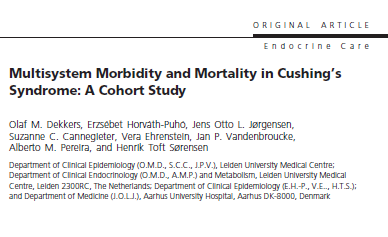
People with Cushing’s syndrome, even when treated, have higher morbidity and mortality rates that comparable controls. That is the conclusion of a new study published in the June issue of the Journal of Clinical Endocrinology Metabolism. The study by Olaf Dekkers et al, examined data records from the Danish National Registry of Patients and the Danish Civil Registration System of 343 patients with benign Cushing’s syndrome of adrenal or pituitary origin (i.e., Cushing’s disease) and a matched population comparison cohort (n=34,300).  Due to the lengthy delay of many patients being diagnosed with Cushing’s syndrome, morbidity was investigated in the 3 years before diagnosis while  morbidity and mortality were assessed during complete follow-up after diagnosis and treatment.

The study found that mortality was twice as high in Cushing’s syndrome patients (HR 2.3, 95% CI 1.8-2.9) compared with controls over a mean follow-up period of 12.1 years. Furthermore, patients with Cushing’s syndrome were at increased risk for:

  • venous thromboembolism (HR 2.6, 95% CI 1.5-4.7)
  • myocardial infarction (HR 3.7, 95% CI 2.4-5.5)
  • stroke (HR 2.0, 95% CI 1.3-3.2)
  • peptic ulcers (HR 2.0, 95% CI 1.1-3.6)
  • fractures (HR 1.4, 95% CI 1.0-1.9)
  • infections (HR 4.9, 95% CI 3.7-6.4).

The study also found that this increased multimorbidity risk was present before diagnosis indicating that it was due to cortisol overproduction rather than treatment.

Many of the Cushing’s syndrome patients underwent surgery to remove the benign tumor. For this group, the investigators performed a sensitivity analysis of the  long-term mortality and cardiovascular risk in this  subgroup (n=186)  considered to be cured after operation (adrenal surgery and patients with pituitary surgery in combination with a diagnosis of hypopituitarism in the first 6 months after operation).  The risk estimates for mortality (HR 2.31, 95% CI 1.62-3.28), venous thromboembolism (HR 2.03, 95% CI 0.75-5.48), stroke (HR 1.91, 95% CI 0.90-4.05), and acute myocardial infarction (HR 4.38, 95% CI 2.31-8.28) were also increased in this subgroup one year after the operation.

The standard treatment for endogenous Cushing’s syndrome is surgery. This past year, Signifor (pasireotide) was approved for treatment of adults patients with Cushing’s disease for whom pituitary surgery is not an option or has not been curative.  Cushing’s disease, which accounts for the majority of Cushing’s syndrome patients, is defined as the presence of an ACTH producing tumor on the pituitary grand. In the study by Dekker’s et al, the percentage of patients with Cushing’s disease is not known. We look forward to reexamination of this dataset in a few years following the introduction of more treatment options for Cushing’s disease as well as an analysis that explores the differences in mortality/morbidity rates in the different subsets of patients that make of Cushing’s syndrome (Cushing’s disease, ectopic Cushing’s syndrome, Exogenous Cyshing’s syndrome).

References

Dekkers OM, Horvath-Pujo, Jorgensen JOL, et al, Multisystem morbidity and mortality in Cushing’s syndrome: a cohort study. J Clin Endocrinol Metab 2013 98(6): 2277–2284. doi: 10.1210/jc.2012-3582

– See more at: http://www.raredr.com/medicine/articles/cushing%E2%80%99s-syndrome-hazardous-your-health-0